

100
M. P. Ramos and O. O. Chisari
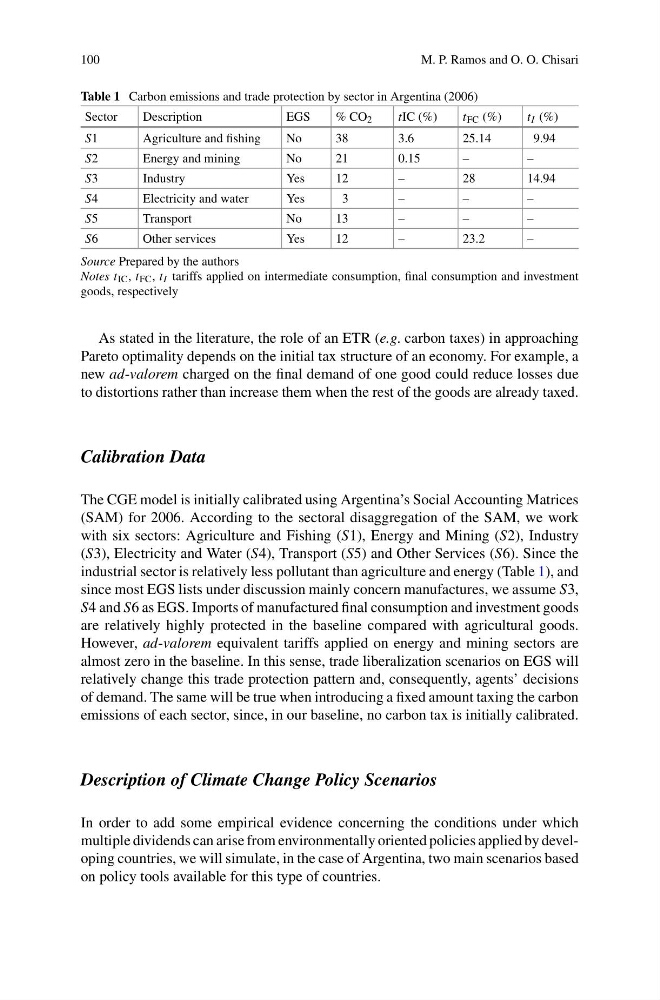
Table 1 Carbon emissions and trade protection by sector in Argentina (2006)
Sector
Description
EGS
% CO 2
tIC (%)
t FC (%)
t I (%)
S1
Agriculture and fishing
No
38
3.6
25.14
9.94
S2
Energy and mining
No
21
0.15
–
–
S3
Industry
Yes
12
–
28
14.94
S4
Electricity and water
Yes
3
–
–
–
S5
Transport
No
13
–
–
–
S6
Other services
Yes
12
–
23.2
–
Source Prepared by the authors
Notes t IC , t FC , t I tariffs applied on intermediate consumption, final consumption and investment
goods, respectively
As stated in the literature, the role of an ETR (e.g. carbon taxes) in approaching
Pareto optimality depends on the initial tax structure of an economy. For example, a
new ad-valorem charged on the final demand of one good could reduce losses due
to distortions rather than increase them when the rest of the goods are already taxed.
Calibration Data
The CGE model is initially calibrated using Argentina’s Social Accounting Matrices
(SAM) for 2006. According to the sectoral disaggregation of the SAM, we work
with six sectors: Agriculture and Fishing (S1), Energy and Mining (S2), Industry
(S3), Electricity and Water (S4), Transport (S5) and Other Services (S6). Since the
industrial sector is relatively less pollutant than agriculture and energy (Table 1), and
since most EGS lists under discussion mainly concern manufactures, we assume S3,
S4 and S6 as EGS. Imports of manufactured final consumption and investment goods
are relatively highly protected in the baseline compared with agricultural goods.
However, ad-valorem equivalent tariffs applied on energy and mining sectors are
almost zero in the baseline. In this sense, trade liberalization scenarios on EGS will
relatively change this trade protection pattern and, consequently, agents’ decisions
of demand. The same will be true when introducing a fixed amount taxing the carbon
emissions of each sector, since, in our baseline, no carbon tax is initially calibrated.
Description of Climate Change Policy Scenarios
In order to add some empirical evidence concerning the conditions under which
multiple dividends can arise from environmentally oriented policies applied by developing countries, we will simulate, in the case of Argentina, two main scenarios based
on policy tools available for this type of countries.
M. P. Ramos and O. O. Chisari
Table 1 Carbon emissions and trade protection by sector in Argentina (2006)
Sector
Description
EGS
% CO 2
tIC (%)
t FC (%)
t I (%)
S1
Agriculture and fishing
No
38
3.6
25.14
9.94
S2
Energy and mining
No
21
0.15
–
–
S3
Industry
Yes
12
–
28
14.94
S4
Electricity and water
Yes
3
–
–
–
S5
Transport
No
13
–
–
–
S6
Other services
Yes
12
–
23.2
–
Source Prepared by the authors
Notes t IC , t FC , t I tariffs applied on intermediate consumption, final consumption and investment
goods, respectively
As stated in the literature, the role of an ETR (e.g. carbon taxes) in approaching
Pareto optimality depends on the initial tax structure of an economy. For example, a
new ad-valorem charged on the final demand of one good could reduce losses due
to distortions rather than increase them when the rest of the goods are already taxed.
Calibration Data
The CGE model is initially calibrated using Argentina’s Social Accounting Matrices
(SAM) for 2006. According to the sectoral disaggregation of the SAM, we work
with six sectors: Agriculture and Fishing (S1), Energy and Mining (S2), Industry
(S3), Electricity and Water (S4), Transport (S5) and Other Services (S6). Since the
industrial sector is relatively less pollutant than agriculture and energy (Table 1), and
since most EGS lists under discussion mainly concern manufactures, we assume S3,
S4 and S6 as EGS. Imports of manufactured final consumption and investment goods
are relatively highly protected in the baseline compared with agricultural goods.
However, ad-valorem equivalent tariffs applied on energy and mining sectors are
almost zero in the baseline. In this sense, trade liberalization scenarios on EGS will
relatively change this trade protection pattern and, consequently, agents’ decisions
of demand. The same will be true when introducing a fixed amount taxing the carbon
emissions of each sector, since, in our baseline, no carbon tax is initially calibrated.
Description of Climate Change Policy Scenarios
In order to add some empirical evidence concerning the conditions under which
multiple dividends can arise from environmentally oriented policies applied by developing countries, we will simulate, in the case of Argentina, two main scenarios based
on policy tools available for this type of countries.