

188
In a society with huge gap between the rich and poor, roads will be filled by
private vehicles and footpaths will be used by poor people, making transportation
inconvenience for both.
Theoretically, potential health gains can be expected with a shift from private
motorized transport to public transportation or cycling/walking by reduced respiratory disease and cardiovascular from air pollution, lower noise-related stress besides
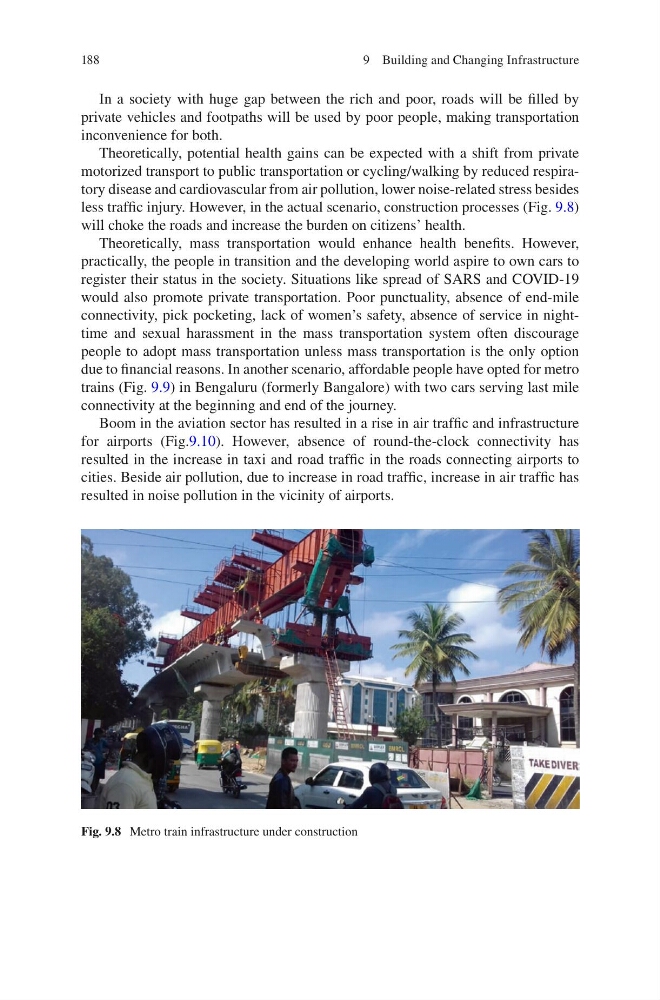
less traffic injury. However, in the actual scenario, construction processes (Fig. 9.8)
will choke the roads and increase the burden on citizens’ health.
Theoretically, mass transportation would enhance health benefits. However,
practically, the people in transition and the developing world aspire to own cars to
register their status in the society. Situations like spread of SARS and COVID-19
would also promote private transportation. Poor punctuality, absence of end-mile
connectivity, pick pocketing, lack of women’s safety, absence of service in nighttime and sexual harassment in the mass transportation system often discourage
people to adopt mass transportation unless mass transportation is the only option
due to financial reasons. In another scenario, affordable people have opted for metro
trains (Fig. 9.9) in Bengaluru (formerly Bangalore) with two cars serving last mile
connectivity at the beginning and end of the journey.
Boom in the aviation sector has resulted in a rise in air traffic and infrastructure
for airports (Fig.9.10). However, absence of round-the-clock connectivity has
resulted in the increase in taxi and road traffic in the roads connecting airports to
cities. Beside air pollution, due to increase in road traffic, increase in air traffic has
resulted in noise pollution in the vicinity of airports.
Fig. 9.8 Metro train infrastructure under construction
9 Building and Changing Infrastructure
In a society with huge gap between the rich and poor, roads will be filled by
private vehicles and footpaths will be used by poor people, making transportation
inconvenience for both.
Theoretically, potential health gains can be expected with a shift from private
motorized transport to public transportation or cycling/walking by reduced respiratory disease and cardiovascular from air pollution, lower noise-related stress besides
less traffic injury. However, in the actual scenario, construction processes (Fig. 9.8)
will choke the roads and increase the burden on citizens’ health.
Theoretically, mass transportation would enhance health benefits. However,
practically, the people in transition and the developing world aspire to own cars to
register their status in the society. Situations like spread of SARS and COVID-19
would also promote private transportation. Poor punctuality, absence of end-mile
connectivity, pick pocketing, lack of women’s safety, absence of service in nighttime and sexual harassment in the mass transportation system often discourage
people to adopt mass transportation unless mass transportation is the only option
due to financial reasons. In another scenario, affordable people have opted for metro
trains (Fig. 9.9) in Bengaluru (formerly Bangalore) with two cars serving last mile
connectivity at the beginning and end of the journey.
Boom in the aviation sector has resulted in a rise in air traffic and infrastructure
for airports (Fig.9.10). However, absence of round-the-clock connectivity has
resulted in the increase in taxi and road traffic in the roads connecting airports to
cities. Beside air pollution, due to increase in road traffic, increase in air traffic has
resulted in noise pollution in the vicinity of airports.
Fig. 9.8 Metro train infrastructure under construction
9 Building and Changing Infrastructure