

176
If radioactive waste contains only radionuclides with a half-life of less than
31 years, it is said to be “short-lived”. It is said to be “long-lived” if it has a large
quantity of radionuclides with more than 31 years of half-life (IRSN 2013).
Radionuclides used in health care are sealed sources or unsealed sources. Sealed
sources are radioactive substances enclosed in parts of equipment or encapsulated
in impervious or unbreakable objects, such as “seed” pins, or needles. Unsealed
sources are normally liquids that are applied directly (WHO 2014).
Radioactive wastes are dangerous as they emit ionizing radiation. Radioactive
wastes are characterized based on the chemical, physical, as well as radiological
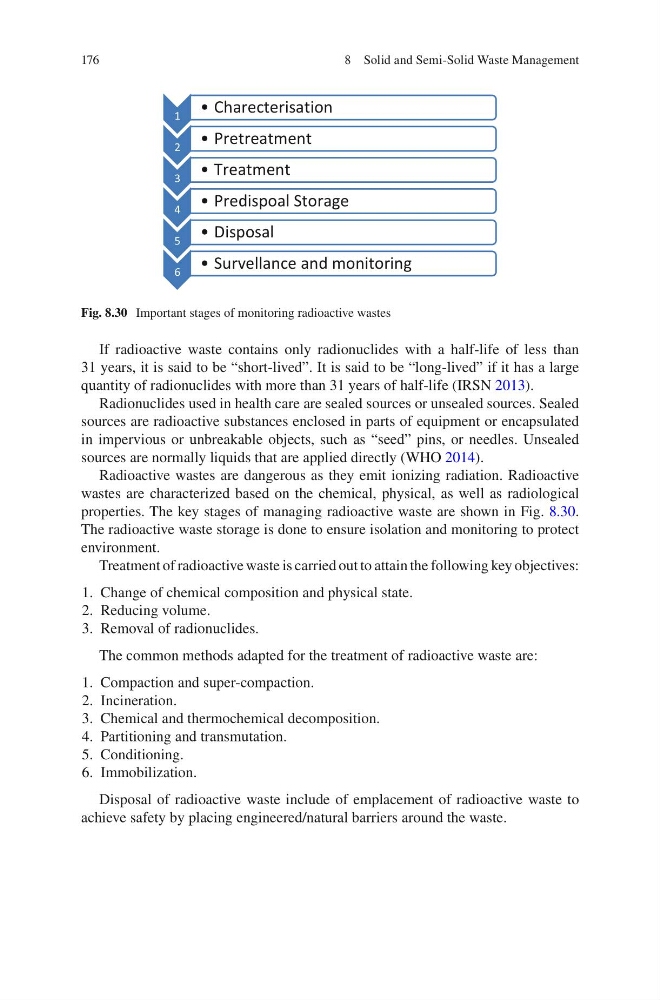
properties. The key stages of managing radioactive waste are shown in Fig. 8.30.
The radioactive waste storage is done to ensure isolation and monitoring to protect
environment.
Treatment of radioactive waste is carried out to attain the following key objectives:
1. Change of chemical composition and physical state.
2. Reducing volume.
3. Removal of radionuclides.
The common methods adapted for the treatment of radioactive waste are:
1. Compaction and super-compaction.
2. Incineration.
3. Chemical and thermochemical decomposition.
4. Partitioning and transmutation.
5. Conditioning.
6. Immobilization.
Disposal of radioactive waste include of emplacement of radioactive waste to
achieve safety by placing engineered/natural barriers around the waste.
1
• Charecterisation
2
• Pretreatment
3
• Treatment
4
• Predispoal Storage
5
• Disposal
6
• Survellance and monitoring
Fig. 8.30 Important stages of monitoring radioactive wastes
8 Solid and Semi-Solid Waste Management
If radioactive waste contains only radionuclides with a half-life of less than
31 years, it is said to be “short-lived”. It is said to be “long-lived” if it has a large
quantity of radionuclides with more than 31 years of half-life (IRSN 2013).
Radionuclides used in health care are sealed sources or unsealed sources. Sealed
sources are radioactive substances enclosed in parts of equipment or encapsulated
in impervious or unbreakable objects, such as “seed” pins, or needles. Unsealed
sources are normally liquids that are applied directly (WHO 2014).
Radioactive wastes are dangerous as they emit ionizing radiation. Radioactive
wastes are characterized based on the chemical, physical, as well as radiological
properties. The key stages of managing radioactive waste are shown in Fig. 8.30.
The radioactive waste storage is done to ensure isolation and monitoring to protect
environment.
Treatment of radioactive waste is carried out to attain the following key objectives:
1. Change of chemical composition and physical state.
2. Reducing volume.
3. Removal of radionuclides.
The common methods adapted for the treatment of radioactive waste are:
1. Compaction and super-compaction.
2. Incineration.
3. Chemical and thermochemical decomposition.
4. Partitioning and transmutation.
5. Conditioning.
6. Immobilization.
Disposal of radioactive waste include of emplacement of radioactive waste to
achieve safety by placing engineered/natural barriers around the waste.
1
• Charecterisation
2
• Pretreatment
3
• Treatment
4
• Predispoal Storage
5
• Disposal
6
• Survellance and monitoring
Fig. 8.30 Important stages of monitoring radioactive wastes
8 Solid and Semi-Solid Waste Management