

154
8.2 Storage
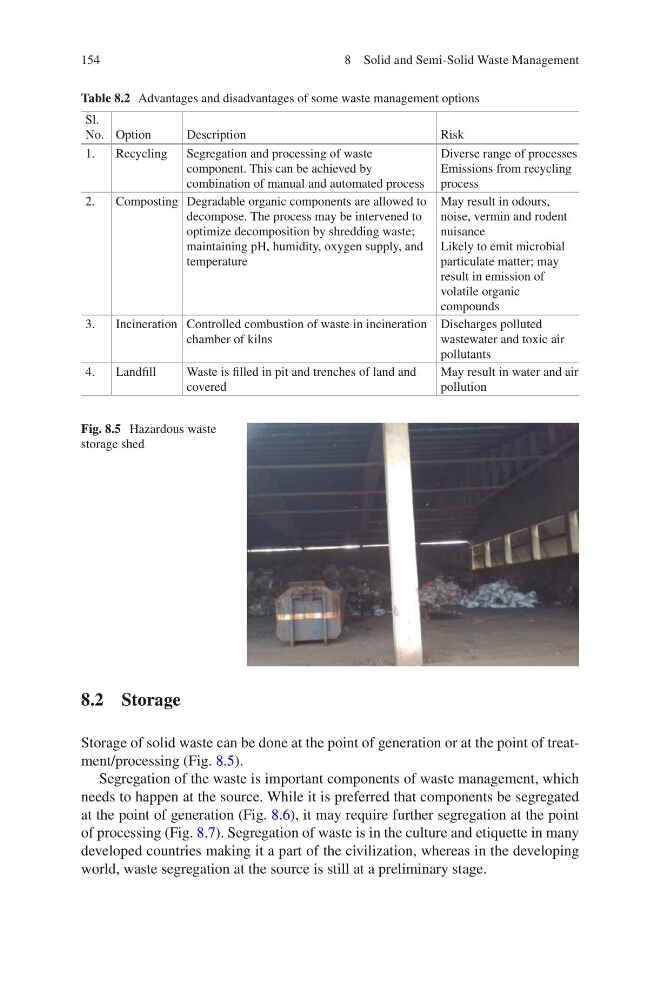
Storage of solid waste can be done at the point of generation or at the point of treatment/processing (Fig. 8.5).
Segregation of the waste is important components of waste management, which
needs to happen at the source. While it is preferred that components be segregated
at the point of generation (Fig. 8.6), it may require further segregation at the point
of processing (Fig. 8.7). Segregation of waste is in the culture and etiquette in many
developed countries making it a part of the civilization, whereas in the developing
world, waste segregation at the source is still at a preliminary stage.
Table 8.2 Advantages and disadvantages of some waste management options
Sl.
No. Option
Description
Risk
1.
Recycling
Segregation and processing of waste
component. This can be achieved by
combination of manual and automated process
Diverse range of processes
Emissions from recycling
process
2.
Composting Degradable organic components are allowed to
decompose. The process may be intervened to
optimize decomposition by shredding waste;
maintaining pH, humidity, oxygen supply, and
temperature
May result in odours,
noise, vermin and rodent
nuisance
Likely to emit microbial
particulate matter; may
result in emission of
volatile organic
compounds
3.
Incineration Controlled combustion of waste in incineration
chamber of kilns
Discharges polluted
wastewater and toxic air
pollutants
4.
Landfill
Waste is filled in pit and trenches of land and
covered
May result in water and air
pollution
Fig. 8.5 Hazardous waste
storage shed
8 Solid and Semi-Solid Waste Management
8.2 Storage
Storage of solid waste can be done at the point of generation or at the point of treatment/processing (Fig. 8.5).
Segregation of the waste is important components of waste management, which
needs to happen at the source. While it is preferred that components be segregated
at the point of generation (Fig. 8.6), it may require further segregation at the point
of processing (Fig. 8.7). Segregation of waste is in the culture and etiquette in many
developed countries making it a part of the civilization, whereas in the developing
world, waste segregation at the source is still at a preliminary stage.
Table 8.2 Advantages and disadvantages of some waste management options
Sl.
No. Option
Description
Risk
1.
Recycling
Segregation and processing of waste
component. This can be achieved by
combination of manual and automated process
Diverse range of processes
Emissions from recycling
process
2.
Composting Degradable organic components are allowed to
decompose. The process may be intervened to
optimize decomposition by shredding waste;
maintaining pH, humidity, oxygen supply, and
temperature
May result in odours,
noise, vermin and rodent
nuisance
Likely to emit microbial
particulate matter; may
result in emission of
volatile organic
compounds
3.
Incineration Controlled combustion of waste in incineration
chamber of kilns
Discharges polluted
wastewater and toxic air
pollutants
4.
Landfill
Waste is filled in pit and trenches of land and
covered
May result in water and air
pollution
Fig. 8.5 Hazardous waste
storage shed
8 Solid and Semi-Solid Waste Management