

132
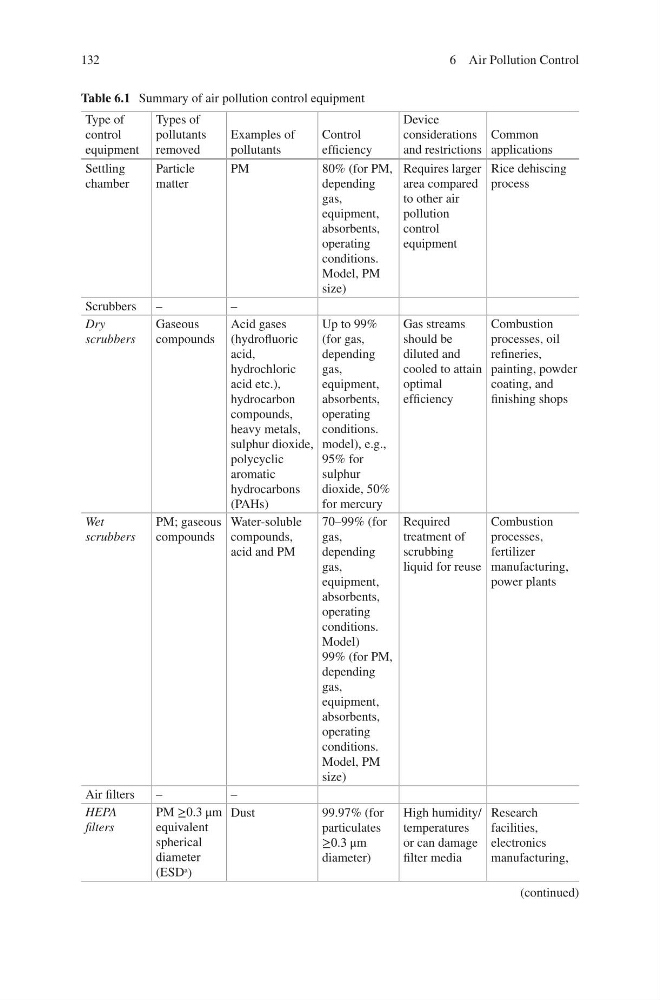
Table 6.1 Summary of air pollution control equipment
Type of
control
equipment
Types of
pollutants
removed
Examples of
pollutants
Control
efficiency
Device
considerations
and restrictions
Common
applications
Settling
chamber
Particle
matter
PM
80% (for PM,
depending
gas,
equipment,
absorbents,
operating
conditions.
Model, PM
size)
Requires larger
area compared
to other air
pollution
control
equipment
Rice dehiscing
process
Scrubbers
–
–
Dry
scrubbers
Gaseous
compounds
Acid gases
(hydrofluoric
acid,
hydrochloric
acid etc.),
hydrocarbon
compounds,
heavy metals,
sulphur dioxide,
polycyclic
aromatic
hydrocarbons
(PAHs)
Up to 99%
(for gas,
depending
gas,
equipment,
absorbents,
operating
conditions.
model), e.g.,
95% for
sulphur
dioxide, 50%
for mercury
Gas streams
should be
diluted and
cooled to attain
optimal
efficiency
Combustion
processes, oil
refineries,
painting, powder
coating, and
finishing shops
Wet
scrubbers
PM; gaseous
compounds
Water-soluble
compounds,
acid and PM
70–99% (for
gas,
depending
gas,
equipment,
absorbents,
operating
conditions.
Model)
99% (for PM,
depending
gas,
equipment,
absorbents,
operating
conditions.
Model, PM
size)
Required
treatment of
scrubbing
liquid for reuse
Combustion
processes,
fertilizer
manufacturing,
power plants
Air filters
–
–
HEPA
filters
PM ≥0.3 μm
equivalent
spherical
diameter
(ESD a )
Dust
99.97% (for
particulates
≥0.3 μm
diameter)
High humidity/
temperatures
or can damage
filter media
Research
facilities,
electronics
manufacturing,
(continued)
6 Air Pollution Control
Table 6.1 Summary of air pollution control equipment
Type of
control
equipment
Types of
pollutants
removed
Examples of
pollutants
Control
efficiency
Device
considerations
and restrictions
Common
applications
Settling
chamber
Particle
matter
PM
80% (for PM,
depending
gas,
equipment,
absorbents,
operating
conditions.
Model, PM
size)
Requires larger
area compared
to other air
pollution
control
equipment
Rice dehiscing
process
Scrubbers
–
–
Dry
scrubbers
Gaseous
compounds
Acid gases
(hydrofluoric
acid,
hydrochloric
acid etc.),
hydrocarbon
compounds,
heavy metals,
sulphur dioxide,
polycyclic
aromatic
hydrocarbons
(PAHs)
Up to 99%
(for gas,
depending
gas,
equipment,
absorbents,
operating
conditions.
model), e.g.,
95% for
sulphur
dioxide, 50%
for mercury
Gas streams
should be
diluted and
cooled to attain
optimal
efficiency
Combustion
processes, oil
refineries,
painting, powder
coating, and
finishing shops
Wet
scrubbers
PM; gaseous
compounds
Water-soluble
compounds,
acid and PM
70–99% (for
gas,
depending
gas,
equipment,
absorbents,
operating
conditions.
Model)
99% (for PM,
depending
gas,
equipment,
absorbents,
operating
conditions.
Model, PM
size)
Required
treatment of
scrubbing
liquid for reuse
Combustion
processes,
fertilizer
manufacturing,
power plants
Air filters
–
–
HEPA
filters
PM ≥0.3 μm
equivalent
spherical
diameter
(ESD a )
Dust
99.97% (for
particulates
≥0.3 μm
diameter)
High humidity/
temperatures
or can damage
filter media
Research
facilities,
electronics
manufacturing,
(continued)
6 Air Pollution Control