

120
5.2.2.15 Constructed Wetland
Constructed wetlands are long thin beds of reeds (wetland plants) planted in soil/
gravel bed. The constructed wetland with open water surface can promote breading
of mosquitoes and hence it is recommended to avoid open water surface. But since
it is constructed wetland do not consume anthropogenic energy, wetlands are
designed using gravel or inside glass house, poly house, shade house.
5.2.2.16 Nitrification–Denitrification
Organic matter will have carbon and nitrogen. Microorganisms in biological process will prefer to consume carbon compound and use it for their growth after disintegration of organic matter leaving behind most of the nitrogen in treated effluent
from secondary treatment. Nitrogen content if not removed will pose eutrification in
water body and health issues in humans and animals that consume water with nitrogen content (Fig. 5.11).
Nitrification and denitrification comprise of three steps:
1. Ammonification
2. Nitrification
3. Denitrification
During ammonification, the nitrogen in the organic matter is transformed to
ammonia or ammonium by some type of bacteria.
During nitrification, ammonium is converted into nitrate by biological action.
Ammonia is oxidized to nitrite by nitrifying bacteria called Nitrosomonas, which is
then oxidized into nitrates by the bacteria called Nitrobacter.
Nitrification occurs at dissolved oxygen levels of 1.0 mg/l or more and requires
a long hydraulic residential time compared to activated sludge process, trickling
Fill
React
SeƩle
Idle
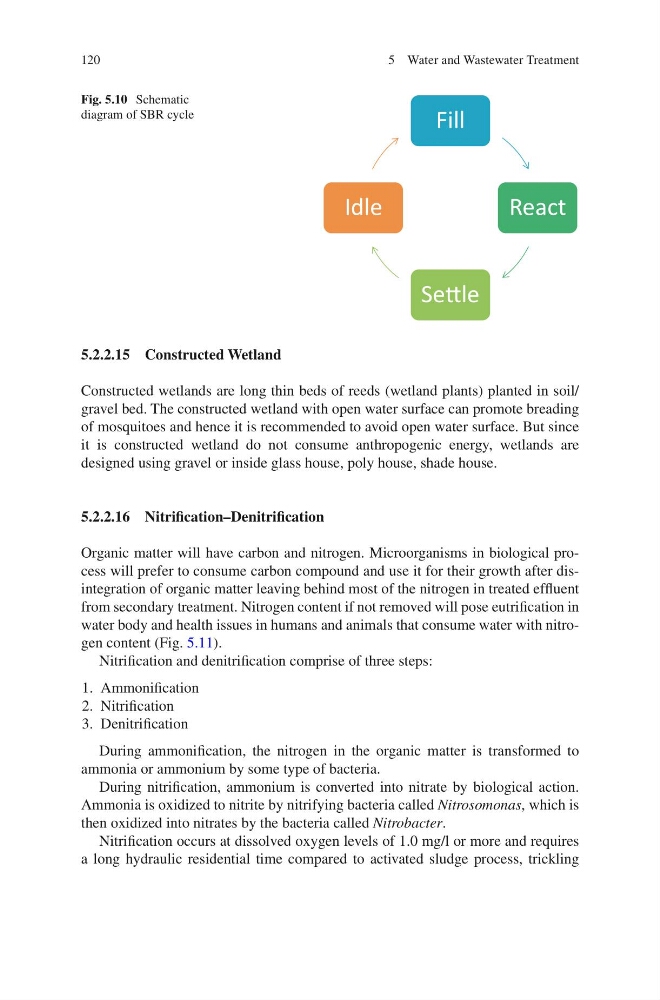
Fig. 5.10 Schematic
diagram of SBR cycle
5 Water and Wastewater Treatment
5.2.2.15 Constructed Wetland
Constructed wetlands are long thin beds of reeds (wetland plants) planted in soil/
gravel bed. The constructed wetland with open water surface can promote breading
of mosquitoes and hence it is recommended to avoid open water surface. But since
it is constructed wetland do not consume anthropogenic energy, wetlands are
designed using gravel or inside glass house, poly house, shade house.
5.2.2.16 Nitrification–Denitrification
Organic matter will have carbon and nitrogen. Microorganisms in biological process will prefer to consume carbon compound and use it for their growth after disintegration of organic matter leaving behind most of the nitrogen in treated effluent
from secondary treatment. Nitrogen content if not removed will pose eutrification in
water body and health issues in humans and animals that consume water with nitrogen content (Fig. 5.11).
Nitrification and denitrification comprise of three steps:
1. Ammonification
2. Nitrification
3. Denitrification
During ammonification, the nitrogen in the organic matter is transformed to
ammonia or ammonium by some type of bacteria.
During nitrification, ammonium is converted into nitrate by biological action.
Ammonia is oxidized to nitrite by nitrifying bacteria called Nitrosomonas, which is
then oxidized into nitrates by the bacteria called Nitrobacter.
Nitrification occurs at dissolved oxygen levels of 1.0 mg/l or more and requires
a long hydraulic residential time compared to activated sludge process, trickling
Fill
React
SeƩle
Idle
Fig. 5.10 Schematic
diagram of SBR cycle
5 Water and Wastewater Treatment