

110
5.2.1.7 Activated Carbon Filter
Activated carbon filters are used for removing chlorine and organic compounds
from water. Eliminating organic matter in potable water prevents formation of trihalomethanes. Activated carbon filtration is not capable of all contaminants.
Contaminants such as microbes, sodium, fluoride, as well as nitrates, cannot be
removed with activated carbon filter.
5.2.1.8 Reverse Osmosis
Reverse osmosis is a water purification process with special partially permeable
membrane at a pressure more than osmotic pressure. The typical transmembrane
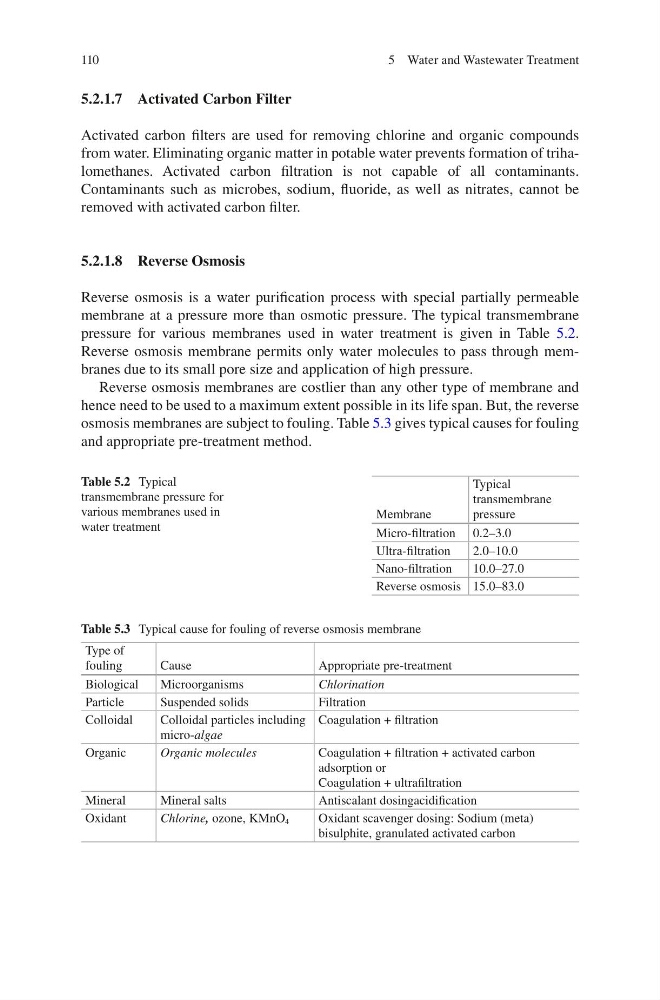
pressure for various membranes used in water treatment is given in Table 5.2.
Reverse osmosis membrane permits only water molecules to pass through membranes due to its small pore size and application of high pressure.
Reverse osmosis membranes are costlier than any other type of membrane and
hence need to be used to a maximum extent possible in its life span. But, the reverse
osmosis membranes are subject to fouling. Table 5.3 gives typical causes for fouling
and appropriate pre-treatment method.
Table 5.2 Typical
transmembrane pressure for
various membranes used in
water treatment
Membrane
Typical
transmembrane
pressure
Micro-filtration 0.2–3.0
Ultra-filtration
2.0–10.0
Nano-filtration
10.0–27.0
Reverse osmosis 15.0–83.0
Table 5.3 Typical cause for fouling of reverse osmosis membrane
Type of
fouling
Cause
Appropriate pre-treatment
Biological
Microorganisms
Chlorination
Particle
Suspended solids
Filtration
Colloidal
Colloidal particles including
micro-algae
Coagulation + filtration
Organic
Organic molecules
Coagulation + filtration + activated carbon
adsorption or
Coagulation + ultrafiltration
Mineral
Mineral salts
Antiscalant dosingacidification
Oxidant
Chlorine, ozone, KMnO 4
Oxidant scavenger dosing: Sodium (meta)
bisulphite, granulated activated carbon
5 Water and Wastewater Treatment
5.2.1.7 Activated Carbon Filter
Activated carbon filters are used for removing chlorine and organic compounds
from water. Eliminating organic matter in potable water prevents formation of trihalomethanes. Activated carbon filtration is not capable of all contaminants.
Contaminants such as microbes, sodium, fluoride, as well as nitrates, cannot be
removed with activated carbon filter.
5.2.1.8 Reverse Osmosis
Reverse osmosis is a water purification process with special partially permeable
membrane at a pressure more than osmotic pressure. The typical transmembrane
pressure for various membranes used in water treatment is given in Table 5.2.
Reverse osmosis membrane permits only water molecules to pass through membranes due to its small pore size and application of high pressure.
Reverse osmosis membranes are costlier than any other type of membrane and
hence need to be used to a maximum extent possible in its life span. But, the reverse
osmosis membranes are subject to fouling. Table 5.3 gives typical causes for fouling
and appropriate pre-treatment method.
Table 5.2 Typical
transmembrane pressure for
various membranes used in
water treatment
Membrane
Typical
transmembrane
pressure
Micro-filtration 0.2–3.0
Ultra-filtration
2.0–10.0
Nano-filtration
10.0–27.0
Reverse osmosis 15.0–83.0
Table 5.3 Typical cause for fouling of reverse osmosis membrane
Type of
fouling
Cause
Appropriate pre-treatment
Biological
Microorganisms
Chlorination
Particle
Suspended solids
Filtration
Colloidal
Colloidal particles including
micro-algae
Coagulation + filtration
Organic
Organic molecules
Coagulation + filtration + activated carbon
adsorption or
Coagulation + ultrafiltration
Mineral
Mineral salts
Antiscalant dosingacidification
Oxidant
Chlorine, ozone, KMnO 4
Oxidant scavenger dosing: Sodium (meta)
bisulphite, granulated activated carbon
5 Water and Wastewater Treatment