

102
Pathogens and undesirable chemicals would encourage waterborne diseases
when ingested or when they come in contact with the skin. Stagnant water would
proliferate vectors in the absence of predators like fish, lizard and frog.
Nature can purify pollutants entering water and to some extent by self- purification
by following methods:
1. Dilution: Pollutants are diluted by water by dispersion to an extent wherein pollutants will not harm environment.
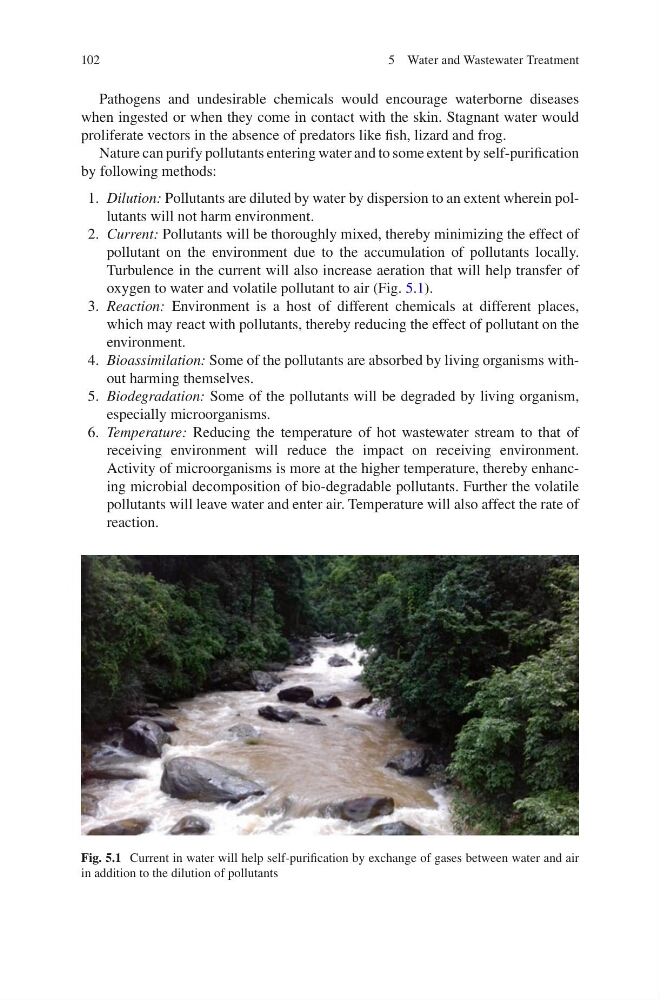
2. Current: Pollutants will be thoroughly mixed, thereby minimizing the effect of
pollutant on the environment due to the accumulation of pollutants locally.
Turbulence in the current will also increase aeration that will help transfer of
oxygen to water and volatile pollutant to air (Fig. 5.1).
3. Reaction: Environment is a host of different chemicals at different places,
which may react with pollutants, thereby reducing the effect of pollutant on the
environment.
4. Bioassimilation: Some of the pollutants are absorbed by living organisms without harming themselves.
5. Biodegradation: Some of the pollutants will be degraded by living organism,
especially microorganisms.
6. Temperature: Reducing the temperature of hot wastewater stream to that of
receiving environment will reduce the impact on receiving environment.
Activity of microorganisms is more at the higher temperature, thereby enhancing microbial decomposition of bio-degradable pollutants. Further the volatile
pollutants will leave water and enter air. Temperature will also affect the rate of
reaction.
Fig. 5.1 Current in water will help self-purification by exchange of gases between water and air
in addition to the dilution of pollutants
5 Water and Wastewater Treatment
Pathogens and undesirable chemicals would encourage waterborne diseases
when ingested or when they come in contact with the skin. Stagnant water would
proliferate vectors in the absence of predators like fish, lizard and frog.
Nature can purify pollutants entering water and to some extent by self- purification
by following methods:
1. Dilution: Pollutants are diluted by water by dispersion to an extent wherein pollutants will not harm environment.
2. Current: Pollutants will be thoroughly mixed, thereby minimizing the effect of
pollutant on the environment due to the accumulation of pollutants locally.
Turbulence in the current will also increase aeration that will help transfer of
oxygen to water and volatile pollutant to air (Fig. 5.1).
3. Reaction: Environment is a host of different chemicals at different places,
which may react with pollutants, thereby reducing the effect of pollutant on the
environment.
4. Bioassimilation: Some of the pollutants are absorbed by living organisms without harming themselves.
5. Biodegradation: Some of the pollutants will be degraded by living organism,
especially microorganisms.
6. Temperature: Reducing the temperature of hot wastewater stream to that of
receiving environment will reduce the impact on receiving environment.
Activity of microorganisms is more at the higher temperature, thereby enhancing microbial decomposition of bio-degradable pollutants. Further the volatile
pollutants will leave water and enter air. Temperature will also affect the rate of
reaction.
Fig. 5.1 Current in water will help self-purification by exchange of gases between water and air
in addition to the dilution of pollutants
5 Water and Wastewater Treatment