

77
1. Air quality
2. Animal control
3. Food protection
4. Hazardous substance control
5. Human–animal conflict
6. Injury control
7. Liquid waste management
8. Noise control
9. Occupational health
10. Radiological health
11. Recreational safety and health
12. Rural and urban planning
13. Shelter
14. Solid waste management
15. Vector control
16. Water quality
Health advocacy needs to become integral part of health planning to help individuals as well as communities improve their health, by enhancing their knowledge
or influencing their attitudes.
Principles of health promotion are (Mahajan and Gupta 2013):
• Shall involve the population as a whole rather than specific group
• Shall be directed towards causes of health
• Shall combine diverse and complementary methods/approaches
• Shall aim at effective public participation
Considering the above aspects, health education ideally shall cover following
information:
1. Disease information
(a) Types of disease
(i) Communicable diseases
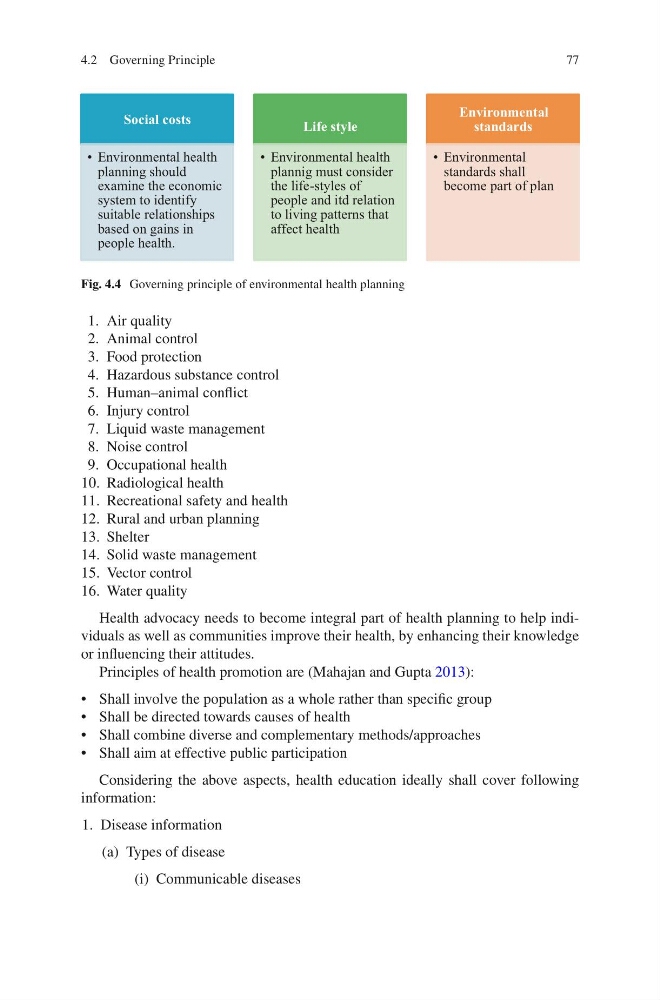
Social costs
• Environmental health
planning should
examine the economic
system to identify
suitable relationships
based on gains in
people health.
Life style
• Environmental health
plannig must consider
the life-styles of
people and itd relation
to living patterns that
affect health
Environmental
standards
• Environmental
standards shall
become part of plan
Fig. 4.4 Governing principle of environmental health planning
4.2 Governing Principle
1. Air quality
2. Animal control
3. Food protection
4. Hazardous substance control
5. Human–animal conflict
6. Injury control
7. Liquid waste management
8. Noise control
9. Occupational health
10. Radiological health
11. Recreational safety and health
12. Rural and urban planning
13. Shelter
14. Solid waste management
15. Vector control
16. Water quality
Health advocacy needs to become integral part of health planning to help individuals as well as communities improve their health, by enhancing their knowledge
or influencing their attitudes.
Principles of health promotion are (Mahajan and Gupta 2013):
• Shall involve the population as a whole rather than specific group
• Shall be directed towards causes of health
• Shall combine diverse and complementary methods/approaches
• Shall aim at effective public participation
Considering the above aspects, health education ideally shall cover following
information:
1. Disease information
(a) Types of disease
(i) Communicable diseases
Social costs
• Environmental health
planning should
examine the economic
system to identify
suitable relationships
based on gains in
people health.
Life style
• Environmental health
plannig must consider
the life-styles of
people and itd relation
to living patterns that
affect health
Environmental
standards
• Environmental
standards shall
become part of plan
Fig. 4.4 Governing principle of environmental health planning
4.2 Governing Principle