

5 Company–Community Partnership and Climate Change Adaptation Practices …
93
Table 5.4 Effects of company–community partnership on climate change adaptation and mitigation
practices: PSM Kernel matching using bootstrapping
Variable
Farm income
(in Rupiah)
Log of
farm
income
Adopting
water and soil
conservation
technique
Adopting
grafting
technique
Planting
spice
crops (=
1 if yes)
Planting
hardwood
trees (=1 if
yes)
ATT
5,490,000 **
0.253 *** 0.048 *
0.060 ***
0.077 **
0.065 ***
(2,200,000)
(0.083)
(0.031)
(0.021)
(0.038)
(0.025)
Observations 650
650
650
650
650
650
Bootstrapped standard errors in parentheses, *** p < 0.01, ** p < 0.05, * p < 0.1. Bootstrap analysis
was repeated 50 times
agroforestry technique, crop diversification, and farm income. Farmers who belong
to the partnership are found to significantly generate more annual farm income by
5.5 million Rp (less than US$500) compared to those who do not. This is probably contributed by the higher prices of coffee beans procured by the MNCs relative to the market price, in addition to higher production yields resulting from crop
diversification compared to the control group.
While these conservation practices are not mandated by the MNCs, farmers in
partnership are more likely to adopt conservation and grafting techniques compared
to the control group by 5 and 6% points. They also have higher propensity to diversify with spice crops and plant hardwood trees compared to the non-partnership
group by 8 and 7% points. While farmers belong to the partnership may be more
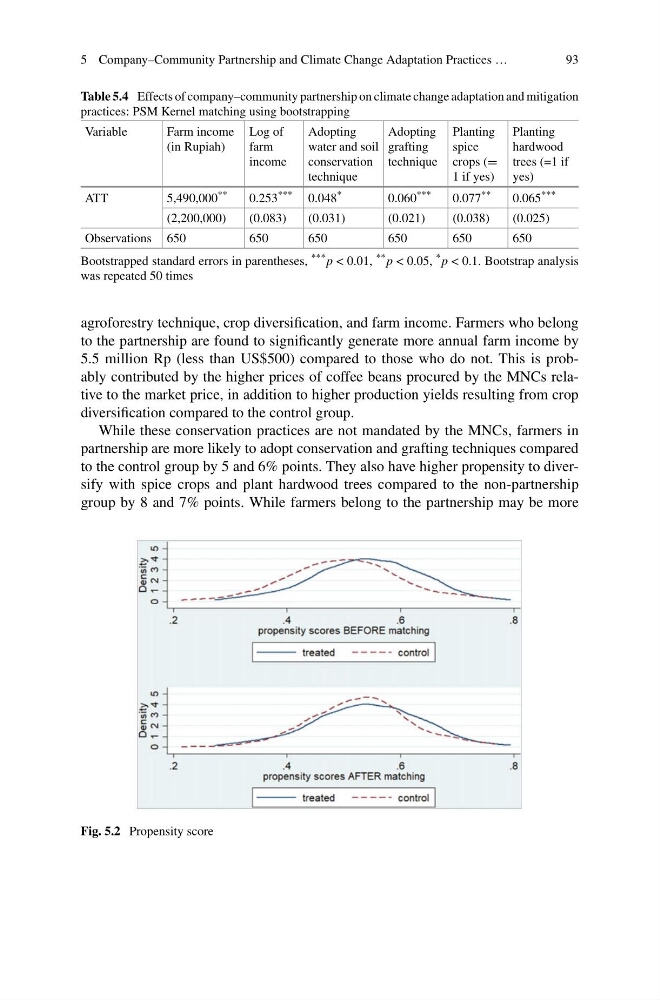
Fig. 5.2 Propensity score
93
Table 5.4 Effects of company–community partnership on climate change adaptation and mitigation
practices: PSM Kernel matching using bootstrapping
Variable
Farm income
(in Rupiah)
Log of
farm
income
Adopting
water and soil
conservation
technique
Adopting
grafting
technique
Planting
spice
crops (=
1 if yes)
Planting
hardwood
trees (=1 if
yes)
ATT
5,490,000 **
0.253 *** 0.048 *
0.060 ***
0.077 **
0.065 ***
(2,200,000)
(0.083)
(0.031)
(0.021)
(0.038)
(0.025)
Observations 650
650
650
650
650
650
Bootstrapped standard errors in parentheses, *** p < 0.01, ** p < 0.05, * p < 0.1. Bootstrap analysis
was repeated 50 times
agroforestry technique, crop diversification, and farm income. Farmers who belong
to the partnership are found to significantly generate more annual farm income by
5.5 million Rp (less than US$500) compared to those who do not. This is probably contributed by the higher prices of coffee beans procured by the MNCs relative to the market price, in addition to higher production yields resulting from crop
diversification compared to the control group.
While these conservation practices are not mandated by the MNCs, farmers in
partnership are more likely to adopt conservation and grafting techniques compared
to the control group by 5 and 6% points. They also have higher propensity to diversify with spice crops and plant hardwood trees compared to the non-partnership
group by 8 and 7% points. While farmers belong to the partnership may be more
Fig. 5.2 Propensity score