

90
A. Pratiwi et al.
status and the outcome variables. Due to the absence of baseline data, we could
not employ a more rigorous statistical model to eliminate endogeneity. With this
limitation, the optimum way is to compare the farmers with partnership status and
without. Thus, we employed propensity score matching (PSM) and inverse propensity
score weighted regression (IPWR) to reduce the differences that were due to observable characteristics between farmers in partnership and non-partnership. While PSM
and IPWR can control for the observable effects related to the partnership agreement, they cannot exogenize the unobserved effects such as willingness to work
hard. In conducting PSM, we ensure that the covariates are adequately balanced
between treatment and control individual to remove the observable bias between
the two groups. Hence, the systematic difference between farmers with partnership
and non-partnership with the same values of covariates can be attributable to the
partnership.
While we conduct various algorithm methods for the matching, the kernel
matching methods are reported here, because they gave the lowest mean bias
estimates. Kernel matching (KM) are nonparametric matching estimators that use
weighted averages of all individuals in the control group to construct the counterfactual outcome. Thus, one major advantage of these approaches is the lower variance which is achieved because more information is used (Caliendo and Kopeinig
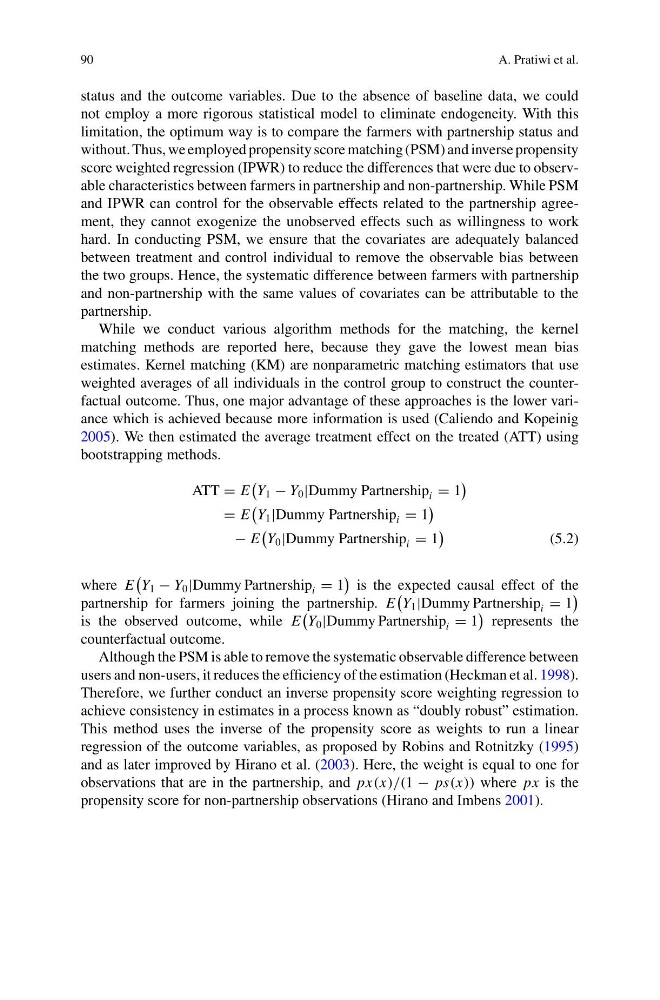
2005). We then estimated the average treatment effect on the treated (ATT) using
bootstrapping methods.
ATT = E
Y 1 − Y 0 |Dummy Partnership i = 1
= E
Y 1 |Dummy Partnership i = 1
− E
Y 0 |Dummy Partnership i = 1
(5.2)
where E
Y 1 − Y 0 |Dummy Partnership i = 1
is the expected causal effect of the
partnership for farmers joining the partnership. E
Y 1 |Dummy Partnership i = 1
is the observed outcome, while E
Y 0 |Dummy Partnership i = 1
represents the
counterfactual outcome.
Although the PSM is able to remove the systematic observable difference between
users and non-users, it reduces the efficiency of the estimation (Heckman et al. 1998).
Therefore, we further conduct an inverse propensity score weighting regression to
achieve consistency in estimates in a process known as “doubly robust” estimation.
This method uses the inverse of the propensity score as weights to run a linear
regression of the outcome variables, as proposed by Robins and Rotnitzky (1995)
and as later improved by Hirano et al. (2003). Here, the weight is equal to one for
observations that are in the partnership, and px(x)/(1 − ps(x)) where px is the
propensity score for non-partnership observations (Hirano and Imbens 2001).
A. Pratiwi et al.
status and the outcome variables. Due to the absence of baseline data, we could
not employ a more rigorous statistical model to eliminate endogeneity. With this
limitation, the optimum way is to compare the farmers with partnership status and
without. Thus, we employed propensity score matching (PSM) and inverse propensity
score weighted regression (IPWR) to reduce the differences that were due to observable characteristics between farmers in partnership and non-partnership. While PSM
and IPWR can control for the observable effects related to the partnership agreement, they cannot exogenize the unobserved effects such as willingness to work
hard. In conducting PSM, we ensure that the covariates are adequately balanced
between treatment and control individual to remove the observable bias between
the two groups. Hence, the systematic difference between farmers with partnership
and non-partnership with the same values of covariates can be attributable to the
partnership.
While we conduct various algorithm methods for the matching, the kernel
matching methods are reported here, because they gave the lowest mean bias
estimates. Kernel matching (KM) are nonparametric matching estimators that use
weighted averages of all individuals in the control group to construct the counterfactual outcome. Thus, one major advantage of these approaches is the lower variance which is achieved because more information is used (Caliendo and Kopeinig
2005). We then estimated the average treatment effect on the treated (ATT) using
bootstrapping methods.
ATT = E
Y 1 − Y 0 |Dummy Partnership i = 1
= E
Y 1 |Dummy Partnership i = 1
− E
Y 0 |Dummy Partnership i = 1
(5.2)
where E
Y 1 − Y 0 |Dummy Partnership i = 1
is the expected causal effect of the
partnership for farmers joining the partnership. E
Y 1 |Dummy Partnership i = 1
is the observed outcome, while E
Y 0 |Dummy Partnership i = 1
represents the
counterfactual outcome.
Although the PSM is able to remove the systematic observable difference between
users and non-users, it reduces the efficiency of the estimation (Heckman et al. 1998).
Therefore, we further conduct an inverse propensity score weighting regression to
achieve consistency in estimates in a process known as “doubly robust” estimation.
This method uses the inverse of the propensity score as weights to run a linear
regression of the outcome variables, as proposed by Robins and Rotnitzky (1995)
and as later improved by Hirano et al. (2003). Here, the weight is equal to one for
observations that are in the partnership, and px(x)/(1 − ps(x)) where px is the
propensity score for non-partnership observations (Hirano and Imbens 2001).