

276
Z. Z. Mutiara et al.
Table 13.5 (continued)
Clusters of key
interventions
Contributors (OPD)
Average of public funds ratio
allocated to total climate finance per
cluster of interventions
2015
2016
%
%
Environment office
0.003
0.03
Disaster mitigation office
0.054
0.20
a In 2017 based on Law No. 32 on Local Regional Government’s functionality this function is taking
over by provincial government
b In 2017 has changed in to Environment office
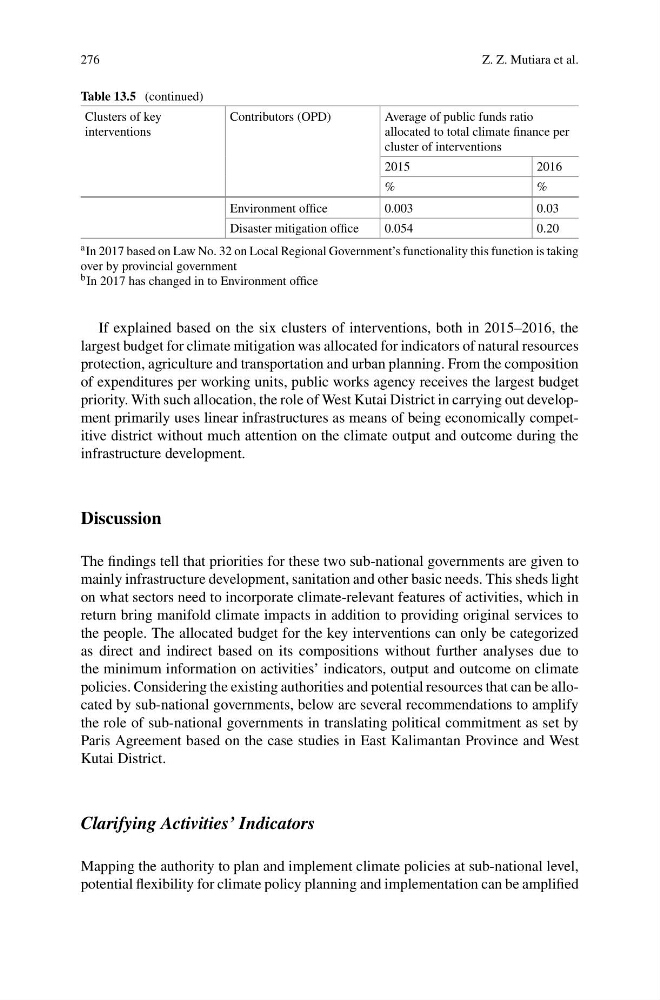
If explained based on the six clusters of interventions, both in 2015–2016, the
largest budget for climate mitigation was allocated for indicators of natural resources
protection, agriculture and transportation and urban planning. From the composition
of expenditures per working units, public works agency receives the largest budget
priority. With such allocation, the role of West Kutai District in carrying out development primarily uses linear infrastructures as means of being economically competitive district without much attention on the climate output and outcome during the
infrastructure development.
Discussion
The findings tell that priorities for these two sub-national governments are given to
mainly infrastructure development, sanitation and other basic needs. This sheds light
on what sectors need to incorporate climate-relevant features of activities, which in
return bring manifold climate impacts in addition to providing original services to
the people. The allocated budget for the key interventions can only be categorized
as direct and indirect based on its compositions without further analyses due to
the minimum information on activities’ indicators, output and outcome on climate
policies. Considering the existing authorities and potential resources that can be allocated by sub-national governments, below are several recommendations to amplify
the role of sub-national governments in translating political commitment as set by
Paris Agreement based on the case studies in East Kalimantan Province and West
Kutai District.
Clarifying Activities’ Indicators
Mapping the authority to plan and implement climate policies at sub-national level,
potential flexibility for climate policy planning and implementation can be amplified
Z. Z. Mutiara et al.
Table 13.5 (continued)
Clusters of key
interventions
Contributors (OPD)
Average of public funds ratio
allocated to total climate finance per
cluster of interventions
2015
2016
%
%
Environment office
0.003
0.03
Disaster mitigation office
0.054
0.20
a In 2017 based on Law No. 32 on Local Regional Government’s functionality this function is taking
over by provincial government
b In 2017 has changed in to Environment office
If explained based on the six clusters of interventions, both in 2015–2016, the
largest budget for climate mitigation was allocated for indicators of natural resources
protection, agriculture and transportation and urban planning. From the composition
of expenditures per working units, public works agency receives the largest budget
priority. With such allocation, the role of West Kutai District in carrying out development primarily uses linear infrastructures as means of being economically competitive district without much attention on the climate output and outcome during the
infrastructure development.
Discussion
The findings tell that priorities for these two sub-national governments are given to
mainly infrastructure development, sanitation and other basic needs. This sheds light
on what sectors need to incorporate climate-relevant features of activities, which in
return bring manifold climate impacts in addition to providing original services to
the people. The allocated budget for the key interventions can only be categorized
as direct and indirect based on its compositions without further analyses due to
the minimum information on activities’ indicators, output and outcome on climate
policies. Considering the existing authorities and potential resources that can be allocated by sub-national governments, below are several recommendations to amplify
the role of sub-national governments in translating political commitment as set by
Paris Agreement based on the case studies in East Kalimantan Province and West
Kutai District.
Clarifying Activities’ Indicators
Mapping the authority to plan and implement climate policies at sub-national level,
potential flexibility for climate policy planning and implementation can be amplified