

12 Innovative Financing for Peatland Restoration in Indonesia
261
RSPO-certified palm oil plantation companies caused deforestation in the process
of establishing their plantations to compensate such deforestation liabilities with
rehabilitating and conserving forests, hectare to hectare, using a methodological
formula.
For the remediation and compensation procedure to benefit peat restoration, a
framework can be devised. According to RSPO, there are 82,609 ha of non-compliant
land clearance in palm oil plantation establishment in Indonesia that causes deforestation without due HCV assessments since November 2005. Consequently, through
a formula, there are 59,563 ha of conservation liability in Indonesia (e.g. Harris et al.
2015a, b). The compensation projects can be directed towards those areas under BRG
mandate and therefore, such compensation can contribute to the fulfillment of the
restoration mandate.
The so-called compensation projects can be located within BRG’s one million ha
of non-licensed areas in the seven provinces. By implementing this kind of compensation, the plantation companies can fulfill their compensation liabilities under the
sustainability standards while assisting the BRG in fulfilling its mandate.
Blending Financial Sources
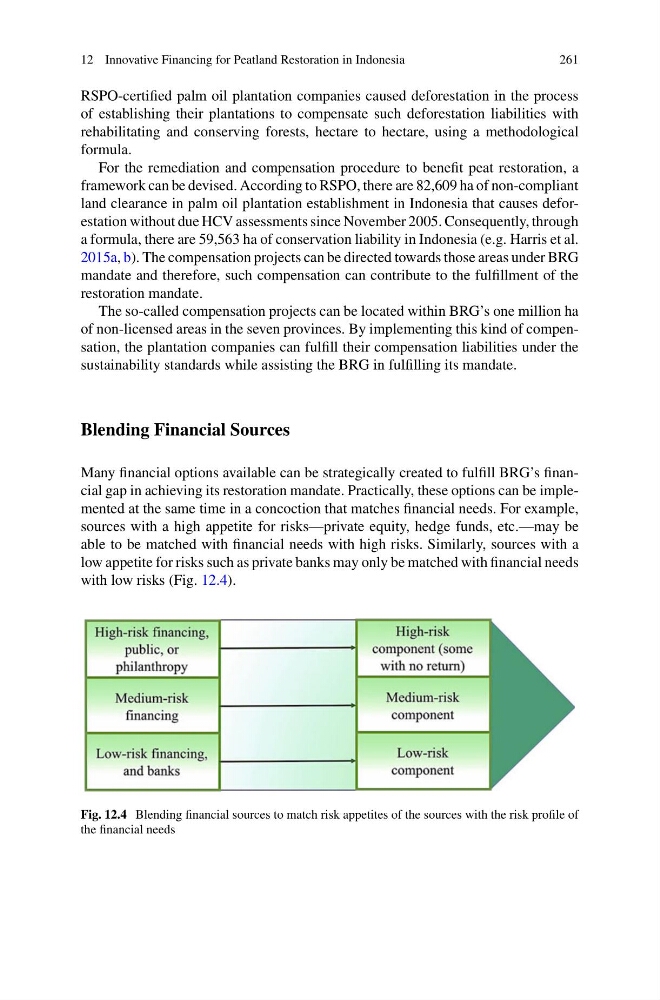
Many financial options available can be strategically created to fulfill BRG’s financial gap in achieving its restoration mandate. Practically, these options can be implemented at the same time in a concoction that matches financial needs. For example,
sources with a high appetite for risks—private equity, hedge funds, etc.—may be
able to be matched with financial needs with high risks. Similarly, sources with a
low appetite for risks such as private banks may only be matched with financial needs
with low risks (Fig. 12.4).
Fig. 12.4 Blending financial sources to match risk appetites of the sources with the risk profile of
the financial needs
261
RSPO-certified palm oil plantation companies caused deforestation in the process
of establishing their plantations to compensate such deforestation liabilities with
rehabilitating and conserving forests, hectare to hectare, using a methodological
formula.
For the remediation and compensation procedure to benefit peat restoration, a
framework can be devised. According to RSPO, there are 82,609 ha of non-compliant
land clearance in palm oil plantation establishment in Indonesia that causes deforestation without due HCV assessments since November 2005. Consequently, through
a formula, there are 59,563 ha of conservation liability in Indonesia (e.g. Harris et al.
2015a, b). The compensation projects can be directed towards those areas under BRG
mandate and therefore, such compensation can contribute to the fulfillment of the
restoration mandate.
The so-called compensation projects can be located within BRG’s one million ha
of non-licensed areas in the seven provinces. By implementing this kind of compensation, the plantation companies can fulfill their compensation liabilities under the
sustainability standards while assisting the BRG in fulfilling its mandate.
Blending Financial Sources
Many financial options available can be strategically created to fulfill BRG’s financial gap in achieving its restoration mandate. Practically, these options can be implemented at the same time in a concoction that matches financial needs. For example,
sources with a high appetite for risks—private equity, hedge funds, etc.—may be
able to be matched with financial needs with high risks. Similarly, sources with a
low appetite for risks such as private banks may only be matched with financial needs
with low risks (Fig. 12.4).
Fig. 12.4 Blending financial sources to match risk appetites of the sources with the risk profile of
the financial needs