

248
A. P. Sari et al.
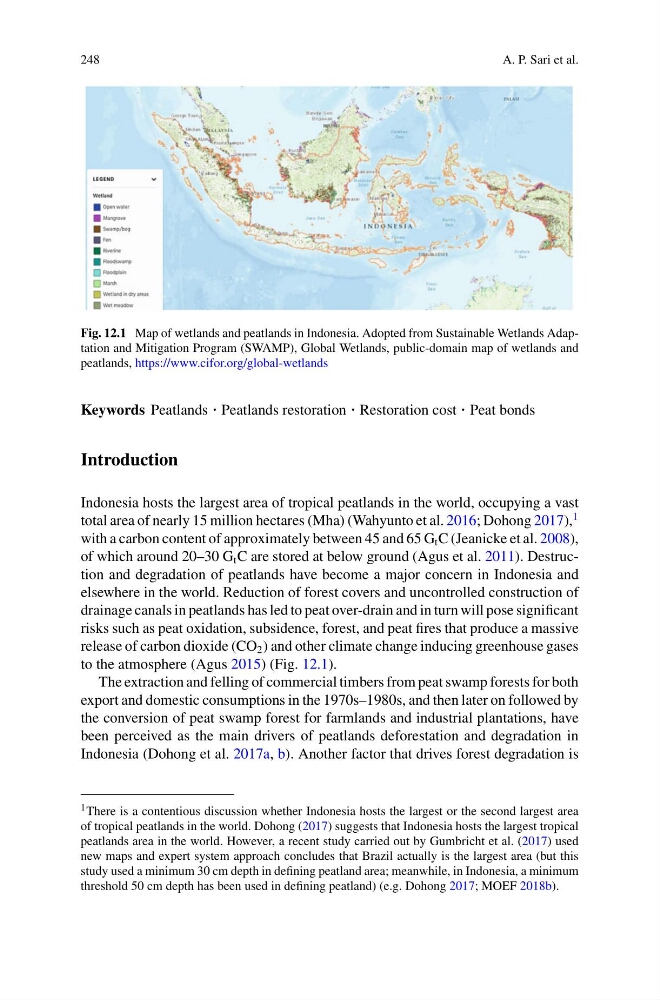
Fig. 12.1 Map of wetlands and peatlands in Indonesia. Adopted from Sustainable Wetlands Adaptation and Mitigation Program (SWAMP), Global Wetlands, public-domain map of wetlands and
peatlands, https://www.cifor.org/global-wetlands
Keywords Peatlands · Peatlands restoration · Restoration cost · Peat bonds
Introduction
Indonesia hosts the largest area of tropical peatlands in the world, occupying a vast
total area of nearly 15 million hectares (Mha) (Wahyunto et al. 2016; Dohong 2017),
1
with a carbon content of approximately between 45 and 65 G t C (Jeanicke et al. 2008),
of which around 20–30 G t C are stored at below ground (Agus et al. 2011). Destruction and degradation of peatlands have become a major concern in Indonesia and
elsewhere in the world. Reduction of forest covers and uncontrolled construction of
drainage canals in peatlands has led to peat over-drain and in turn will pose significant
risks such as peat oxidation, subsidence, forest, and peat fires that produce a massive
release of carbon dioxide (CO 2 ) and other climate change inducing greenhouse gases
to the atmosphere (Agus 2015) (Fig. 12.1).
The extraction and felling of commercial timbers from peat swamp forests for both
export and domestic consumptions in the 1970s–1980s, and then later on followed by
the conversion of peat swamp forest for farmlands and industrial plantations, have
been perceived as the main drivers of peatlands deforestation and degradation in
Indonesia (Dohong et al. 2017a, b). Another factor that drives forest degradation is
1 There is a contentious discussion whether Indonesia hosts the largest or the second largest area
of tropical peatlands in the world. Dohong (2017) suggests that Indonesia hosts the largest tropical
peatlands area in the world. However, a recent study carried out by Gumbricht et al. (2017) used
new maps and expert system approach concludes that Brazil actually is the largest area (but this
study used a minimum 30 cm depth in defining peatland area; meanwhile, in Indonesia, a minimum
threshold 50 cm depth has been used in defining peatland) (e.g. Dohong 2017; MOEF 2018b).
A. P. Sari et al.
Fig. 12.1 Map of wetlands and peatlands in Indonesia. Adopted from Sustainable Wetlands Adaptation and Mitigation Program (SWAMP), Global Wetlands, public-domain map of wetlands and
peatlands, https://www.cifor.org/global-wetlands
Keywords Peatlands · Peatlands restoration · Restoration cost · Peat bonds
Introduction
Indonesia hosts the largest area of tropical peatlands in the world, occupying a vast
total area of nearly 15 million hectares (Mha) (Wahyunto et al. 2016; Dohong 2017),
1
with a carbon content of approximately between 45 and 65 G t C (Jeanicke et al. 2008),
of which around 20–30 G t C are stored at below ground (Agus et al. 2011). Destruction and degradation of peatlands have become a major concern in Indonesia and
elsewhere in the world. Reduction of forest covers and uncontrolled construction of
drainage canals in peatlands has led to peat over-drain and in turn will pose significant
risks such as peat oxidation, subsidence, forest, and peat fires that produce a massive
release of carbon dioxide (CO 2 ) and other climate change inducing greenhouse gases
to the atmosphere (Agus 2015) (Fig. 12.1).
The extraction and felling of commercial timbers from peat swamp forests for both
export and domestic consumptions in the 1970s–1980s, and then later on followed by
the conversion of peat swamp forest for farmlands and industrial plantations, have
been perceived as the main drivers of peatlands deforestation and degradation in
Indonesia (Dohong et al. 2017a, b). Another factor that drives forest degradation is
1 There is a contentious discussion whether Indonesia hosts the largest or the second largest area
of tropical peatlands in the world. Dohong (2017) suggests that Indonesia hosts the largest tropical
peatlands area in the world. However, a recent study carried out by Gumbricht et al. (2017) used
new maps and expert system approach concludes that Brazil actually is the largest area (but this
study used a minimum 30 cm depth in defining peatland area; meanwhile, in Indonesia, a minimum
threshold 50 cm depth has been used in defining peatland) (e.g. Dohong 2017; MOEF 2018b).