

236
C. S. Goh and S. H. J. T. Lee
5.4
3.8
7.1
1.7
0
2
4
6
8
10 12 14 16 18 20
Central Kalimantan
East Kalimantan
West Kalimantan
South Kalimantan
Mha
Dry-field forest
Swamp forest
Non-forested wetland
Other functional land classes
Agroforestry, rubber and timber plantation
Oil palm (industrial plantation on peat)
Oil palm (others)
Paddy (Intensive)
Low carbon land
1. Oil palm data were adapted from DG Estate Crops Indonesia (2016)
2. Wetland and peatland data were adapted from Miettinen et al. (2016)
3. Dry-field forest data were adapted from NRE (2015) and MoE (2016)
4. Other functional land classes were adapted from Gunarso et al. 2013 and Goh et al.
2017, assuming insignificant changes in area from 2010-2015
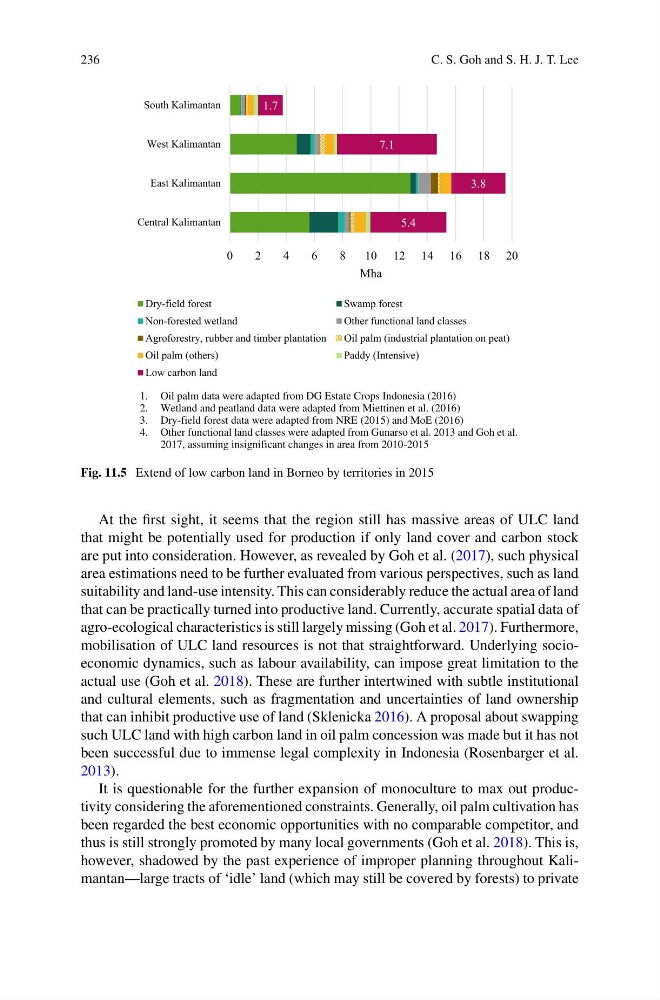
Fig. 11.5 Extend of low carbon land in Borneo by territories in 2015
At the first sight, it seems that the region still has massive areas of ULC land
that might be potentially used for production if only land cover and carbon stock
are put into consideration. However, as revealed by Goh et al. (2017), such physical
area estimations need to be further evaluated from various perspectives, such as land
suitability and land-use intensity. This can considerably reduce the actual area of land
that can be practically turned into productive land. Currently, accurate spatial data of
agro-ecological characteristics is still largely missing (Goh et al. 2017). Furthermore,
mobilisation of ULC land resources is not that straightforward. Underlying socioeconomic dynamics, such as labour availability, can impose great limitation to the
actual use (Goh et al. 2018). These are further intertwined with subtle institutional
and cultural elements, such as fragmentation and uncertainties of land ownership
that can inhibit productive use of land (Sklenicka 2016). A proposal about swapping
such ULC land with high carbon land in oil palm concession was made but it has not
been successful due to immense legal complexity in Indonesia (Rosenbarger et al.
2013).
It is questionable for the further expansion of monoculture to max out productivity considering the aforementioned constraints. Generally, oil palm cultivation has
been regarded the best economic opportunities with no comparable competitor, and
thus is still strongly promoted by many local governments (Goh et al. 2018). This is,
however, shadowed by the past experience of improper planning throughout Kalimantan—large tracts of ‘idle’ land (which may still be covered by forests) to private
C. S. Goh and S. H. J. T. Lee
5.4
3.8
7.1
1.7
0
2
4
6
8
10 12 14 16 18 20
Central Kalimantan
East Kalimantan
West Kalimantan
South Kalimantan
Mha
Dry-field forest
Swamp forest
Non-forested wetland
Other functional land classes
Agroforestry, rubber and timber plantation
Oil palm (industrial plantation on peat)
Oil palm (others)
Paddy (Intensive)
Low carbon land
1. Oil palm data were adapted from DG Estate Crops Indonesia (2016)
2. Wetland and peatland data were adapted from Miettinen et al. (2016)
3. Dry-field forest data were adapted from NRE (2015) and MoE (2016)
4. Other functional land classes were adapted from Gunarso et al. 2013 and Goh et al.
2017, assuming insignificant changes in area from 2010-2015
Fig. 11.5 Extend of low carbon land in Borneo by territories in 2015
At the first sight, it seems that the region still has massive areas of ULC land
that might be potentially used for production if only land cover and carbon stock
are put into consideration. However, as revealed by Goh et al. (2017), such physical
area estimations need to be further evaluated from various perspectives, such as land
suitability and land-use intensity. This can considerably reduce the actual area of land
that can be practically turned into productive land. Currently, accurate spatial data of
agro-ecological characteristics is still largely missing (Goh et al. 2017). Furthermore,
mobilisation of ULC land resources is not that straightforward. Underlying socioeconomic dynamics, such as labour availability, can impose great limitation to the
actual use (Goh et al. 2018). These are further intertwined with subtle institutional
and cultural elements, such as fragmentation and uncertainties of land ownership
that can inhibit productive use of land (Sklenicka 2016). A proposal about swapping
such ULC land with high carbon land in oil palm concession was made but it has not
been successful due to immense legal complexity in Indonesia (Rosenbarger et al.
2013).
It is questionable for the further expansion of monoculture to max out productivity considering the aforementioned constraints. Generally, oil palm cultivation has
been regarded the best economic opportunities with no comparable competitor, and
thus is still strongly promoted by many local governments (Goh et al. 2018). This is,
however, shadowed by the past experience of improper planning throughout Kalimantan—large tracts of ‘idle’ land (which may still be covered by forests) to private