

162
M. Kasim
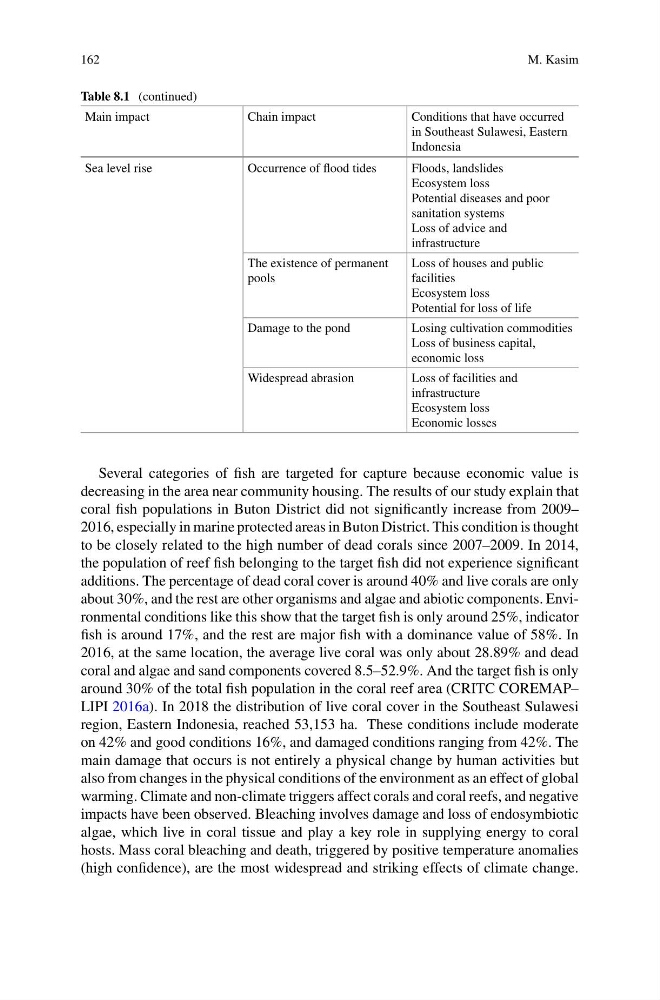
Table 8.1 (continued)
Main impact
Chain impact
Conditions that have occurred
in Southeast Sulawesi, Eastern
Indonesia
Sea level rise
Occurrence of flood tides
Floods, landslides
Ecosystem loss
Potential diseases and poor
sanitation systems
Loss of advice and
infrastructure
The existence of permanent
pools
Loss of houses and public
facilities
Ecosystem loss
Potential for loss of life
Damage to the pond
Losing cultivation commodities
Loss of business capital,
economic loss
Widespread abrasion
Loss of facilities and
infrastructure
Ecosystem loss
Economic losses
Several categories of fish are targeted for capture because economic value is
decreasing in the area near community housing. The results of our study explain that
coral fish populations in Buton District did not significantly increase from 2009–
2016, especially in marine protected areas in Buton District. This condition is thought
to be closely related to the high number of dead corals since 2007–2009. In 2014,
the population of reef fish belonging to the target fish did not experience significant
additions. The percentage of dead coral cover is around 40% and live corals are only
about 30%, and the rest are other organisms and algae and abiotic components. Environmental conditions like this show that the target fish is only around 25%, indicator
fish is around 17%, and the rest are major fish with a dominance value of 58%. In
2016, at the same location, the average live coral was only about 28.89% and dead
coral and algae and sand components covered 8.5–52.9%. And the target fish is only
around 30% of the total fish population in the coral reef area (CRITC COREMAP–
LIPI 2016a). In 2018 the distribution of live coral cover in the Southeast Sulawesi
region, Eastern Indonesia, reached 53,153 ha. These conditions include moderate
on 42% and good conditions 16%, and damaged conditions ranging from 42%. The
main damage that occurs is not entirely a physical change by human activities but
also from changes in the physical conditions of the environment as an effect of global
warming. Climate and non-climate triggers affect corals and coral reefs, and negative
impacts have been observed. Bleaching involves damage and loss of endosymbiotic
algae, which live in coral tissue and play a key role in supplying energy to coral
hosts. Mass coral bleaching and death, triggered by positive temperature anomalies
(high confidence), are the most widespread and striking effects of climate change.
M. Kasim
Table 8.1 (continued)
Main impact
Chain impact
Conditions that have occurred
in Southeast Sulawesi, Eastern
Indonesia
Sea level rise
Occurrence of flood tides
Floods, landslides
Ecosystem loss
Potential diseases and poor
sanitation systems
Loss of advice and
infrastructure
The existence of permanent
pools
Loss of houses and public
facilities
Ecosystem loss
Potential for loss of life
Damage to the pond
Losing cultivation commodities
Loss of business capital,
economic loss
Widespread abrasion
Loss of facilities and
infrastructure
Ecosystem loss
Economic losses
Several categories of fish are targeted for capture because economic value is
decreasing in the area near community housing. The results of our study explain that
coral fish populations in Buton District did not significantly increase from 2009–
2016, especially in marine protected areas in Buton District. This condition is thought
to be closely related to the high number of dead corals since 2007–2009. In 2014,
the population of reef fish belonging to the target fish did not experience significant
additions. The percentage of dead coral cover is around 40% and live corals are only
about 30%, and the rest are other organisms and algae and abiotic components. Environmental conditions like this show that the target fish is only around 25%, indicator
fish is around 17%, and the rest are major fish with a dominance value of 58%. In
2016, at the same location, the average live coral was only about 28.89% and dead
coral and algae and sand components covered 8.5–52.9%. And the target fish is only
around 30% of the total fish population in the coral reef area (CRITC COREMAP–
LIPI 2016a). In 2018 the distribution of live coral cover in the Southeast Sulawesi
region, Eastern Indonesia, reached 53,153 ha. These conditions include moderate
on 42% and good conditions 16%, and damaged conditions ranging from 42%. The
main damage that occurs is not entirely a physical change by human activities but
also from changes in the physical conditions of the environment as an effect of global
warming. Climate and non-climate triggers affect corals and coral reefs, and negative
impacts have been observed. Bleaching involves damage and loss of endosymbiotic
algae, which live in coral tissue and play a key role in supplying energy to coral
hosts. Mass coral bleaching and death, triggered by positive temperature anomalies
(high confidence), are the most widespread and striking effects of climate change.