

project include uncertain environmental impacts and adverse effects caused by the
construction of the platform.
Negative impacts are contrasted with likely benefits for the tourist sector, which is
another crucial economic driver for the Liuqiu Island. Benefits for tourism businesses are predicted to result in an increase of income and generation of jobs, due to
increasing tourist numbers and a boost to the public image of the local area. The
generally critical views on potential impacts on the environment and fishing industries seem to have been strengthened by the economic foundation of the area.
Our research has shown that people are mainly concerned with environmental
impacts and potential disruptions to the existing fishing sector. This points to the
need for thorough consideration of these concerns in the planning and development
process in order to get local citizens on board with the project, to legitimise it and to
integrate the platform more effectively in the local context.
4.5.2 Ecosystem Services Value
The main objective was to identify stakeholder preferences, the willingness to pay,
for two different platform designs for the Liuqiu Island. In the study we only focus
on the use value, which includes the direct use value (provision services and cultural
services) and the indirect use value (regulating services). We distinguish the local
residents and tourists in the choice experiment survey as they have very different
preferences. In the paper we only include the results from the tourists as the sample
size for local residents is too small to provide valid and robust estimates. Among
tourists there are about 41.18% respondents who preferred the status quo option and
40.96% who preferred Design 2 which combines aquaculture, OTEC and leisure
facilities. Design 2 is preferred over Design 1 which includes only aquaculture
facilities. This may be due to the fact that Design 2 offers leisure facilities that
could be used by the tourists.
The results also indicate that the higher the tax, the less likely that the option will
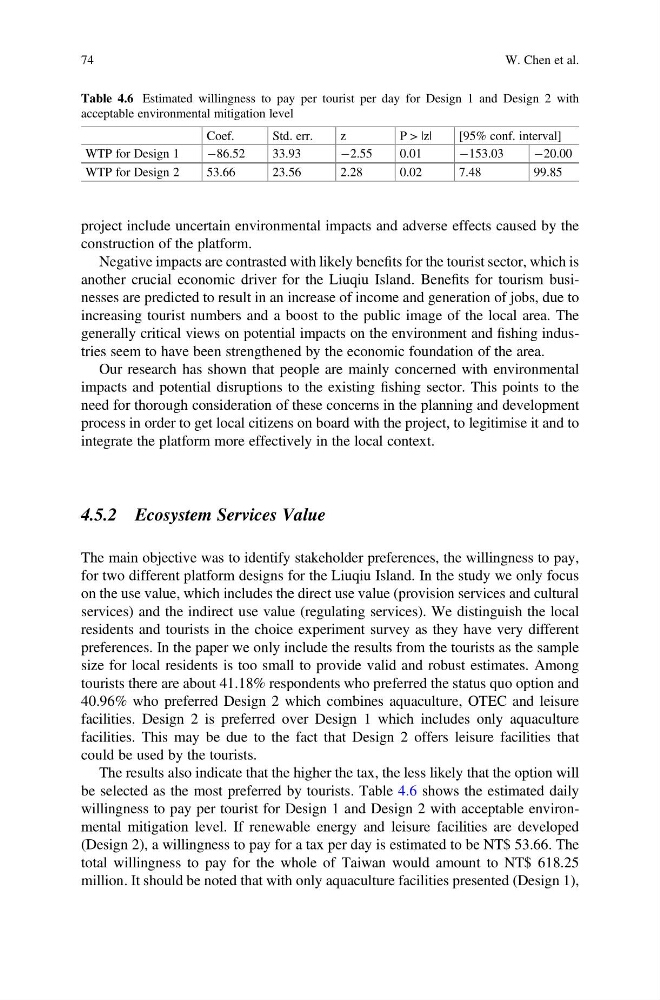
be selected as the most preferred by tourists. Table 4.6 shows the estimated daily
willingness to pay per tourist for Design 1 and Design 2 with acceptable environmental mitigation level. If renewable energy and leisure facilities are developed
(Design 2), a willingness to pay for a tax per day is estimated to be NT$ 53.66. The
total willingness to pay for the whole of Taiwan would amount to NT$ 618.25
million. It should be noted that with only aquaculture facilities presented (Design 1),
Table 4.6 Estimated willingness to pay per tourist per day for Design 1 and Design 2 with
acceptable environmental mitigation level
Coef.
Std. err.
z
P > |z|
[95% conf. interval]
WTP for Design 1
À86.52
33.93
À2.55
0.01
À153.03
À20.00
WTP for Design 2
53.66
23.56
2.28
0.02
7.48
99.85
74
W. Chen et al.
construction of the platform.
Negative impacts are contrasted with likely benefits for the tourist sector, which is
another crucial economic driver for the Liuqiu Island. Benefits for tourism businesses are predicted to result in an increase of income and generation of jobs, due to
increasing tourist numbers and a boost to the public image of the local area. The
generally critical views on potential impacts on the environment and fishing industries seem to have been strengthened by the economic foundation of the area.
Our research has shown that people are mainly concerned with environmental
impacts and potential disruptions to the existing fishing sector. This points to the
need for thorough consideration of these concerns in the planning and development
process in order to get local citizens on board with the project, to legitimise it and to
integrate the platform more effectively in the local context.
4.5.2 Ecosystem Services Value
The main objective was to identify stakeholder preferences, the willingness to pay,
for two different platform designs for the Liuqiu Island. In the study we only focus
on the use value, which includes the direct use value (provision services and cultural
services) and the indirect use value (regulating services). We distinguish the local
residents and tourists in the choice experiment survey as they have very different
preferences. In the paper we only include the results from the tourists as the sample
size for local residents is too small to provide valid and robust estimates. Among
tourists there are about 41.18% respondents who preferred the status quo option and
40.96% who preferred Design 2 which combines aquaculture, OTEC and leisure
facilities. Design 2 is preferred over Design 1 which includes only aquaculture
facilities. This may be due to the fact that Design 2 offers leisure facilities that
could be used by the tourists.
The results also indicate that the higher the tax, the less likely that the option will
be selected as the most preferred by tourists. Table 4.6 shows the estimated daily
willingness to pay per tourist for Design 1 and Design 2 with acceptable environmental mitigation level. If renewable energy and leisure facilities are developed
(Design 2), a willingness to pay for a tax per day is estimated to be NT$ 53.66. The
total willingness to pay for the whole of Taiwan would amount to NT$ 618.25
million. It should be noted that with only aquaculture facilities presented (Design 1),
Table 4.6 Estimated willingness to pay per tourist per day for Design 1 and Design 2 with
acceptable environmental mitigation level
Coef.
Std. err.
z
P > |z|
[95% conf. interval]
WTP for Design 1
À86.52
33.93
À2.55
0.01
À153.03
À20.00
WTP for Design 2
53.66
23.56
2.28
0.02
7.48
99.85
74
W. Chen et al.