

from the Transport, Energy, Aquaculture and Leisure sectors (named as TEAL
components). The platform aims to reduce land use pressure and make use of the
ocean space in a more sustainable manner (Quevedo et al. 2013). The concepts
represent a new way to develop the offshore, combining a range of uses, and with the
potential to address a range of sustainability related issues. The developed TROPOS
platform concepts are all composed of a central unit (CU); different modules, which
are integrated into the central unit; and satellite units connected via subsea cables.
The platforms are designed around the concept of ‘Green & Blue’, which means
combining the generation of clean energy with the use of biological ocean resources.
One Green & Blue platform scenario is set of off the Liuqiu Island, which is
located southwest of Taiwan’s main island. The area of the Liuqiu Island is about 6.8
square kilometres, and most of the islanders make their living by fishing. The island
has become one of the major tourist destinations and is an important income source
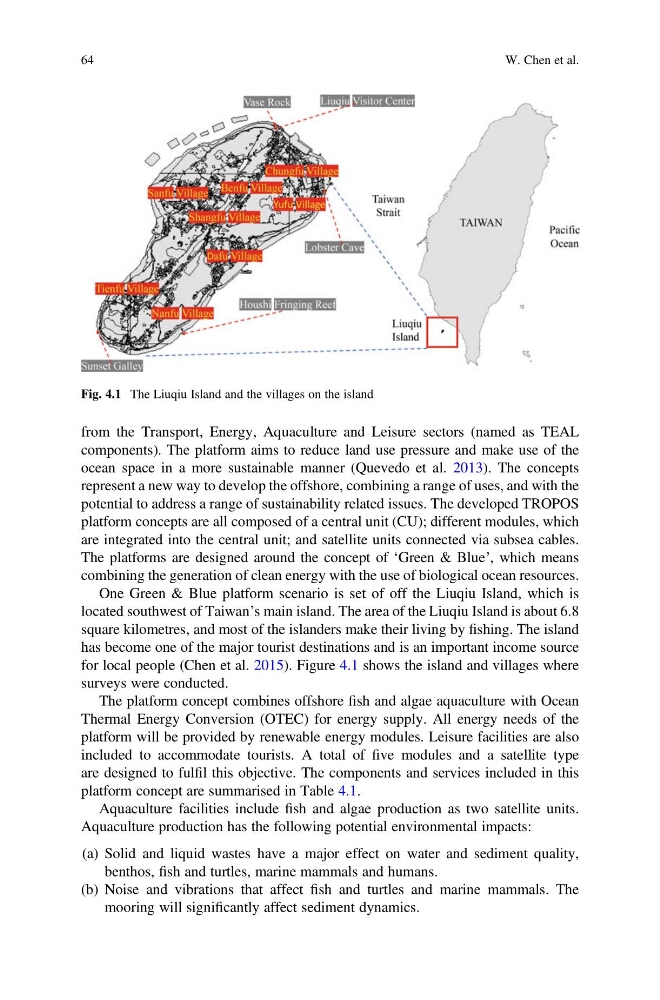
for local people (Chen et al. 2015). Figure 4.1 shows the island and villages where
surveys were conducted.
The platform concept combines offshore fish and algae aquaculture with Ocean
Thermal Energy Conversion (OTEC) for energy supply. All energy needs of the
platform will be provided by renewable energy modules. Leisure facilities are also
included to accommodate tourists. A total of five modules and a satellite type
are designed to fulfil this objective. The components and services included in this
platform concept are summarised in Table 4.1.
Aquaculture facilities include fish and algae production as two satellite units.
Aquaculture production has the following potential environmental impacts:
(a) Solid and liquid wastes have a major effect on water and sediment quality,
benthos, fish and turtles, marine mammals and humans.
(b) Noise and vibrations that affect fish and turtles and marine mammals. The
mooring will significantly affect sediment dynamics.
Fig. 4.1 The Liuqiu Island and the villages on the island
64
W. Chen et al.
components). The platform aims to reduce land use pressure and make use of the
ocean space in a more sustainable manner (Quevedo et al. 2013). The concepts
represent a new way to develop the offshore, combining a range of uses, and with the
potential to address a range of sustainability related issues. The developed TROPOS
platform concepts are all composed of a central unit (CU); different modules, which
are integrated into the central unit; and satellite units connected via subsea cables.
The platforms are designed around the concept of ‘Green & Blue’, which means
combining the generation of clean energy with the use of biological ocean resources.
One Green & Blue platform scenario is set of off the Liuqiu Island, which is
located southwest of Taiwan’s main island. The area of the Liuqiu Island is about 6.8
square kilometres, and most of the islanders make their living by fishing. The island
has become one of the major tourist destinations and is an important income source
for local people (Chen et al. 2015). Figure 4.1 shows the island and villages where
surveys were conducted.
The platform concept combines offshore fish and algae aquaculture with Ocean
Thermal Energy Conversion (OTEC) for energy supply. All energy needs of the
platform will be provided by renewable energy modules. Leisure facilities are also
included to accommodate tourists. A total of five modules and a satellite type
are designed to fulfil this objective. The components and services included in this
platform concept are summarised in Table 4.1.
Aquaculture facilities include fish and algae production as two satellite units.
Aquaculture production has the following potential environmental impacts:
(a) Solid and liquid wastes have a major effect on water and sediment quality,
benthos, fish and turtles, marine mammals and humans.
(b) Noise and vibrations that affect fish and turtles and marine mammals. The
mooring will significantly affect sediment dynamics.
Fig. 4.1 The Liuqiu Island and the villages on the island
64
W. Chen et al.