

in knowledge dissemination, blue growth and industrial and coastal development;
and 2 development agencies and 2 partners representing the business sector.
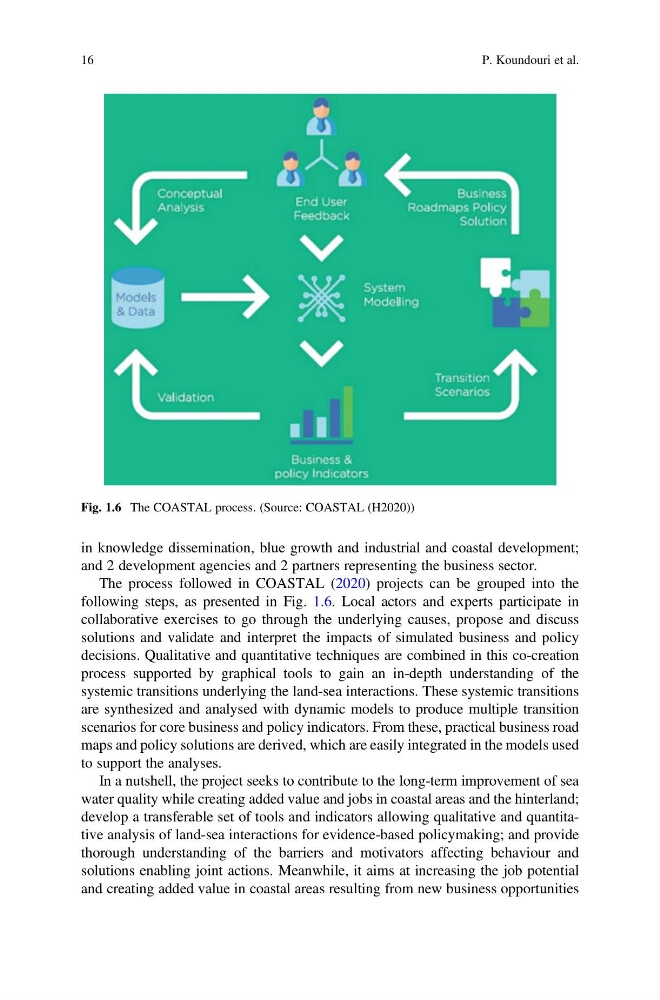
The process followed in COASTAL (2020) projects can be grouped into the
following steps, as presented in Fig. 1.6. Local actors and experts participate in
collaborative exercises to go through the underlying causes, propose and discuss
solutions and validate and interpret the impacts of simulated business and policy
decisions. Qualitative and quantitative techniques are combined in this co-creation
process supported by graphical tools to gain an in-depth understanding of the
systemic transitions underlying the land-sea interactions. These systemic transitions
are synthesized and analysed with dynamic models to produce multiple transition
scenarios for core business and policy indicators. From these, practical business road
maps and policy solutions are derived, which are easily integrated in the models used
to support the analyses.
In a nutshell, the project seeks to contribute to the long-term improvement of sea
water quality while creating added value and jobs in coastal areas and the hinterland;
develop a transferable set of tools and indicators allowing qualitative and quantitative analysis of land-sea interactions for evidence-based policymaking; and provide
thorough understanding of the barriers and motivators affecting behaviour and
solutions enabling joint actions. Meanwhile, it aims at increasing the job potential
and creating added value in coastal areas resulting from new business opportunities
Fig. 1.6 The COASTAL process. (Source: COASTAL (H2020))
16
P. Koundouri et al.
and 2 development agencies and 2 partners representing the business sector.
The process followed in COASTAL (2020) projects can be grouped into the
following steps, as presented in Fig. 1.6. Local actors and experts participate in
collaborative exercises to go through the underlying causes, propose and discuss
solutions and validate and interpret the impacts of simulated business and policy
decisions. Qualitative and quantitative techniques are combined in this co-creation
process supported by graphical tools to gain an in-depth understanding of the
systemic transitions underlying the land-sea interactions. These systemic transitions
are synthesized and analysed with dynamic models to produce multiple transition
scenarios for core business and policy indicators. From these, practical business road
maps and policy solutions are derived, which are easily integrated in the models used
to support the analyses.
In a nutshell, the project seeks to contribute to the long-term improvement of sea
water quality while creating added value and jobs in coastal areas and the hinterland;
develop a transferable set of tools and indicators allowing qualitative and quantitative analysis of land-sea interactions for evidence-based policymaking; and provide
thorough understanding of the barriers and motivators affecting behaviour and
solutions enabling joint actions. Meanwhile, it aims at increasing the job potential
and creating added value in coastal areas resulting from new business opportunities
Fig. 1.6 The COASTAL process. (Source: COASTAL (H2020))
16
P. Koundouri et al.