

introduction to these projects by first reviewing the goals, partners, methodology and
objectives of each of the projects.
Keywords Marine ecosystems · Maritime activities · Sustainable oceans · Deep
Demonstration · Multi-use offshore platforms · Marine protected areas
1.1 Introduction
Seas and oceans affect our daily lives, providing an essential part of our wealth and
well-being. They not only are a critical source of food, energy and resources but also
provide the majority of Europe’s trade routes. Ocean supplies fresh water (most rain
comes from the ocean) and nearly all Earth’s oxygen and moderates the Earth’s
climate, influences our weather and affects human health. It provides foods, medicines and mineral and energy resources. Moreover, it supports jobs and national
economies, serves as a highway for the transportation of goods and people and plays
a role in national security. A big part of the world’s population lives in coastal areas,
which are susceptible to natural hazards (tsunamis, hurricanes, cyclones, sea-level
change, and storm surges) (Costanza et al. 1999).
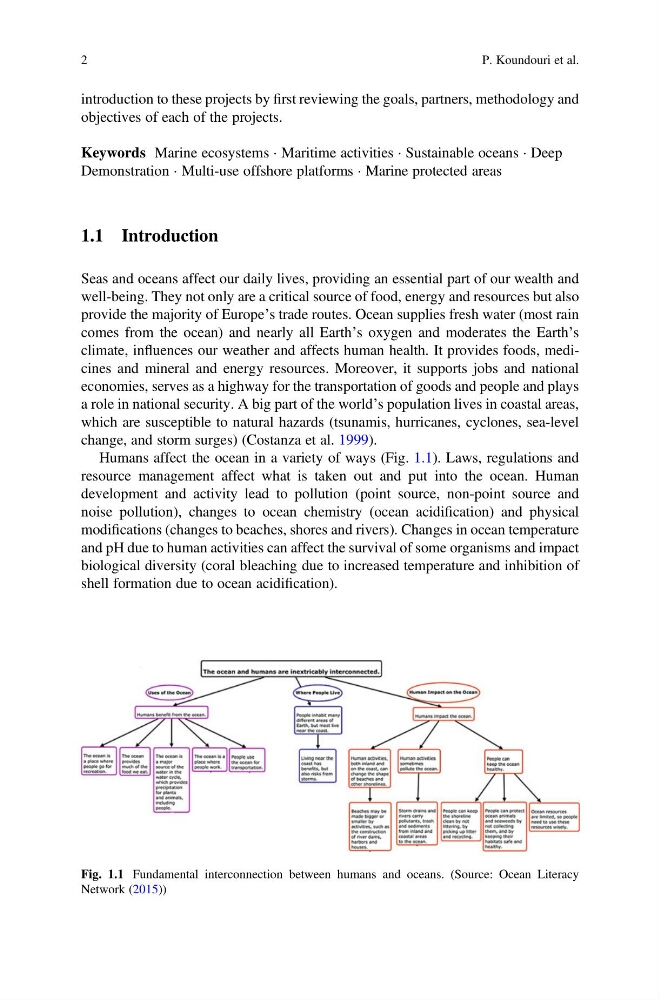
Humans affect the ocean in a variety of ways (Fig. 1.1). Laws, regulations and
resource management affect what is taken out and put into the ocean. Human
development and activity lead to pollution (point source, non-point source and
noise pollution), changes to ocean chemistry (ocean acidification) and physical
modifications (changes to beaches, shores and rivers). Changes in ocean temperature
and pH due to human activities can affect the survival of some organisms and impact
biological diversity (coral bleaching due to increased temperature and inhibition of
shell formation due to ocean acidification).
Fig. 1.1 Fundamental interconnection between humans and oceans. (Source: Ocean Literacy
Network (2015))
2
P. Koundouri et al.
objectives of each of the projects.
Keywords Marine ecosystems · Maritime activities · Sustainable oceans · Deep
Demonstration · Multi-use offshore platforms · Marine protected areas
1.1 Introduction
Seas and oceans affect our daily lives, providing an essential part of our wealth and
well-being. They not only are a critical source of food, energy and resources but also
provide the majority of Europe’s trade routes. Ocean supplies fresh water (most rain
comes from the ocean) and nearly all Earth’s oxygen and moderates the Earth’s
climate, influences our weather and affects human health. It provides foods, medicines and mineral and energy resources. Moreover, it supports jobs and national
economies, serves as a highway for the transportation of goods and people and plays
a role in national security. A big part of the world’s population lives in coastal areas,
which are susceptible to natural hazards (tsunamis, hurricanes, cyclones, sea-level
change, and storm surges) (Costanza et al. 1999).
Humans affect the ocean in a variety of ways (Fig. 1.1). Laws, regulations and
resource management affect what is taken out and put into the ocean. Human
development and activity lead to pollution (point source, non-point source and
noise pollution), changes to ocean chemistry (ocean acidification) and physical
modifications (changes to beaches, shores and rivers). Changes in ocean temperature
and pH due to human activities can affect the survival of some organisms and impact
biological diversity (coral bleaching due to increased temperature and inhibition of
shell formation due to ocean acidification).
Fig. 1.1 Fundamental interconnection between humans and oceans. (Source: Ocean Literacy
Network (2015))
2
P. Koundouri et al.