

European standardisation activities and recording domestic needs for models to
help select standards of Greek interest (July 27, 2017).
(f) An inter-ministerial group for the prevention of food waste and the creation
of waste from food residues (September 27, 2017).
(g) A partnership on circular economy (EU Urban Agenda), with the participation
of six major urban centres (Oslo, The Hague, Prato, Porto, Kaunas and Flanders), four states (Finland, Poland, Slovenia, Greece), the European Commission
(DG REGIO, ENV, CLIMA, RTD, GROW, etc.) and some organisations
(CEMR, EUROCITIES, URBACT and EIB); the aim is the policies of circular
economy in urban centres. The Greek working team includes participants from
the Ministries of Environment and Energy, Shipping and Insular Policy, Tourism
and the General Secretariat for Industry, under the coordination of the Ministry
of Economy and Development (Special Service for Strategy, Planning and
Evaluation – EYSSA).
The major sources of funding include the relevant Sectoral and Regional Operational Programmes, the Green Fund and the EU competitive programmes.
The relevant Sectoral Operational Programmes are grouped in two categories,
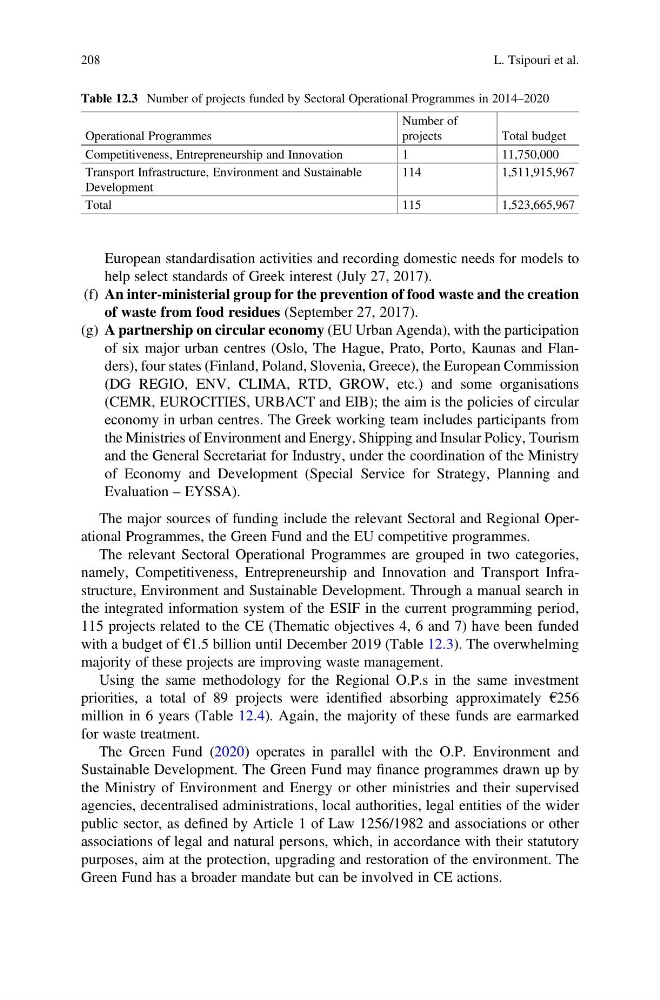
namely, Competitiveness, Entrepreneurship and Innovation and Transport Infrastructure, Environment and Sustainable Development. Through a manual search in
the integrated information system of the ESIF in the current programming period,
115 projects related to the CE (Thematic objectives 4, 6 and 7) have been funded
with a budget of €1.5 billion until December 2019 (Table 12.3). The overwhelming
majority of these projects are improving waste management.
Using the same methodology for the Regional O.P.s in the same investment
priorities, a total of 89 projects were identified absorbing approximately €256
million in 6 years (Table 12.4). Again, the majority of these funds are earmarked
for waste treatment.
The Green Fund (2020) operates in parallel with the O.P. Environment and
Sustainable Development. The Green Fund may finance programmes drawn up by
the Ministry of Environment and Energy or other ministries and their supervised
agencies, decentralised administrations, local authorities, legal entities of the wider
public sector, as defined by Article 1 of Law 1256/1982 and associations or other
associations of legal and natural persons, which, in accordance with their statutory
purposes, aim at the protection, upgrading and restoration of the environment. The
Green Fund has a broader mandate but can be involved in CE actions.
Table 12.3 Number of projects funded by Sectoral Operational Programmes in 2014–2020
Operational Programmes
Number of
projects
Total budget
Competitiveness, Entrepreneurship and Innovation
1
11,750,000
Transport Infrastructure, Environment and Sustainable
Development
114
1,511,915,967
Total
115
1,523,665,967
208
L. Tsipouri et al.
help select standards of Greek interest (July 27, 2017).
(f) An inter-ministerial group for the prevention of food waste and the creation
of waste from food residues (September 27, 2017).
(g) A partnership on circular economy (EU Urban Agenda), with the participation
of six major urban centres (Oslo, The Hague, Prato, Porto, Kaunas and Flanders), four states (Finland, Poland, Slovenia, Greece), the European Commission
(DG REGIO, ENV, CLIMA, RTD, GROW, etc.) and some organisations
(CEMR, EUROCITIES, URBACT and EIB); the aim is the policies of circular
economy in urban centres. The Greek working team includes participants from
the Ministries of Environment and Energy, Shipping and Insular Policy, Tourism
and the General Secretariat for Industry, under the coordination of the Ministry
of Economy and Development (Special Service for Strategy, Planning and
Evaluation – EYSSA).
The major sources of funding include the relevant Sectoral and Regional Operational Programmes, the Green Fund and the EU competitive programmes.
The relevant Sectoral Operational Programmes are grouped in two categories,
namely, Competitiveness, Entrepreneurship and Innovation and Transport Infrastructure, Environment and Sustainable Development. Through a manual search in
the integrated information system of the ESIF in the current programming period,
115 projects related to the CE (Thematic objectives 4, 6 and 7) have been funded
with a budget of €1.5 billion until December 2019 (Table 12.3). The overwhelming
majority of these projects are improving waste management.
Using the same methodology for the Regional O.P.s in the same investment
priorities, a total of 89 projects were identified absorbing approximately €256
million in 6 years (Table 12.4). Again, the majority of these funds are earmarked
for waste treatment.
The Green Fund (2020) operates in parallel with the O.P. Environment and
Sustainable Development. The Green Fund may finance programmes drawn up by
the Ministry of Environment and Energy or other ministries and their supervised
agencies, decentralised administrations, local authorities, legal entities of the wider
public sector, as defined by Article 1 of Law 1256/1982 and associations or other
associations of legal and natural persons, which, in accordance with their statutory
purposes, aim at the protection, upgrading and restoration of the environment. The
Green Fund has a broader mandate but can be involved in CE actions.
Table 12.3 Number of projects funded by Sectoral Operational Programmes in 2014–2020
Operational Programmes
Number of
projects
Total budget
Competitiveness, Entrepreneurship and Innovation
1
11,750,000
Transport Infrastructure, Environment and Sustainable
Development
114
1,511,915,967
Total
115
1,523,665,967
208
L. Tsipouri et al.