

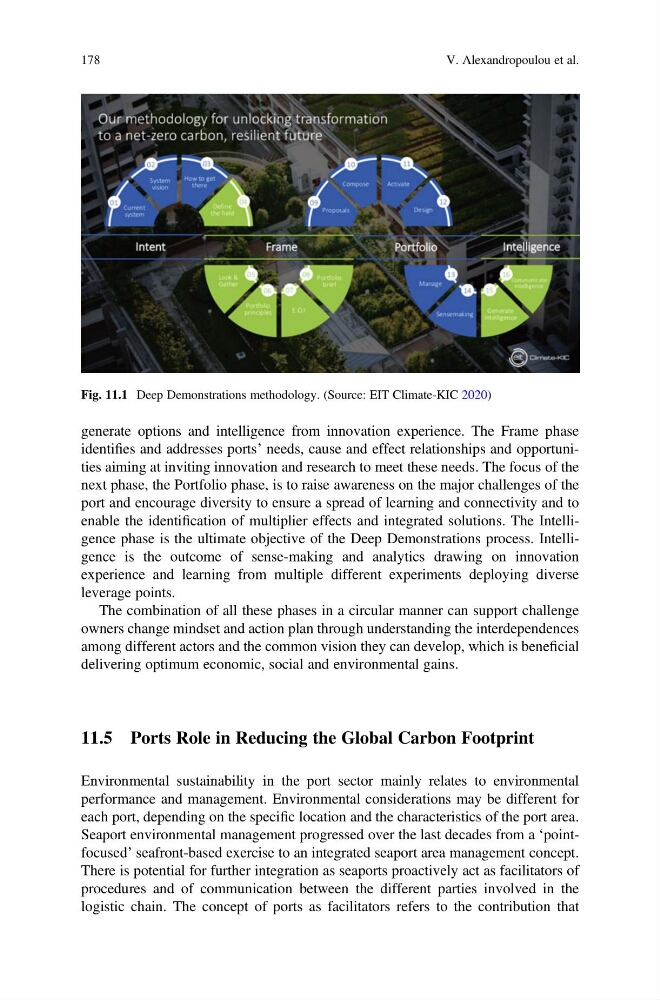
generate options and intelligence from innovation experience. The Frame phase
identifies and addresses ports’ needs, cause and effect relationships and opportunities aiming at inviting innovation and research to meet these needs. The focus of the
next phase, the Portfolio phase, is to raise awareness on the major challenges of the
port and encourage diversity to ensure a spread of learning and connectivity and to
enable the identification of multiplier effects and integrated solutions. The Intelligence phase is the ultimate objective of the Deep Demonstrations process. Intelligence is the outcome of sense-making and analytics drawing on innovation
experience and learning from multiple different experiments deploying diverse
leverage points.
The combination of all these phases in a circular manner can support challenge
owners change mindset and action plan through understanding the interdependences
among different actors and the common vision they can develop, which is beneficial
delivering optimum economic, social and environmental gains.
11.5 Ports Role in Reducing the Global Carbon Footprint
Environmental sustainability in the port sector mainly relates to environmental
performance and management. Environmental considerations may be different for
each port, depending on the specific location and the characteristics of the port area.
Seaport environmental management progressed over the last decades from a ‘pointfocused’ seafront-based exercise to an integrated seaport area management concept.
There is potential for further integration as seaports proactively act as facilitators of
procedures and of communication between the different parties involved in the
logistic chain. The concept of ports as facilitators refers to the contribution that
Fig. 11.1 Deep Demonstrations methodology. (Source: EIT Climate-KIC 2020)
178
V. Alexandropoulou et al.
identifies and addresses ports’ needs, cause and effect relationships and opportunities aiming at inviting innovation and research to meet these needs. The focus of the
next phase, the Portfolio phase, is to raise awareness on the major challenges of the
port and encourage diversity to ensure a spread of learning and connectivity and to
enable the identification of multiplier effects and integrated solutions. The Intelligence phase is the ultimate objective of the Deep Demonstrations process. Intelligence is the outcome of sense-making and analytics drawing on innovation
experience and learning from multiple different experiments deploying diverse
leverage points.
The combination of all these phases in a circular manner can support challenge
owners change mindset and action plan through understanding the interdependences
among different actors and the common vision they can develop, which is beneficial
delivering optimum economic, social and environmental gains.
11.5 Ports Role in Reducing the Global Carbon Footprint
Environmental sustainability in the port sector mainly relates to environmental
performance and management. Environmental considerations may be different for
each port, depending on the specific location and the characteristics of the port area.
Seaport environmental management progressed over the last decades from a ‘pointfocused’ seafront-based exercise to an integrated seaport area management concept.
There is potential for further integration as seaports proactively act as facilitators of
procedures and of communication between the different parties involved in the
logistic chain. The concept of ports as facilitators refers to the contribution that
Fig. 11.1 Deep Demonstrations methodology. (Source: EIT Climate-KIC 2020)
178
V. Alexandropoulou et al.