

effects on the marine ecosystems, as well as the existence of European Directives on
plastics. Fishermen specifically seem to know about the marine litter problem, but
they ignore the impacts on their professional and personal life, especially about the
microplastics and how they end up in the food chain. Another outcome of the study
was that besides the environmental responsibility being perceived as significant by
the majority of tourists, their WTP for environment-friendly services was comparatively lower to their WTP for a renting better facility. However, when the cost factor
was removed from the decision-making choice, the respondents were willing to
adapt their needs. Lastly, elderly people are observed to be less supportive of the
environmental cause, despite identifying the importance of having good environmental status.
Finally, the project produced a 10-year roadmap identifying the actions that are
needed to be taken by policymakers, the private sector and the society in the future in
different time spots to tackle the plastics issue. Top priorities appear to be education
and private initiatives in combination with regulation and policy implementation
(e.g. circular economy strategy). Education is key to comprehend the damages of
plastic and how it affects public health, while the awareness raise could bridge the
knowledge gap of adults, who have completed their secondary education. The
private sector can be a pioneer in driving change by implementing circular economy
models and creating opportunities supported by complementary laws and strategies.
Annexures
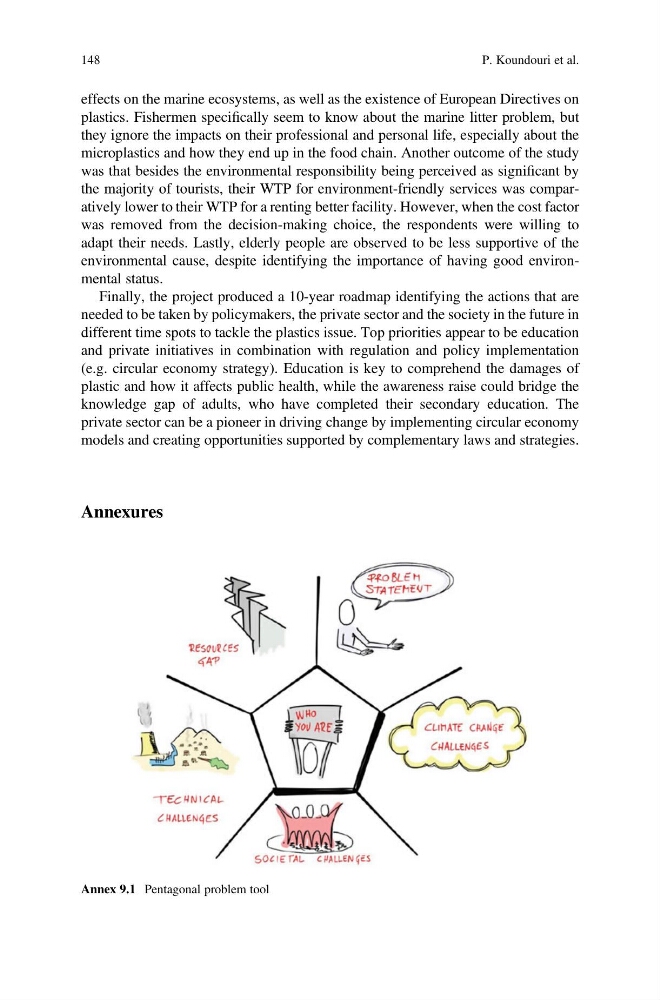
Annex 9.1 Pentagonal problem tool
148
P. Koundouri et al.
plastics. Fishermen specifically seem to know about the marine litter problem, but
they ignore the impacts on their professional and personal life, especially about the
microplastics and how they end up in the food chain. Another outcome of the study
was that besides the environmental responsibility being perceived as significant by
the majority of tourists, their WTP for environment-friendly services was comparatively lower to their WTP for a renting better facility. However, when the cost factor
was removed from the decision-making choice, the respondents were willing to
adapt their needs. Lastly, elderly people are observed to be less supportive of the
environmental cause, despite identifying the importance of having good environmental status.
Finally, the project produced a 10-year roadmap identifying the actions that are
needed to be taken by policymakers, the private sector and the society in the future in
different time spots to tackle the plastics issue. Top priorities appear to be education
and private initiatives in combination with regulation and policy implementation
(e.g. circular economy strategy). Education is key to comprehend the damages of
plastic and how it affects public health, while the awareness raise could bridge the
knowledge gap of adults, who have completed their secondary education. The
private sector can be a pioneer in driving change by implementing circular economy
models and creating opportunities supported by complementary laws and strategies.
Annexures
Annex 9.1 Pentagonal problem tool
148
P. Koundouri et al.