

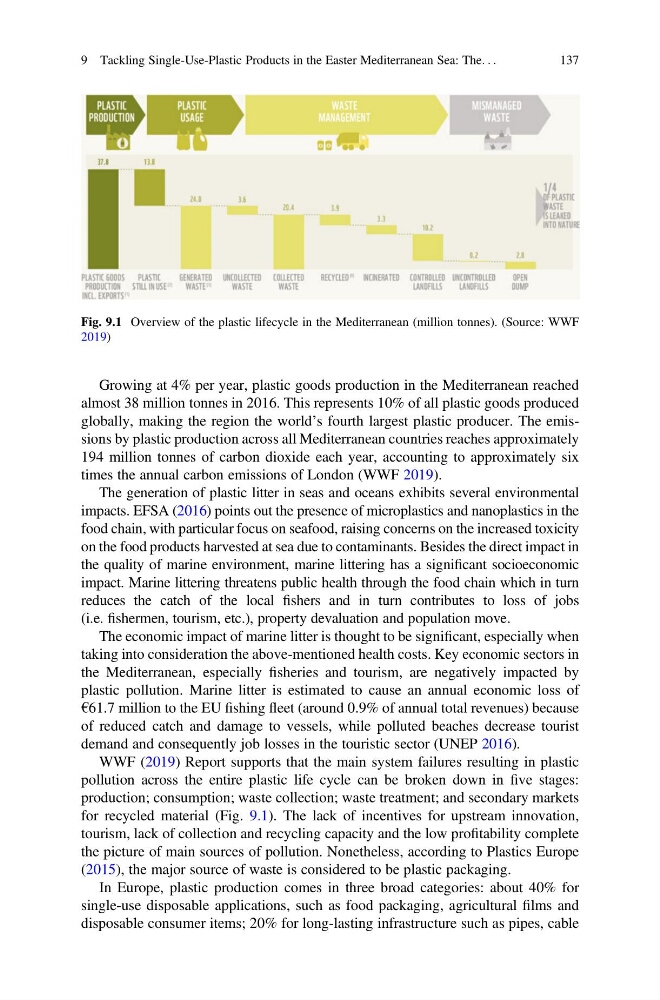
Growing at 4% per year, plastic goods production in the Mediterranean reached
almost 38 million tonnes in 2016. This represents 10% of all plastic goods produced
globally, making the region the world’s fourth largest plastic producer. The emissions by plastic production across all Mediterranean countries reaches approximately
194 million tonnes of carbon dioxide each year, accounting to approximately six
times the annual carbon emissions of London (WWF 2019).
The generation of plastic litter in seas and oceans exhibits several environmental
impacts. EFSA (2016) points out the presence of microplastics and nanoplastics in the
food chain, with particular focus on seafood, raising concerns on the increased toxicity
on the food products harvested at sea due to contaminants. Besides the direct impact in
the quality of marine environment, marine littering has a significant socioeconomic
impact. Marine littering threatens public health through the food chain which in turn
reduces the catch of the local fishers and in turn contributes to loss of jobs
(i.e. fishermen, tourism, etc.), property devaluation and population move.
The economic impact of marine litter is thought to be significant, especially when
taking into consideration the above-mentioned health costs. Key economic sectors in
the Mediterranean, especially fisheries and tourism, are negatively impacted by
plastic pollution. Marine litter is estimated to cause an annual economic loss of
€61.7 million to the EU fishing fleet (around 0.9% of annual total revenues) because
of reduced catch and damage to vessels, while polluted beaches decrease tourist
demand and consequently job losses in the touristic sector (UNEP 2016).
WWF (2019) Report supports that the main system failures resulting in plastic
pollution across the entire plastic life cycle can be broken down in five stages:
production; consumption; waste collection; waste treatment; and secondary markets
for recycled material (Fig. 9.1). The lack of incentives for upstream innovation,
tourism, lack of collection and recycling capacity and the low profitability complete
the picture of main sources of pollution. Nonetheless, according to Plastics Europe
(2015), the major source of waste is considered to be plastic packaging.
In Europe, plastic production comes in three broad categories: about 40% for
single-use disposable applications, such as food packaging, agricultural films and
disposable consumer items; 20% for long-lasting infrastructure such as pipes, cable
Fig. 9.1 Overview of the plastic lifecycle in the Mediterranean (million tonnes). (Source: WWF
2019)
9 Tackling Single-Use-Plastic Products in the Easter Mediterranean Sea: The. . .
137
almost 38 million tonnes in 2016. This represents 10% of all plastic goods produced
globally, making the region the world’s fourth largest plastic producer. The emissions by plastic production across all Mediterranean countries reaches approximately
194 million tonnes of carbon dioxide each year, accounting to approximately six
times the annual carbon emissions of London (WWF 2019).
The generation of plastic litter in seas and oceans exhibits several environmental
impacts. EFSA (2016) points out the presence of microplastics and nanoplastics in the
food chain, with particular focus on seafood, raising concerns on the increased toxicity
on the food products harvested at sea due to contaminants. Besides the direct impact in
the quality of marine environment, marine littering has a significant socioeconomic
impact. Marine littering threatens public health through the food chain which in turn
reduces the catch of the local fishers and in turn contributes to loss of jobs
(i.e. fishermen, tourism, etc.), property devaluation and population move.
The economic impact of marine litter is thought to be significant, especially when
taking into consideration the above-mentioned health costs. Key economic sectors in
the Mediterranean, especially fisheries and tourism, are negatively impacted by
plastic pollution. Marine litter is estimated to cause an annual economic loss of
€61.7 million to the EU fishing fleet (around 0.9% of annual total revenues) because
of reduced catch and damage to vessels, while polluted beaches decrease tourist
demand and consequently job losses in the touristic sector (UNEP 2016).
WWF (2019) Report supports that the main system failures resulting in plastic
pollution across the entire plastic life cycle can be broken down in five stages:
production; consumption; waste collection; waste treatment; and secondary markets
for recycled material (Fig. 9.1). The lack of incentives for upstream innovation,
tourism, lack of collection and recycling capacity and the low profitability complete
the picture of main sources of pollution. Nonetheless, according to Plastics Europe
(2015), the major source of waste is considered to be plastic packaging.
In Europe, plastic production comes in three broad categories: about 40% for
single-use disposable applications, such as food packaging, agricultural films and
disposable consumer items; 20% for long-lasting infrastructure such as pipes, cable
Fig. 9.1 Overview of the plastic lifecycle in the Mediterranean (million tonnes). (Source: WWF
2019)
9 Tackling Single-Use-Plastic Products in the Easter Mediterranean Sea: The. . .
137