

well-being, mental and physical health, and equip people with a range of skills and
capabilities” (Fish et al. 2016). This framework allows for an assessment of CES
taking into consideration the extent and state of different spaces, the practices
(e.g. snorkeling, wildlife watching, diving) and the well-being benefits associated
with spaces and practices through capacities (e.g. knowledge and skills), identities
(e.g. cultural identities) and experiences (e.g. spiritual and aesthetic experiences).
For the above reasons, that framework can allow the consideration of multiple
cultural and natural features in the geographical area under consideration and thus
is also suitable in MPAs.
8.3 Monetary and Non-monetary Valuation Methods
An approach used for describing and capturing the benefits from the diverse ES is the
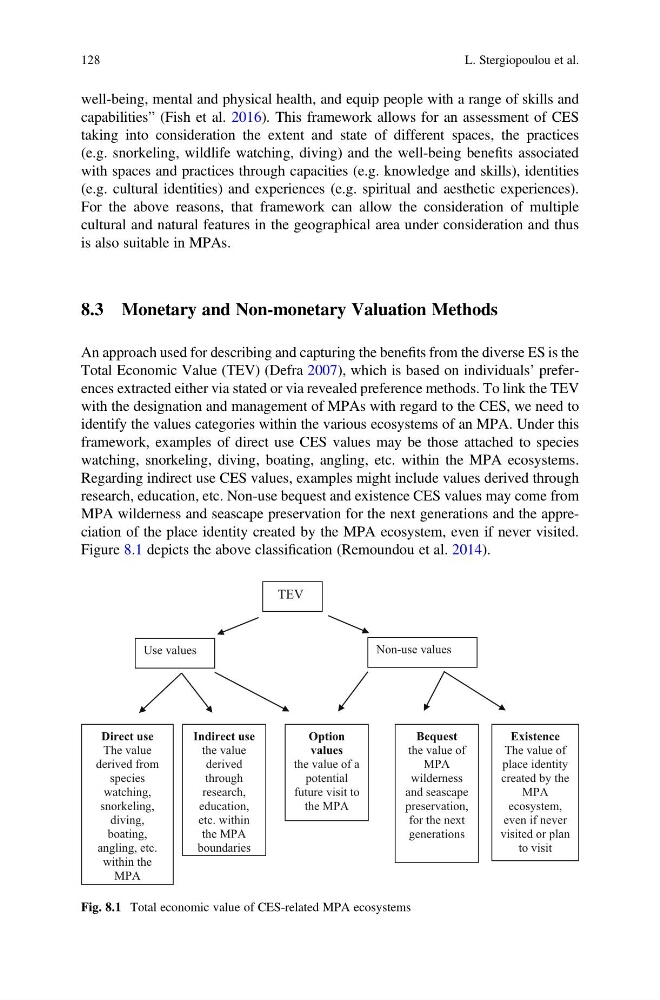
Total Economic Value (TEV) (Defra 2007), which is based on individuals’ preferences extracted either via stated or via revealed preference methods. To link the TEV
with the designation and management of MPAs with regard to the CES, we need to
identify the values categories within the various ecosystems of an MPA. Under this
framework, examples of direct use CES values may be those attached to species
watching, snorkeling, diving, boating, angling, etc. within the MPA ecosystems.
Regarding indirect use CES values, examples might include values derived through
research, education, etc. Non-use bequest and existence CES values may come from
MPA wilderness and seascape preservation for the next generations and the appreciation of the place identity created by the MPA ecosystem, even if never visited.
Figure 8.1 depicts the above classification (Remoundou et al. 2014).
Direct use
The value
derived from
species
watching,
snorkeling,
diving,
boating,
angling, etc.
within the
MPA
Indirect use
the value
derived
through
research,
education,
etc. within
the MPA
boundaries
Option
values
the value of a
potential
future visit to
the MPA
Bequest
the value of
MPA
wilderness
and seascape
preservation,
for the next
generations
Existence
The value of
place identity
created by the
MPA
ecosystem,
even if never
visited or plan
to visit
TEV
Use values
Non-use values
Fig. 8.1 Total economic value of CES-related MPA ecosystems
128
L. Stergiopoulou et al.
capabilities” (Fish et al. 2016). This framework allows for an assessment of CES
taking into consideration the extent and state of different spaces, the practices
(e.g. snorkeling, wildlife watching, diving) and the well-being benefits associated
with spaces and practices through capacities (e.g. knowledge and skills), identities
(e.g. cultural identities) and experiences (e.g. spiritual and aesthetic experiences).
For the above reasons, that framework can allow the consideration of multiple
cultural and natural features in the geographical area under consideration and thus
is also suitable in MPAs.
8.3 Monetary and Non-monetary Valuation Methods
An approach used for describing and capturing the benefits from the diverse ES is the
Total Economic Value (TEV) (Defra 2007), which is based on individuals’ preferences extracted either via stated or via revealed preference methods. To link the TEV
with the designation and management of MPAs with regard to the CES, we need to
identify the values categories within the various ecosystems of an MPA. Under this
framework, examples of direct use CES values may be those attached to species
watching, snorkeling, diving, boating, angling, etc. within the MPA ecosystems.
Regarding indirect use CES values, examples might include values derived through
research, education, etc. Non-use bequest and existence CES values may come from
MPA wilderness and seascape preservation for the next generations and the appreciation of the place identity created by the MPA ecosystem, even if never visited.
Figure 8.1 depicts the above classification (Remoundou et al. 2014).
Direct use
The value
derived from
species
watching,
snorkeling,
diving,
boating,
angling, etc.
within the
MPA
Indirect use
the value
derived
through
research,
education,
etc. within
the MPA
boundaries
Option
values
the value of a
potential
future visit to
the MPA
Bequest
the value of
MPA
wilderness
and seascape
preservation,
for the next
generations
Existence
The value of
place identity
created by the
MPA
ecosystem,
even if never
visited or plan
to visit
TEV
Use values
Non-use values
Fig. 8.1 Total economic value of CES-related MPA ecosystems
128
L. Stergiopoulou et al.