

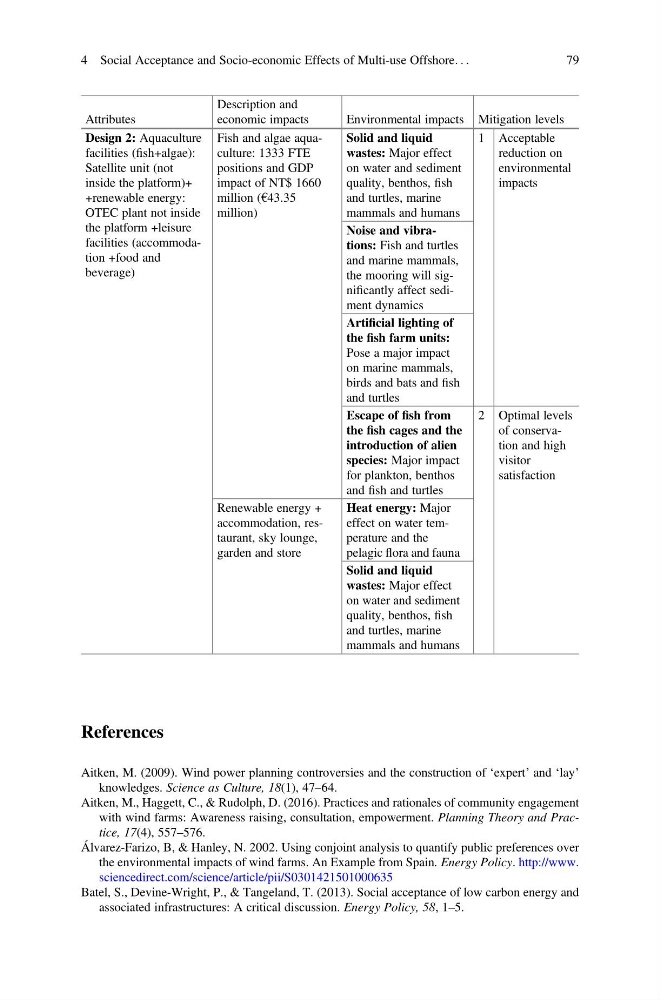
Attributes
Description and
economic impacts
Environmental impacts Mitigation levels
Design 2: Aquaculture
facilities (fish+algae):
Satellite unit (not
inside the platform)+
+renewable energy:
OTEC plant not inside
the platform +leisure
facilities (accommodation +food and
beverage)
Fish and algae aquaculture: 1333 FTE
positions and GDP
impact of NT$ 1660
million (€43.35
million)
Solid and liquid
wastes: Major effect
on water and sediment
quality, benthos, fish
and turtles, marine
mammals and humans
1 Acceptable
reduction on
environmental
impacts
Noise and vibrations: Fish and turtles
and marine mammals,
the mooring will significantly affect sediment dynamics
Artificial lighting of
the fish farm units:
Pose a major impact
on marine mammals,
birds and bats and fish
and turtles
Escape of fish from
the fish cages and the
introduction of alien
species: Major impact
for plankton, benthos
and fish and turtles
2 Optimal levels
of conservation and high
visitor
satisfaction
Renewable energy +
accommodation, restaurant, sky lounge,
garden and store
Heat energy: Major
effect on water temperature and the
pelagic flora and fauna
Solid and liquid
wastes: Major effect
on water and sediment
quality, benthos, fish
and turtles, marine
mammals and humans
References
Aitken, M. (2009). Wind power planning controversies and the construction of ‘expert’ and ‘lay’
knowledges. Science as Culture, 18(1), 47–64.
Aitken, M., Haggett, C., & Rudolph, D. (2016). Practices and rationales of community engagement
with wind farms: Awareness raising, consultation, empowerment. Planning Theory and Practice, 17(4), 557–576.
Álvarez-Farizo, B, & Hanley, N. 2002. Using conjoint analysis to quantify public preferences over
the environmental impacts of wind farms. An Example from Spain. Energy Policy. http://www.
sciencedirect.com/science/article/pii/S0301421501000635
Batel, S., Devine-Wright, P., & Tangeland, T. (2013). Social acceptance of low carbon energy and
associated infrastructures: A critical discussion. Energy Policy, 58, 1–5.
4 Social Acceptance and Socio-economic Effects of Multi-use Offshore. . .
79
Description and
economic impacts
Environmental impacts Mitigation levels
Design 2: Aquaculture
facilities (fish+algae):
Satellite unit (not
inside the platform)+
+renewable energy:
OTEC plant not inside
the platform +leisure
facilities (accommodation +food and
beverage)
Fish and algae aquaculture: 1333 FTE
positions and GDP
impact of NT$ 1660
million (€43.35
million)
Solid and liquid
wastes: Major effect
on water and sediment
quality, benthos, fish
and turtles, marine
mammals and humans
1 Acceptable
reduction on
environmental
impacts
Noise and vibrations: Fish and turtles
and marine mammals,
the mooring will significantly affect sediment dynamics
Artificial lighting of
the fish farm units:
Pose a major impact
on marine mammals,
birds and bats and fish
and turtles
Escape of fish from
the fish cages and the
introduction of alien
species: Major impact
for plankton, benthos
and fish and turtles
2 Optimal levels
of conservation and high
visitor
satisfaction
Renewable energy +
accommodation, restaurant, sky lounge,
garden and store
Heat energy: Major
effect on water temperature and the
pelagic flora and fauna
Solid and liquid
wastes: Major effect
on water and sediment
quality, benthos, fish
and turtles, marine
mammals and humans
References
Aitken, M. (2009). Wind power planning controversies and the construction of ‘expert’ and ‘lay’
knowledges. Science as Culture, 18(1), 47–64.
Aitken, M., Haggett, C., & Rudolph, D. (2016). Practices and rationales of community engagement
with wind farms: Awareness raising, consultation, empowerment. Planning Theory and Practice, 17(4), 557–576.
Álvarez-Farizo, B, & Hanley, N. 2002. Using conjoint analysis to quantify public preferences over
the environmental impacts of wind farms. An Example from Spain. Energy Policy. http://www.
sciencedirect.com/science/article/pii/S0301421501000635
Batel, S., Devine-Wright, P., & Tangeland, T. (2013). Social acceptance of low carbon energy and
associated infrastructures: A critical discussion. Energy Policy, 58, 1–5.
4 Social Acceptance and Socio-economic Effects of Multi-use Offshore. . .
79