

Verhoeven, 2014). It provides a greater understanding of the
acceptance of technology and it is a widely used model in
the field of ICT acceptance (Rodrigues et al., 2016). Various
researchers acknowledged that UTAUT provides a better
understanding regarding an individual’s behavior toward
acceptance of innovation than other similar models and
theories (Baptista & Oliveira, 2015; Gilbert, Balestrini &
Littleboy, 2004; Schaper & Pervan, 2007; Venkatesh et al.,
2003; Wu, Hsu, & Hwang, 2007). The selection of using a
unified model was inspired by its excellent explanatory and
comprehensiveness power than other models of technology
acceptance (Kripanont, 2007; Tibenderana & Ogao, 2009;
Venkatesh et al., 2003). Various studies have validated
UTAUT in various environments (Lakhal, Khechine, &
Pascot, 2013), such as education, banking (AbuShanab,
Pearson, & Setterstrom, 2010; Tibenderana & Ogao, 2009;
Williams, 2009), organizations (Al-Gahtani, et al., 2007;
Bourbon, & Hollet-Haudebert, 2009; Eckhardt, Laumer, &
Weitzel, 2009), and tourism (San Martin, & Herrero, 2012).
It has become a prominent model and has been cited more
than 5000 times by Google Scholars (Rodrigues et al.,
2016). The results of empirical research by Venkatesh et al.
(2003) explained a greater percentage (70%) of the variance
of ‘intention to use’ and ‘usage behavior’ than any other
model (Al-Gahtani, Hubona & Wang, 2007; Rodrigues
et al., 2016). It has become a benchmark in IS acceptance
(Rodrigues et al., 2016). This indicates that this model is
comprehensive and offers an excellent framework for
explaining the usage and acceptance behaviors of new
technology such as LMS. However, there some limitations
associated with UTAUT. Comparing with other models such
as TAM or DOI, UTAUT is a comparatively new model and
requires further research study to validate its constructs,
replicate findings, and validate its strength (Straub, 2009).
Although UTAUT has been tested in various information
system (IS) research, there are still limitations (Negahban, &
Chung, 2014) and areas open for further research in technological areas (Baptista & Oliveira, 2015) that might fall
within the 30% unexplained adoption of this model (Baron,
Patterson, & Harris, 2006). In addition, this model does not
contain individual variables such as self-motivation, perceived playfulness that may help explain IS acceptance and
its usage.
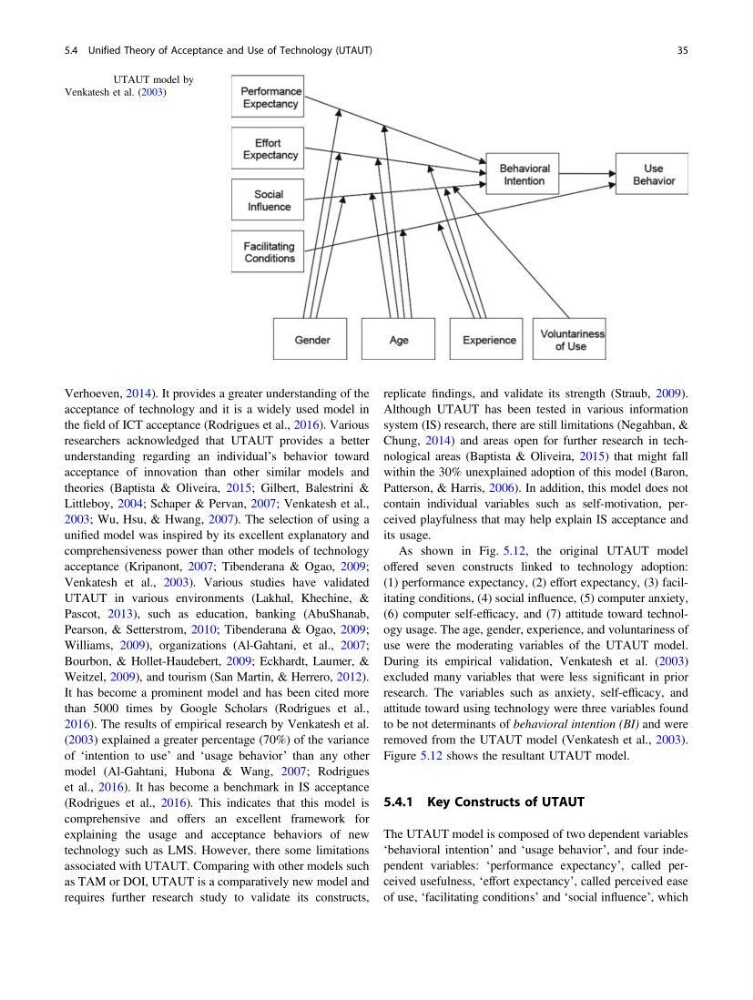
As shown in Fig. 5.12, the original UTAUT model
offered seven constructs linked to technology adoption:
(1) performance expectancy, (2) effort expectancy, (3) facilitating conditions, (4) social influence, (5) computer anxiety,
(6) computer self-efficacy, and (7) attitude toward technology usage. The age, gender, experience, and voluntariness of
use were the moderating variables of the UTAUT model.
During its empirical validation, Venkatesh et al. (2003)
excluded many variables that were less significant in prior
research. The variables such as anxiety, self-efficacy, and
attitude toward using technology were three variables found
to be not determinants of behavioral intention (BI) and were
removed from the UTAUT model (Venkatesh et al., 2003).
Figure 5.12 shows the resultant UTAUT model.
5.4.1 Key Constructs of UTAUT
The UTAUT model is composed of two dependent variables
‘behavioral intention’ and ‘usage behavior’, and four independent variables: ‘performance expectancy’, called perceived usefulness, ‘effort expectancy’, called perceived ease
of use, ‘facilitating conditions’ and ‘social influence’, which
Fig. 5.12 UTAUT model by
Venkatesh et al. (2003)
5.4 Unified Theory of Acceptance and Use of Technology (UTAUT)
35
acceptance of technology and it is a widely used model in
the field of ICT acceptance (Rodrigues et al., 2016). Various
researchers acknowledged that UTAUT provides a better
understanding regarding an individual’s behavior toward
acceptance of innovation than other similar models and
theories (Baptista & Oliveira, 2015; Gilbert, Balestrini &
Littleboy, 2004; Schaper & Pervan, 2007; Venkatesh et al.,
2003; Wu, Hsu, & Hwang, 2007). The selection of using a
unified model was inspired by its excellent explanatory and
comprehensiveness power than other models of technology
acceptance (Kripanont, 2007; Tibenderana & Ogao, 2009;
Venkatesh et al., 2003). Various studies have validated
UTAUT in various environments (Lakhal, Khechine, &
Pascot, 2013), such as education, banking (AbuShanab,
Pearson, & Setterstrom, 2010; Tibenderana & Ogao, 2009;
Williams, 2009), organizations (Al-Gahtani, et al., 2007;
Bourbon, & Hollet-Haudebert, 2009; Eckhardt, Laumer, &
Weitzel, 2009), and tourism (San Martin, & Herrero, 2012).
It has become a prominent model and has been cited more
than 5000 times by Google Scholars (Rodrigues et al.,
2016). The results of empirical research by Venkatesh et al.
(2003) explained a greater percentage (70%) of the variance
of ‘intention to use’ and ‘usage behavior’ than any other
model (Al-Gahtani, Hubona & Wang, 2007; Rodrigues
et al., 2016). It has become a benchmark in IS acceptance
(Rodrigues et al., 2016). This indicates that this model is
comprehensive and offers an excellent framework for
explaining the usage and acceptance behaviors of new
technology such as LMS. However, there some limitations
associated with UTAUT. Comparing with other models such
as TAM or DOI, UTAUT is a comparatively new model and
requires further research study to validate its constructs,
replicate findings, and validate its strength (Straub, 2009).
Although UTAUT has been tested in various information
system (IS) research, there are still limitations (Negahban, &
Chung, 2014) and areas open for further research in technological areas (Baptista & Oliveira, 2015) that might fall
within the 30% unexplained adoption of this model (Baron,
Patterson, & Harris, 2006). In addition, this model does not
contain individual variables such as self-motivation, perceived playfulness that may help explain IS acceptance and
its usage.
As shown in Fig. 5.12, the original UTAUT model
offered seven constructs linked to technology adoption:
(1) performance expectancy, (2) effort expectancy, (3) facilitating conditions, (4) social influence, (5) computer anxiety,
(6) computer self-efficacy, and (7) attitude toward technology usage. The age, gender, experience, and voluntariness of
use were the moderating variables of the UTAUT model.
During its empirical validation, Venkatesh et al. (2003)
excluded many variables that were less significant in prior
research. The variables such as anxiety, self-efficacy, and
attitude toward using technology were three variables found
to be not determinants of behavioral intention (BI) and were
removed from the UTAUT model (Venkatesh et al., 2003).
Figure 5.12 shows the resultant UTAUT model.
5.4.1 Key Constructs of UTAUT
The UTAUT model is composed of two dependent variables
‘behavioral intention’ and ‘usage behavior’, and four independent variables: ‘performance expectancy’, called perceived usefulness, ‘effort expectancy’, called perceived ease
of use, ‘facilitating conditions’ and ‘social influence’, which
Fig. 5.12 UTAUT model by
Venkatesh et al. (2003)
5.4 Unified Theory of Acceptance and Use of Technology (UTAUT)
35