

impact on ‘usage behavior’ (UB) (Alghamdi, 2016; Fishbein
& Ajzen, 1975; Venkatesh, Thong, & Xu, 2012; Venkatesh,
Morris, Davis, & Davis, 2003; Rodrigues, Sarabdeen &
Balasubramanian, 2016). In light of the literature, in this
research, the behavioral intention (BI) has been used as a
predictor of technology acceptance.
5.3 Technology Adoption Models
and Theories
In this section, a brief description of various technology
adoption theories and models considered for development of
UTAUT is given.
5.3.1 Theory of Reasoned Action (TRA)
This theory was proposed by Fishbein and Ajzen in (1975).
TRA is the most powerful theory (Marques, Villate & Carvalho, 2011) for predicting the behavior of users in a particular situation. TRA suggests that an important construct of
an individual’s genuine action is the intention to accomplish
that behavior; that is, a function of subjective norms and
attitudes toward behavior (Vatanparast, 2010). According to
this theory, the behavior of a person is directly influenced by
his willingness to adopt or not to adopt that specific behavior
(Marques et al., 2011). In TRA theory, the behavior of an
individual is measured by his ‘intention’ to perform a
specific task, while the behavioral intention is evaluated by
the ‘attitude toward behavior’ of that person and the
‘subjective norm’. In fact, TAM, UTAUT, and many other
theories of adoption are driven and heavily influenced by
TRA (Vatanparast, 2010). An “individual’s intention is a
function of two elementary factors, one personal attitude
about behavior and other social influences” (Ajzen &
Fishbein, 1980, p. 6). In other words, TRA contains three
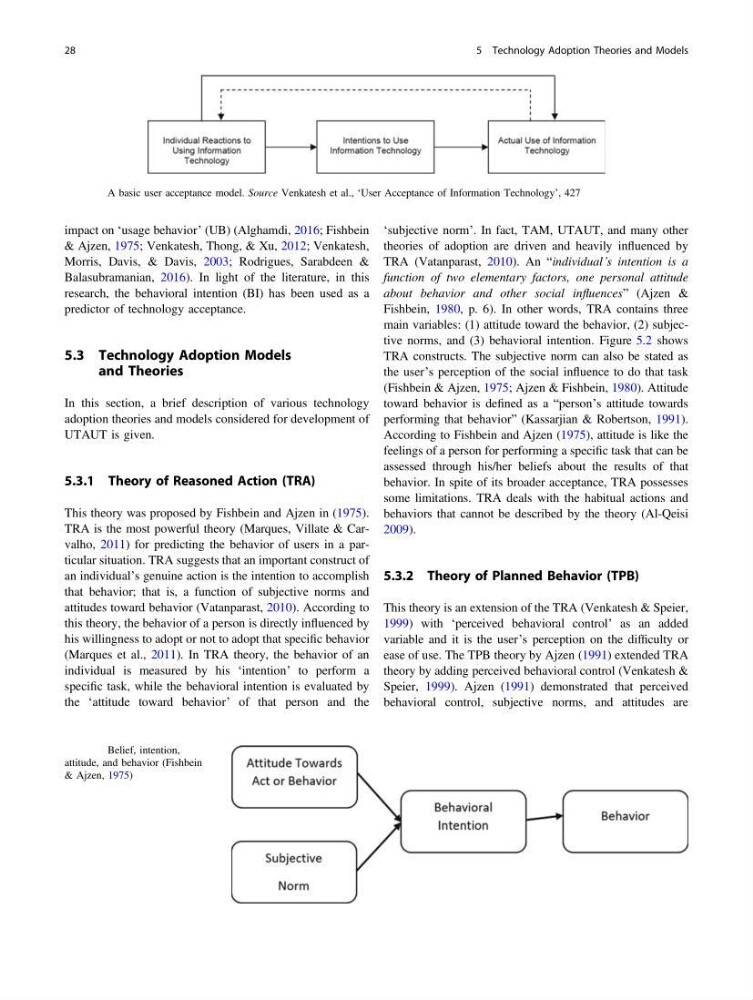
main variables: (1) attitude toward the behavior, (2) subjective norms, and (3) behavioral intention. Figure 5.2 shows
TRA constructs. The subjective norm can also be stated as
the user’s perception of the social influence to do that task
(Fishbein & Ajzen, 1975; Ajzen & Fishbein, 1980). Attitude
toward behavior is defined as a “person’s attitude towards
performing that behavior” (Kassarjian & Robertson, 1991).
According to Fishbein and Ajzen (1975), attitude is like the
feelings of a person for performing a specific task that can be
assessed through his/her beliefs about the results of that
behavior. In spite of its broader acceptance, TRA possesses
some limitations. TRA deals with the habitual actions and
behaviors that cannot be described by the theory (Al-Qeisi
2009).
5.3.2 Theory of Planned Behavior (TPB)
This theory is an extension of the TRA (Venkatesh & Speier,
1999) with ‘perceived behavioral control’ as an added
variable and it is the user’s perception on the difficulty or
ease of use. The TPB theory by Ajzen (1991) extended TRA
theory by adding perceived behavioral control (Venkatesh &
Speier, 1999). Ajzen (1991) demonstrated that perceived
behavioral control, subjective norms, and attitudes are
Fig. 5.1 A basic user acceptance model. Source Venkatesh et al., ‘User Acceptance of Information Technology’, 427
Fig. 5.2 Belief, intention,
attitude, and behavior (Fishbein
& Ajzen, 1975)
28
5 Technology Adoption Theories and Models
& Ajzen, 1975; Venkatesh, Thong, & Xu, 2012; Venkatesh,
Morris, Davis, & Davis, 2003; Rodrigues, Sarabdeen &
Balasubramanian, 2016). In light of the literature, in this
research, the behavioral intention (BI) has been used as a
predictor of technology acceptance.
5.3 Technology Adoption Models
and Theories
In this section, a brief description of various technology
adoption theories and models considered for development of
UTAUT is given.
5.3.1 Theory of Reasoned Action (TRA)
This theory was proposed by Fishbein and Ajzen in (1975).
TRA is the most powerful theory (Marques, Villate & Carvalho, 2011) for predicting the behavior of users in a particular situation. TRA suggests that an important construct of
an individual’s genuine action is the intention to accomplish
that behavior; that is, a function of subjective norms and
attitudes toward behavior (Vatanparast, 2010). According to
this theory, the behavior of a person is directly influenced by
his willingness to adopt or not to adopt that specific behavior
(Marques et al., 2011). In TRA theory, the behavior of an
individual is measured by his ‘intention’ to perform a
specific task, while the behavioral intention is evaluated by
the ‘attitude toward behavior’ of that person and the
‘subjective norm’. In fact, TAM, UTAUT, and many other
theories of adoption are driven and heavily influenced by
TRA (Vatanparast, 2010). An “individual’s intention is a
function of two elementary factors, one personal attitude
about behavior and other social influences” (Ajzen &
Fishbein, 1980, p. 6). In other words, TRA contains three
main variables: (1) attitude toward the behavior, (2) subjective norms, and (3) behavioral intention. Figure 5.2 shows
TRA constructs. The subjective norm can also be stated as
the user’s perception of the social influence to do that task
(Fishbein & Ajzen, 1975; Ajzen & Fishbein, 1980). Attitude
toward behavior is defined as a “person’s attitude towards
performing that behavior” (Kassarjian & Robertson, 1991).
According to Fishbein and Ajzen (1975), attitude is like the
feelings of a person for performing a specific task that can be
assessed through his/her beliefs about the results of that
behavior. In spite of its broader acceptance, TRA possesses
some limitations. TRA deals with the habitual actions and
behaviors that cannot be described by the theory (Al-Qeisi
2009).
5.3.2 Theory of Planned Behavior (TPB)
This theory is an extension of the TRA (Venkatesh & Speier,
1999) with ‘perceived behavioral control’ as an added
variable and it is the user’s perception on the difficulty or
ease of use. The TPB theory by Ajzen (1991) extended TRA
theory by adding perceived behavioral control (Venkatesh &
Speier, 1999). Ajzen (1991) demonstrated that perceived
behavioral control, subjective norms, and attitudes are
Fig. 5.1 A basic user acceptance model. Source Venkatesh et al., ‘User Acceptance of Information Technology’, 427
Fig. 5.2 Belief, intention,
attitude, and behavior (Fishbein
& Ajzen, 1975)
28
5 Technology Adoption Theories and Models