

47
4.3 hoW do envIronMental governanCe sCholars
CharaCterIse the Case?
The story of Berlin’s energy policy in the 1920s has been told only by the
author, and to date only from selective perspectives. These perspectives
have highlighted interest in balancing electricity load curves with demand
management measures (Moss 2014) and the rise and fall of alternative
energy technologies in the interwar years (Moss 2016).
The impact of political division on West Berlin’s energy infrastructures
and utilities was analysed initially by the political scientist Richard Merritt
in the 1960s, but not with respect to environmental issues (Merritt 1968).
The author of this chapter has explored how division nurtured a strategy
of spatial reorientation and self-dependence of energy provision around
the insular city (Moss 2009) that largely failed to entertain options for saving energy or using it more efficiently (Moss 2014).
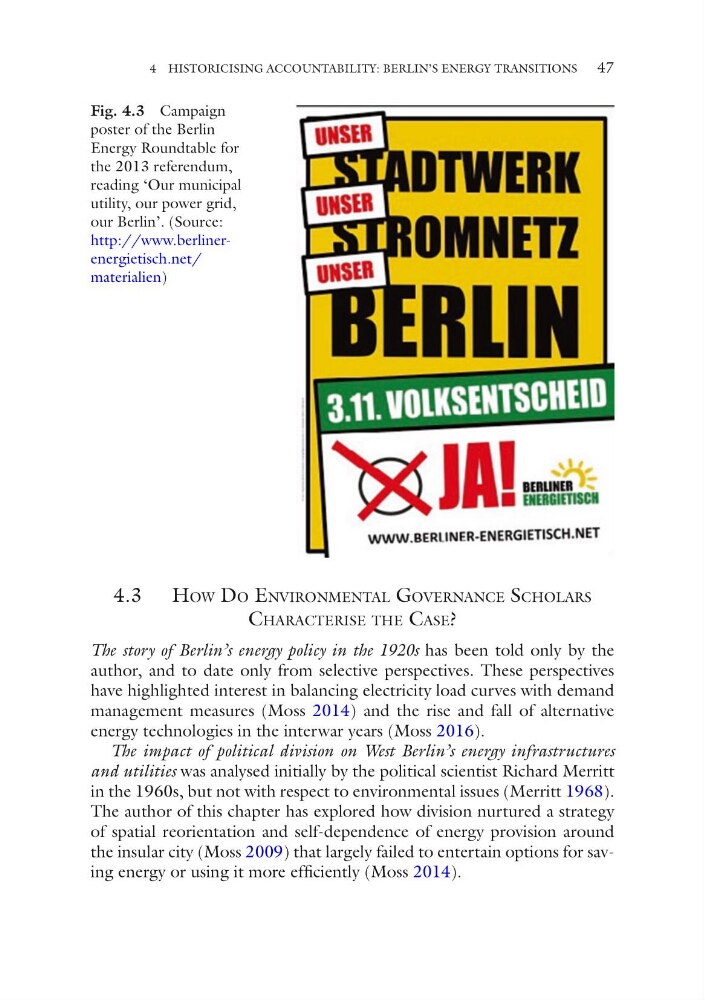
Fig. 4.3 Campaign
poster of the Berlin
Energy Roundtable for
the 2013 referendum,
reading ‘Our municipal
utility, our power grid,
our Berlin’. (Source:
http://www.berlinerenergietisch.net/
materialien)
4 HISTORICISING ACCOUNTABILITY: BERLIN’S ENERGY TRANSITIONS
4.3 hoW do envIronMental governanCe sCholars
CharaCterIse the Case?
The story of Berlin’s energy policy in the 1920s has been told only by the
author, and to date only from selective perspectives. These perspectives
have highlighted interest in balancing electricity load curves with demand
management measures (Moss 2014) and the rise and fall of alternative
energy technologies in the interwar years (Moss 2016).
The impact of political division on West Berlin’s energy infrastructures
and utilities was analysed initially by the political scientist Richard Merritt
in the 1960s, but not with respect to environmental issues (Merritt 1968).
The author of this chapter has explored how division nurtured a strategy
of spatial reorientation and self-dependence of energy provision around
the insular city (Moss 2009) that largely failed to entertain options for saving energy or using it more efficiently (Moss 2014).
Fig. 4.3 Campaign
poster of the Berlin
Energy Roundtable for
the 2013 referendum,
reading ‘Our municipal
utility, our power grid,
our Berlin’. (Source:
http://www.berlinerenergietisch.net/
materialien)
4 HISTORICISING ACCOUNTABILITY: BERLIN’S ENERGY TRANSITIONS