

45
damental assumptions on which the call for increased capacity was based.
The issue came to a head in 1976–1977 over a decision by the city government and its power utility to build a new 600-Mega Watt power plant in
the middle of one of the city’s remaining forests. Massive protests and
prolonged court cases resulted in the planned power plant being stopped,
but not before it had been revealed to the public how both Bewag and the
city government were prepared to ride roughshod over legal constraints
and societal norms in order to achieve their common goal. Bewag’s public
image never really recovered from the damage this affront to public
accountability caused amongst the population (Mielke and Weiß 1977).
The case of the rejected power plant became a milestone of energy governance in Germany (Fig. 4.2).
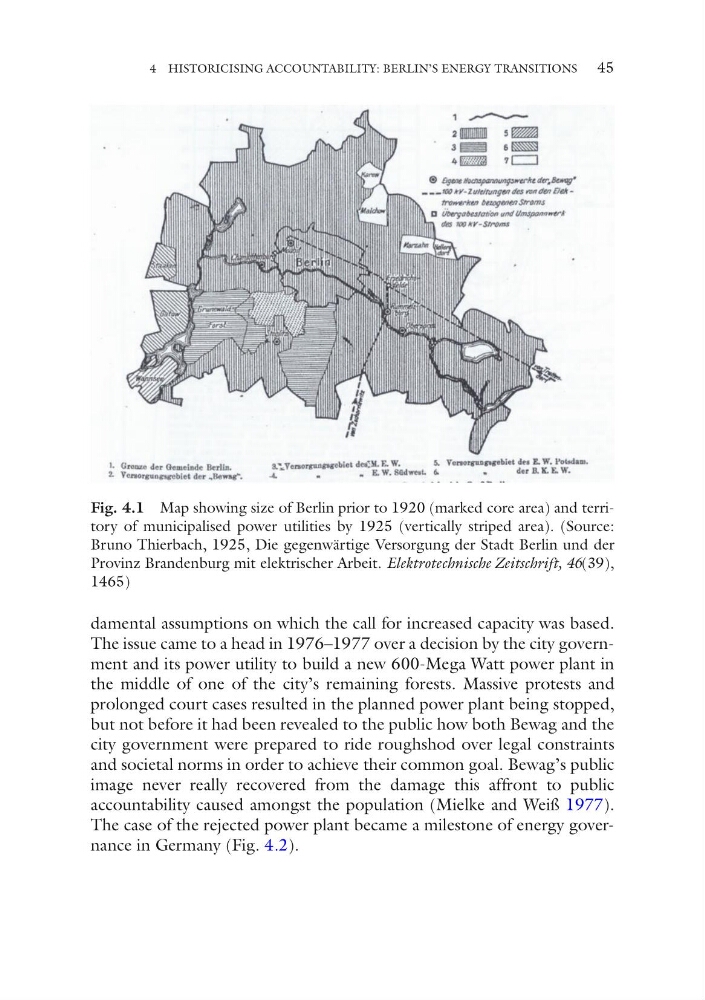
Fig. 4.1 Map showing size of Berlin prior to 1920 (marked core area) and territory of municipalised power utilities by 1925 (vertically striped area). (Source:
Bruno Thierbach, 1925, Die gegenwärtige Versorgung der Stadt Berlin und der
Provinz Brandenburg mit elektrischer Arbeit. Elektrotechnische Zeitschrift, 46(39),
1465)
4 HISTORICISING ACCOUNTABILITY: BERLIN’S ENERGY TRANSITIONS
damental assumptions on which the call for increased capacity was based.
The issue came to a head in 1976–1977 over a decision by the city government and its power utility to build a new 600-Mega Watt power plant in
the middle of one of the city’s remaining forests. Massive protests and
prolonged court cases resulted in the planned power plant being stopped,
but not before it had been revealed to the public how both Bewag and the
city government were prepared to ride roughshod over legal constraints
and societal norms in order to achieve their common goal. Bewag’s public
image never really recovered from the damage this affront to public
accountability caused amongst the population (Mielke and Weiß 1977).
The case of the rejected power plant became a milestone of energy governance in Germany (Fig. 4.2).
Fig. 4.1 Map showing size of Berlin prior to 1920 (marked core area) and territory of municipalised power utilities by 1925 (vertically striped area). (Source:
Bruno Thierbach, 1925, Die gegenwärtige Versorgung der Stadt Berlin und der
Provinz Brandenburg mit elektrischer Arbeit. Elektrotechnische Zeitschrift, 46(39),
1465)
4 HISTORICISING ACCOUNTABILITY: BERLIN’S ENERGY TRANSITIONS