

93
accountability—that fail to change the distribution of relevant behaviours
and outputs are a central mechanism for path dependence in socioecological systems.
Selection is the process that drives demographic change and demographic stability (i.e., organisational ecology). Here, we can imagine a
population of oil and gas firms with variable capacity to respond to new
regulations, new eco-audits, or new consumer sensibilities (Wolf and
Primmer 2006). In addition to demographic change, selection can alter
the distribution of behaviours. Firms adapt more frequently than they disappear. We can imagine the costs of offsetting the degradation of sagegrouse habitat as driving some firms out of business (i.e., churn in the
population), and we can imagine such costs as shifting firms’ drilling operations to geographic zones outside of prime sage-grouse habitat (an adaptation of technical practices and outputs).
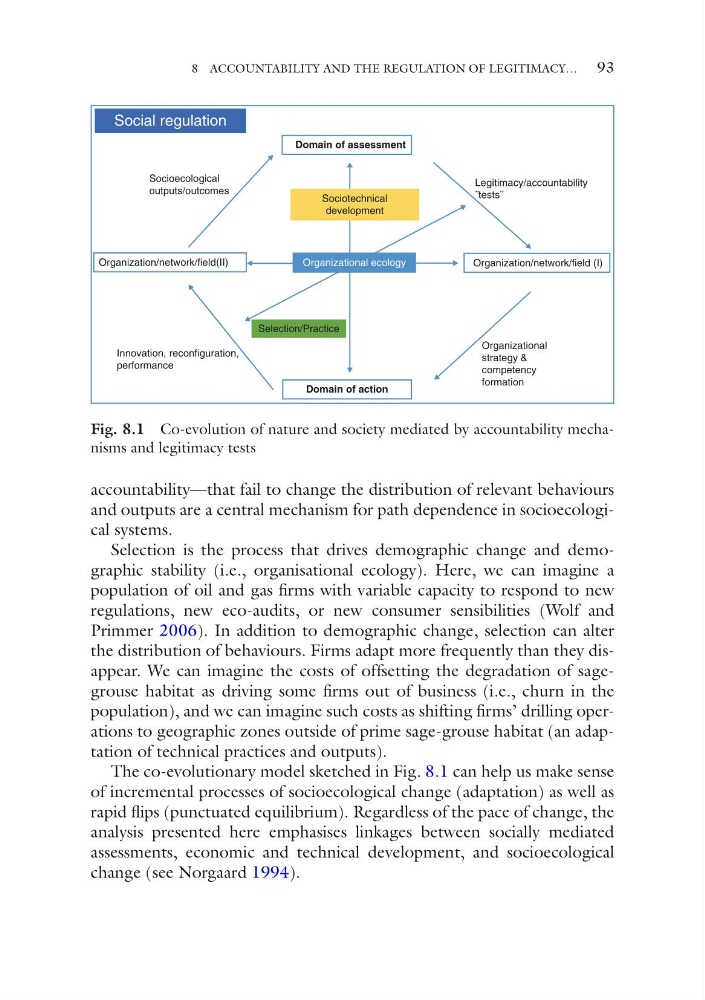
The co-evolutionary model sketched in Fig. 8.1 can help us make sense
of incremental processes of socioecological change (adaptation) as well as
rapid flips (punctuated equilibrium). Regardless of the pace of change, the
analysis presented here emphasises linkages between socially mediated
assessments, economic and technical development, and socioecological
change (see Norgaard 1994).
Domain of assessment
Legitimacy/accountability
˝tests˝
Organizational ecology
Organization/network/field (I)
Organizational
strategy &
competency
formation
Domain of action
Selection/Practice
Organization/network/field(II)
Innovation, reconfiguration,
performance
Socioecological
outputs/outcomes
Social regulation
Sociotechnical
development
Fig. 8.1 Co-evolution of nature and society mediated by accountability mechanisms and legitimacy tests
8 ACCOUNTABILITY AND THE REGULATION OF LEGITIMACY…
accountability—that fail to change the distribution of relevant behaviours
and outputs are a central mechanism for path dependence in socioecological systems.
Selection is the process that drives demographic change and demographic stability (i.e., organisational ecology). Here, we can imagine a
population of oil and gas firms with variable capacity to respond to new
regulations, new eco-audits, or new consumer sensibilities (Wolf and
Primmer 2006). In addition to demographic change, selection can alter
the distribution of behaviours. Firms adapt more frequently than they disappear. We can imagine the costs of offsetting the degradation of sagegrouse habitat as driving some firms out of business (i.e., churn in the
population), and we can imagine such costs as shifting firms’ drilling operations to geographic zones outside of prime sage-grouse habitat (an adaptation of technical practices and outputs).
The co-evolutionary model sketched in Fig. 8.1 can help us make sense
of incremental processes of socioecological change (adaptation) as well as
rapid flips (punctuated equilibrium). Regardless of the pace of change, the
analysis presented here emphasises linkages between socially mediated
assessments, economic and technical development, and socioecological
change (see Norgaard 1994).
Domain of assessment
Legitimacy/accountability
˝tests˝
Organizational ecology
Organization/network/field (I)
Organizational
strategy &
competency
formation
Domain of action
Selection/Practice
Organization/network/field(II)
Innovation, reconfiguration,
performance
Socioecological
outputs/outcomes
Social regulation
Sociotechnical
development
Fig. 8.1 Co-evolution of nature and society mediated by accountability mechanisms and legitimacy tests
8 ACCOUNTABILITY AND THE REGULATION OF LEGITIMACY…