

85
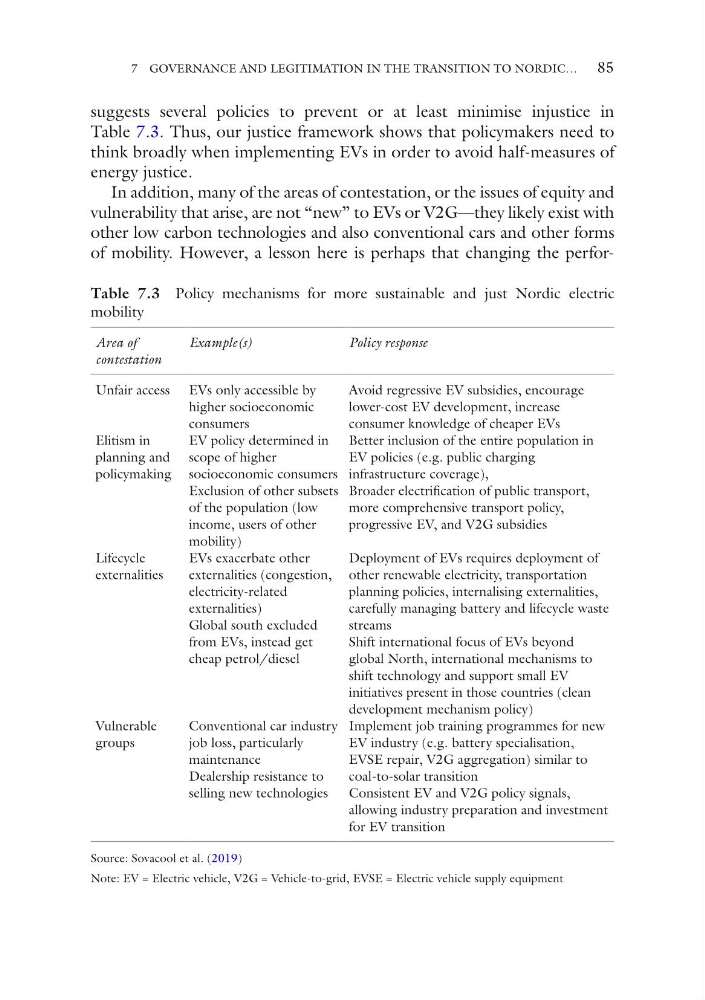
suggests several policies to prevent or at least minimise injustice in
Table 7.3. Thus, our justice framework shows that policymakers need to
think broadly when implementing EVs in order to avoid half-measures of
energy justice.
In addition, many of the areas of contestation, or the issues of equity and
vulnerability that arise, are not “new” to EVs or V2G—they likely exist with
other low carbon technologies and also conventional cars and other forms
of mobility. However, a lesson here is perhaps that changing the perforTable 7.3 Policy mechanisms for more sustainable and just Nordic electric
mobility
Area of
contestation
Example(s)
Policy response
Unfair access EVs only accessible by
higher socioeconomic
consumers
Avoid regressive EV subsidies, encourage
lower-cost EV development, increase
consumer knowledge of cheaper EVs
Elitism in
planning and
policymaking
EV policy determined in
scope of higher
socioeconomic consumers
Exclusion of other subsets
of the population (low
income, users of other
mobility)
Better inclusion of the entire population in
EV policies (e.g. public charging
infrastructure coverage),
Broader electrification of public transport,
more comprehensive transport policy,
progressive EV, and V2G subsidies
Lifecycle
externalities
EVs exacerbate other
externalities (congestion,
electricity-related
externalities)
Global south excluded
from EVs, instead get
cheap petrol/diesel
Deployment of EVs requires deployment of
other renewable electricity, transportation
planning policies, internalising externalities,
carefully managing battery and lifecycle waste
streams
Shift international focus of EVs beyond
global North, international mechanisms to
shift technology and support small EV
initiatives present in those countries (clean
development mechanism policy)
Vulnerable
groups
Conventional car industry
job loss, particularly
maintenance
Dealership resistance to
selling new technologies
Implement job training programmes for new
EV industry (e.g. battery specialisation,
EVSE repair, V2G aggregation) similar to
coal-to-solar transition
Consistent EV and V2G policy signals,
allowing industry preparation and investment
for EV transition
Source: Sovacool et al. (2019)
Note: EV = Electric vehicle, V2G = Vehicle-to-grid, EVSE = Electric vehicle supply equipment
7 GOVERNANCE AND LEGITIMATION IN THE TRANSITION TO NORDIC…
suggests several policies to prevent or at least minimise injustice in
Table 7.3. Thus, our justice framework shows that policymakers need to
think broadly when implementing EVs in order to avoid half-measures of
energy justice.
In addition, many of the areas of contestation, or the issues of equity and
vulnerability that arise, are not “new” to EVs or V2G—they likely exist with
other low carbon technologies and also conventional cars and other forms
of mobility. However, a lesson here is perhaps that changing the perforTable 7.3 Policy mechanisms for more sustainable and just Nordic electric
mobility
Area of
contestation
Example(s)
Policy response
Unfair access EVs only accessible by
higher socioeconomic
consumers
Avoid regressive EV subsidies, encourage
lower-cost EV development, increase
consumer knowledge of cheaper EVs
Elitism in
planning and
policymaking
EV policy determined in
scope of higher
socioeconomic consumers
Exclusion of other subsets
of the population (low
income, users of other
mobility)
Better inclusion of the entire population in
EV policies (e.g. public charging
infrastructure coverage),
Broader electrification of public transport,
more comprehensive transport policy,
progressive EV, and V2G subsidies
Lifecycle
externalities
EVs exacerbate other
externalities (congestion,
electricity-related
externalities)
Global south excluded
from EVs, instead get
cheap petrol/diesel
Deployment of EVs requires deployment of
other renewable electricity, transportation
planning policies, internalising externalities,
carefully managing battery and lifecycle waste
streams
Shift international focus of EVs beyond
global North, international mechanisms to
shift technology and support small EV
initiatives present in those countries (clean
development mechanism policy)
Vulnerable
groups
Conventional car industry
job loss, particularly
maintenance
Dealership resistance to
selling new technologies
Implement job training programmes for new
EV industry (e.g. battery specialisation,
EVSE repair, V2G aggregation) similar to
coal-to-solar transition
Consistent EV and V2G policy signals,
allowing industry preparation and investment
for EV transition
Source: Sovacool et al. (2019)
Note: EV = Electric vehicle, V2G = Vehicle-to-grid, EVSE = Electric vehicle supply equipment
7 GOVERNANCE AND LEGITIMATION IN THE TRANSITION TO NORDIC…