

52 G. GoGGINS ET AL.
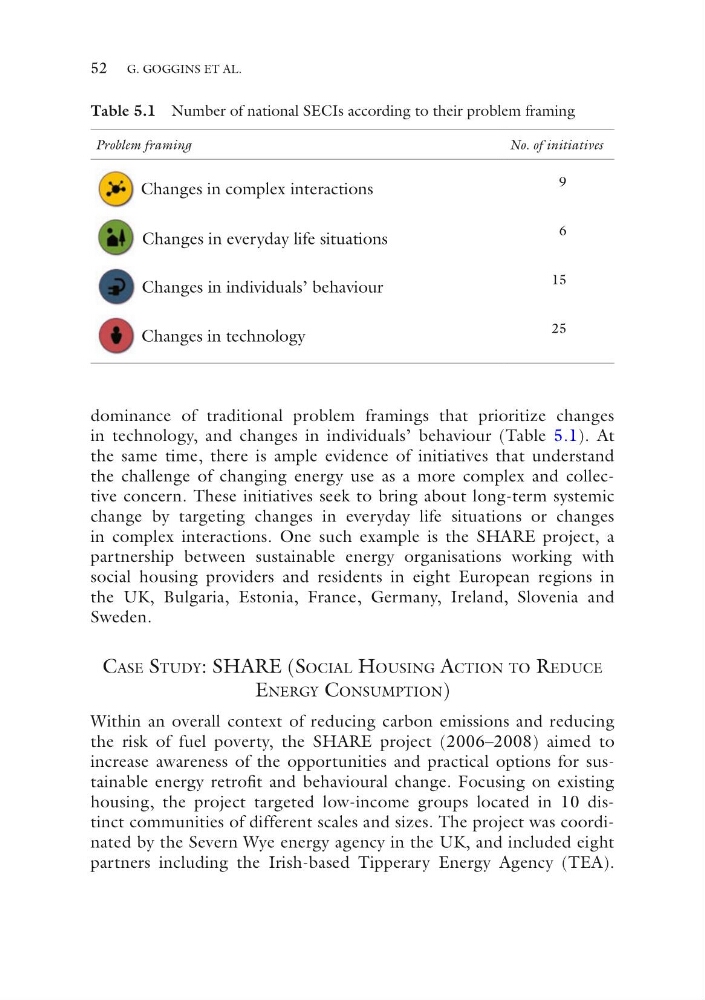
dominance of traditional problem framings that prioritize changes
in technology, and changes in individuals’ behaviour (Table 5.1). At
the same time, there is ample evidence of initiatives that understand
the challenge of changing energy use as a more complex and collective concern. These initiatives seek to bring about long-term systemic
change by targeting changes in everyday life situations or changes
in complex interactions. one such example is the SHARE project, a
partnership between sustainable energy organisations working with
social housing providers and residents in eight European regions in
the UK, Bulgaria, Estonia, France, Germany, Ireland, Slovenia and
Sweden.
Case stuDy: share (soCiaL housing aCtion to reDuCe
energy Consumption)
Within an overall context of reducing carbon emissions and reducing
the risk of fuel poverty, the SHARE project (2006–2008) aimed to
increase awareness of the opportunities and practical options for sustainable energy retrofit and behavioural change. Focusing on existing
housing, the project targeted low-income groups located in 10 distinct communities of different scales and sizes. The project was coordinated by the Severn Wye energy agency in the UK, and included eight
partners including the Irish-based Tipperary Energy Agency (TEA).
Table 5.1 Number of national SECIs according to their problem framing
Problem framing
No. of initiatives
Changes in complex interactions
9
Changes in everyday life situations
6
Changes in individuals’ behaviour
15
Changes in technology
25
dominance of traditional problem framings that prioritize changes
in technology, and changes in individuals’ behaviour (Table 5.1). At
the same time, there is ample evidence of initiatives that understand
the challenge of changing energy use as a more complex and collective concern. These initiatives seek to bring about long-term systemic
change by targeting changes in everyday life situations or changes
in complex interactions. one such example is the SHARE project, a
partnership between sustainable energy organisations working with
social housing providers and residents in eight European regions in
the UK, Bulgaria, Estonia, France, Germany, Ireland, Slovenia and
Sweden.
Case stuDy: share (soCiaL housing aCtion to reDuCe
energy Consumption)
Within an overall context of reducing carbon emissions and reducing
the risk of fuel poverty, the SHARE project (2006–2008) aimed to
increase awareness of the opportunities and practical options for sustainable energy retrofit and behavioural change. Focusing on existing
housing, the project targeted low-income groups located in 10 distinct communities of different scales and sizes. The project was coordinated by the Severn Wye energy agency in the UK, and included eight
partners including the Irish-based Tipperary Energy Agency (TEA).
Table 5.1 Number of national SECIs according to their problem framing
Problem framing
No. of initiatives
Changes in complex interactions
9
Changes in everyday life situations
6
Changes in individuals’ behaviour
15
Changes in technology
25