

116 M. HAJDINJAK AND D. ASENoVA
Keywords Energy poverty · Renewable energy sources · Inefficiency ·
Transition and reforms · Barriers and challenges
introDuCtion
This chapter presents a short overview of the sustainable energy
consumption challenges in Bulgaria. It includes a brief description of the
national energy system and energy policies, brings forth some findings
from the review of sustainable energy consumption initiatives (SECIs)
involving Bulgarian households, and presents a good practice example of
one such SECI.
soCio-materiaL DynamiCs of househoLD energy
use in buLgaria
The residential sector is the third largest sector in terms of final energy consumption (24%), after transport (35%) and industry (28%), and ahead of
services (11%), and agriculture (2%) (odyssee-Mure 2015). A relatively high
share of renewable energy sources (RES) in the energy mix of households
(Table 11.1) is explained by the fact that the most commonly used fuel
for heating of homes is wood (59%). This is not valid for the capital Sofia,
where 60% of households use district heating, but in rural areas almost
all dwellings use either firewood (63%) or coal (32%) as the main heating
source (National Statistical Institute of Bulgaria 2011; Eurostat 2016).
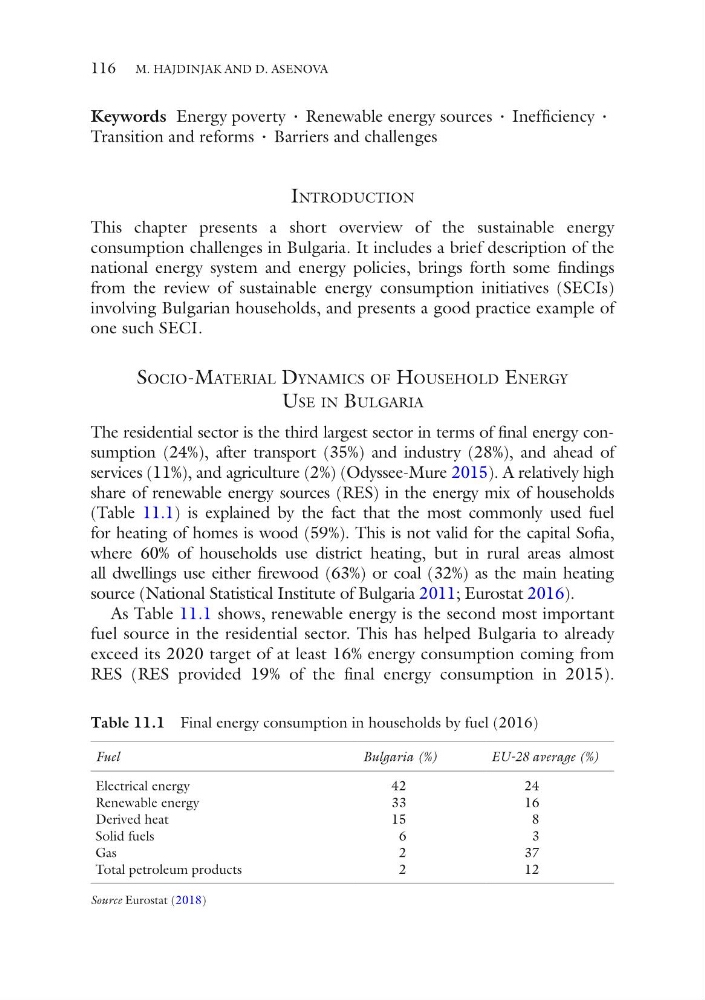
As Table 11.1 shows, renewable energy is the second most important
fuel source in the residential sector. This has helped Bulgaria to already
exceed its 2020 target of at least 16% energy consumption coming from
RES (RES provided 19% of the final energy consumption in 2015).
Table 11.1 Final energy consumption in households by fuel (2016)
Source Eurostat (2018)
Fuel
Bulgaria (%)
EU-28 average (%)
Electrical energy
42
24
Renewable energy
33
16
Derived heat
15
8
Solid fuels
6
3
Gas
2
37
Total petroleum products
2
12
Keywords Energy poverty · Renewable energy sources · Inefficiency ·
Transition and reforms · Barriers and challenges
introDuCtion
This chapter presents a short overview of the sustainable energy
consumption challenges in Bulgaria. It includes a brief description of the
national energy system and energy policies, brings forth some findings
from the review of sustainable energy consumption initiatives (SECIs)
involving Bulgarian households, and presents a good practice example of
one such SECI.
soCio-materiaL DynamiCs of househoLD energy
use in buLgaria
The residential sector is the third largest sector in terms of final energy consumption (24%), after transport (35%) and industry (28%), and ahead of
services (11%), and agriculture (2%) (odyssee-Mure 2015). A relatively high
share of renewable energy sources (RES) in the energy mix of households
(Table 11.1) is explained by the fact that the most commonly used fuel
for heating of homes is wood (59%). This is not valid for the capital Sofia,
where 60% of households use district heating, but in rural areas almost
all dwellings use either firewood (63%) or coal (32%) as the main heating
source (National Statistical Institute of Bulgaria 2011; Eurostat 2016).
As Table 11.1 shows, renewable energy is the second most important
fuel source in the residential sector. This has helped Bulgaria to already
exceed its 2020 target of at least 16% energy consumption coming from
RES (RES provided 19% of the final energy consumption in 2015).
Table 11.1 Final energy consumption in households by fuel (2016)
Source Eurostat (2018)
Fuel
Bulgaria (%)
EU-28 average (%)
Electrical energy
42
24
Renewable energy
33
16
Derived heat
15
8
Solid fuels
6
3
Gas
2
37
Total petroleum products
2
12