

L’ÉNERGIE GRISE DES MATÉRIAUX ET DES OUVRAGES
LES GuIDES
BIo-TECh
113
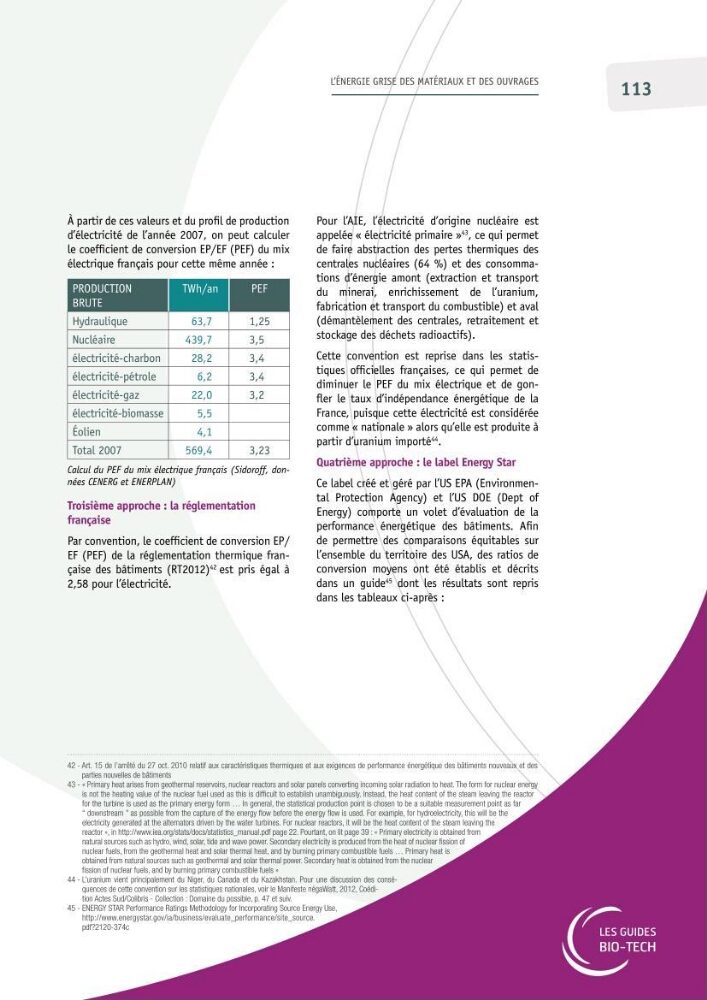
À partir de ces valeurs et du profil de production
d’électricité de l’année 2007, on peut calculer
le coefficient de conversion EP/EF (PEF) du mix
électrique français pour cette même année :
PRODUCTION
BRUTE
TWh/an
PEF
Hydraulique
63,7
1,25
Nucléaire
439,7
3,5
électricité-charbon
28,2
3,4
électricité-pétrole
6,2
3,4
électricité-gaz
22,0
3,2
électricité-biomasse
5,5
Éolien
4,1
Total 2007
569,4
3,23
Calcul du PEF du mix électrique français (Sidoroff, données CENERG et ENERPLAN)
Troisième approche : la réglementation
française
Par convention, le coefficient de conversion EP/
EF (PEF) de la réglementation thermique française des bâtiments (RT2012)
42
est pris égal à
2,58 pour l’électricité.
Pour l’AIE, l’électricité d’origine nucléaire est
appelée « électricité primaire »
43
, ce qui permet
de faire abstraction des pertes thermiques des
centrales nucléaires (64 %) et des consommations d’énergie amont (extraction et transport
du minerai, enrichissement de l’uranium,
fabrication et transport du combustible) et aval
(démantèlement des centrales, retraitement et
stockage des déchets radioactifs).
Cette convention est reprise dans les statistiques officielles françaises, ce qui permet de
diminuer le PEF du mix électrique et de gonfler le taux d’indépendance énergétique de la
France, puisque cette électricité est considérée
comme « nationale » alors qu’elle est produite à
partir d’uranium importé
44
.
Quatrième approche : le label Energy Star
Ce label créé et géré par l’US EPA (Environmental Protection Agency) et l’US DOE (Dept of
Energy) comporte un volet d’évaluation de la
performance énergétique des bâtiments. Afin
de permettre des comparaisons équitables sur
l’ensemble du territoire des USA, des ratios de
conversion moyens ont été établis et décrits
dans un guide
45
dont les résultats sont repris
dans les tableaux ci-après :
42 - Art. 15 de l’arrêté du 27 oct. 2010 relatif aux caractéristiques thermiques et aux exigences de performance énergétique des bâtiments nouveaux et des
parties nouvelles de bâtiments
43 - « Primary heat arises from geothermal reservoirs, nuclear reactors and solar panels converting incoming solar radiation to heat. The form for nuclear energy
is not the heating value of the nuclear fuel used as this is difficult to establish unambiguously. Instead, the heat content of the steam leaving the reactor
for the turbine is used as the primary energy form … In general, the statistical production point is chosen to be a suitable measurement point as far
“ downstream ” as possible from the capture of the energy flow before the energy flow is used. For example, for hydroelectricity, this will be the
electricity generated at the alternators driven by the water turbines. For nuclear reactors, it will be the heat content of the steam leaving the
reactor », in http://www.iea.org/stats/docs/statistics_manual.pdf page 22. Pourtant, on lit page 39 : « Primary electricity is obtained from
natural sources such as hydro, wind, solar, tide and wave power. Secondary electricity is produced from the heat of nuclear fission of
nuclear fuels, from the geothermal heat and solar thermal heat, and by burning primary combustible fuels … Primary heat is
obtained from natural sources such as geothermal and solar thermal power. Secondary heat is obtained from the nuclear
fission of nuclear fuels, and by burning primary combustible fuels »
44 - L’uranium vient principalement du Niger, du Canada et du Kazakhstan. Pour une discussion des conséquences de cette convention sur les statistiques nationales, voir le Manifeste négaWatt, 2012, Coédition Actes Sud/Colibris - Collection : Domaine du possible, p. 47 et suiv.
45 - ENERGY STAR Performance Ratings Methodology for Incorporating Source Energy Use,
http://www.energystar.gov/ia/business/evaluate_performance/site_source.
pdf?2120-374c
LES GuIDES
BIo-TECh
113
À partir de ces valeurs et du profil de production
d’électricité de l’année 2007, on peut calculer
le coefficient de conversion EP/EF (PEF) du mix
électrique français pour cette même année :
PRODUCTION
BRUTE
TWh/an
PEF
Hydraulique
63,7
1,25
Nucléaire
439,7
3,5
électricité-charbon
28,2
3,4
électricité-pétrole
6,2
3,4
électricité-gaz
22,0
3,2
électricité-biomasse
5,5
Éolien
4,1
Total 2007
569,4
3,23
Calcul du PEF du mix électrique français (Sidoroff, données CENERG et ENERPLAN)
Troisième approche : la réglementation
française
Par convention, le coefficient de conversion EP/
EF (PEF) de la réglementation thermique française des bâtiments (RT2012)
42
est pris égal à
2,58 pour l’électricité.
Pour l’AIE, l’électricité d’origine nucléaire est
appelée « électricité primaire »
43
, ce qui permet
de faire abstraction des pertes thermiques des
centrales nucléaires (64 %) et des consommations d’énergie amont (extraction et transport
du minerai, enrichissement de l’uranium,
fabrication et transport du combustible) et aval
(démantèlement des centrales, retraitement et
stockage des déchets radioactifs).
Cette convention est reprise dans les statistiques officielles françaises, ce qui permet de
diminuer le PEF du mix électrique et de gonfler le taux d’indépendance énergétique de la
France, puisque cette électricité est considérée
comme « nationale » alors qu’elle est produite à
partir d’uranium importé
44
.
Quatrième approche : le label Energy Star
Ce label créé et géré par l’US EPA (Environmental Protection Agency) et l’US DOE (Dept of
Energy) comporte un volet d’évaluation de la
performance énergétique des bâtiments. Afin
de permettre des comparaisons équitables sur
l’ensemble du territoire des USA, des ratios de
conversion moyens ont été établis et décrits
dans un guide
45
dont les résultats sont repris
dans les tableaux ci-après :
42 - Art. 15 de l’arrêté du 27 oct. 2010 relatif aux caractéristiques thermiques et aux exigences de performance énergétique des bâtiments nouveaux et des
parties nouvelles de bâtiments
43 - « Primary heat arises from geothermal reservoirs, nuclear reactors and solar panels converting incoming solar radiation to heat. The form for nuclear energy
is not the heating value of the nuclear fuel used as this is difficult to establish unambiguously. Instead, the heat content of the steam leaving the reactor
for the turbine is used as the primary energy form … In general, the statistical production point is chosen to be a suitable measurement point as far
“ downstream ” as possible from the capture of the energy flow before the energy flow is used. For example, for hydroelectricity, this will be the
electricity generated at the alternators driven by the water turbines. For nuclear reactors, it will be the heat content of the steam leaving the
reactor », in http://www.iea.org/stats/docs/statistics_manual.pdf page 22. Pourtant, on lit page 39 : « Primary electricity is obtained from
natural sources such as hydro, wind, solar, tide and wave power. Secondary electricity is produced from the heat of nuclear fission of
nuclear fuels, from the geothermal heat and solar thermal heat, and by burning primary combustible fuels … Primary heat is
obtained from natural sources such as geothermal and solar thermal power. Secondary heat is obtained from the nuclear
fission of nuclear fuels, and by burning primary combustible fuels »
44 - L’uranium vient principalement du Niger, du Canada et du Kazakhstan. Pour une discussion des conséquences de cette convention sur les statistiques nationales, voir le Manifeste négaWatt, 2012, Coédition Actes Sud/Colibris - Collection : Domaine du possible, p. 47 et suiv.
45 - ENERGY STAR Performance Ratings Methodology for Incorporating Source Energy Use,
http://www.energystar.gov/ia/business/evaluate_performance/site_source.
pdf?2120-374c