

responses of oil and gas companies to structurally lower prices and increased technology
disruption, as well as the factors that will affect
those responses.
(1) Current strategies
Current strategies and organisational structures
within the oil and gas industry have been shaped
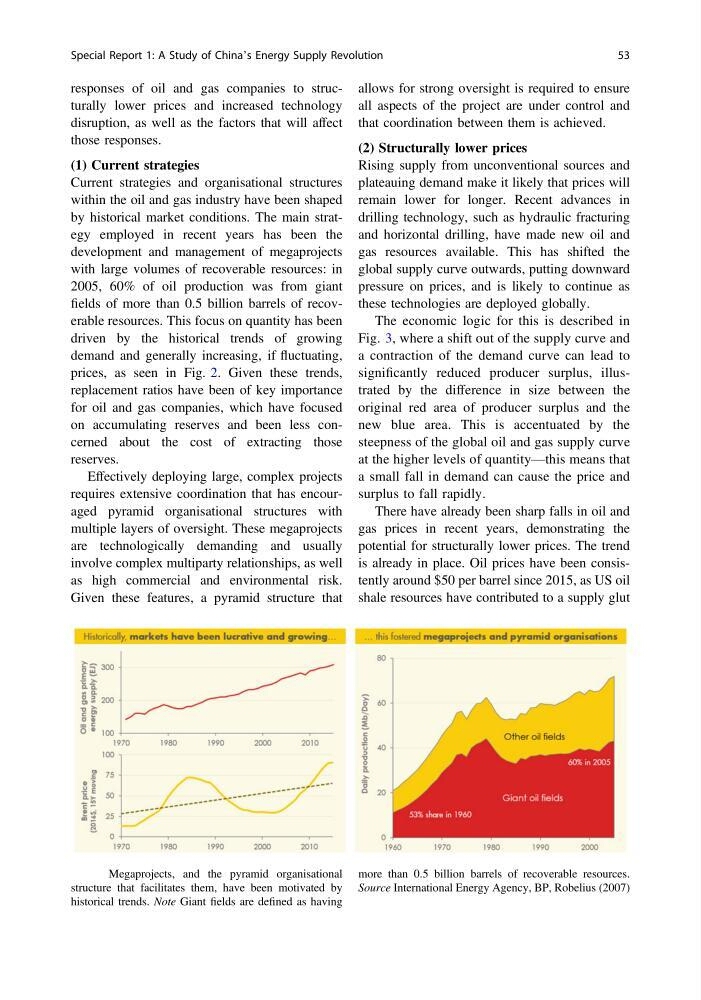
by historical market conditions. The main strategy employed in recent years has been the
development and management of megaprojects
with large volumes of recoverable resources: in
2005, 60% of oil production was from giant
fields of more than 0.5 billion barrels of recoverable resources. This focus on quantity has been
driven by the historical trends of growing
demand and generally increasing, if fluctuating,
prices, as seen in Fig. 2. Given these trends,
replacement ratios have been of key importance
for oil and gas companies, which have focused
on accumulating reserves and been less concerned about the cost of extracting those
reserves.
Effectively deploying large, complex projects
requires extensive coordination that has encouraged pyramid organisational structures with
multiple layers of oversight. These megaprojects
are technologically demanding and usually
involve complex multiparty relationships, as well
as high commercial and environmental risk.
Given these features, a pyramid structure that
allows for strong oversight is required to ensure
all aspects of the project are under control and
that coordination between them is achieved.
(2) Structurally lower prices
Rising supply from unconventional sources and
plateauing demand make it likely that prices will
remain lower for longer. Recent advances in
drilling technology, such as hydraulic fracturing
and horizontal drilling, have made new oil and
gas resources available. This has shifted the
global supply curve outwards, putting downward
pressure on prices, and is likely to continue as
these technologies are deployed globally.
The economic logic for this is described in
Fig. 3, where a shift out of the supply curve and
a contraction of the demand curve can lead to
significantly reduced producer surplus, illustrated by the difference in size between the
original red area of producer surplus and the
new blue area. This is accentuated by the
steepness of the global oil and gas supply curve
at the higher levels of quantity—this means that
a small fall in demand can cause the price and
surplus to fall rapidly.
There have already been sharp falls in oil and
gas prices in recent years, demonstrating the
potential for structurally lower prices. The trend
is already in place. Oil prices have been consistently around $50 per barrel since 2015, as US oil
shale resources have contributed to a supply glut
Fig. 2 Megaprojects, and the pyramid organisational
structure that facilitates them, have been motivated by
historical trends. Note Giant fields are defined as having
more than 0.5 billion barrels of recoverable resources.
Source International Energy Agency, BP, Robelius (2007)
Special Report 1: A Study of China’s Energy Supply Revolution
53
disruption, as well as the factors that will affect
those responses.
(1) Current strategies
Current strategies and organisational structures
within the oil and gas industry have been shaped
by historical market conditions. The main strategy employed in recent years has been the
development and management of megaprojects
with large volumes of recoverable resources: in
2005, 60% of oil production was from giant
fields of more than 0.5 billion barrels of recoverable resources. This focus on quantity has been
driven by the historical trends of growing
demand and generally increasing, if fluctuating,
prices, as seen in Fig. 2. Given these trends,
replacement ratios have been of key importance
for oil and gas companies, which have focused
on accumulating reserves and been less concerned about the cost of extracting those
reserves.
Effectively deploying large, complex projects
requires extensive coordination that has encouraged pyramid organisational structures with
multiple layers of oversight. These megaprojects
are technologically demanding and usually
involve complex multiparty relationships, as well
as high commercial and environmental risk.
Given these features, a pyramid structure that
allows for strong oversight is required to ensure
all aspects of the project are under control and
that coordination between them is achieved.
(2) Structurally lower prices
Rising supply from unconventional sources and
plateauing demand make it likely that prices will
remain lower for longer. Recent advances in
drilling technology, such as hydraulic fracturing
and horizontal drilling, have made new oil and
gas resources available. This has shifted the
global supply curve outwards, putting downward
pressure on prices, and is likely to continue as
these technologies are deployed globally.
The economic logic for this is described in
Fig. 3, where a shift out of the supply curve and
a contraction of the demand curve can lead to
significantly reduced producer surplus, illustrated by the difference in size between the
original red area of producer surplus and the
new blue area. This is accentuated by the
steepness of the global oil and gas supply curve
at the higher levels of quantity—this means that
a small fall in demand can cause the price and
surplus to fall rapidly.
There have already been sharp falls in oil and
gas prices in recent years, demonstrating the
potential for structurally lower prices. The trend
is already in place. Oil prices have been consistently around $50 per barrel since 2015, as US oil
shale resources have contributed to a supply glut
Fig. 2 Megaprojects, and the pyramid organisational
structure that facilitates them, have been motivated by
historical trends. Note Giant fields are defined as having
more than 0.5 billion barrels of recoverable resources.
Source International Energy Agency, BP, Robelius (2007)
Special Report 1: A Study of China’s Energy Supply Revolution
53