

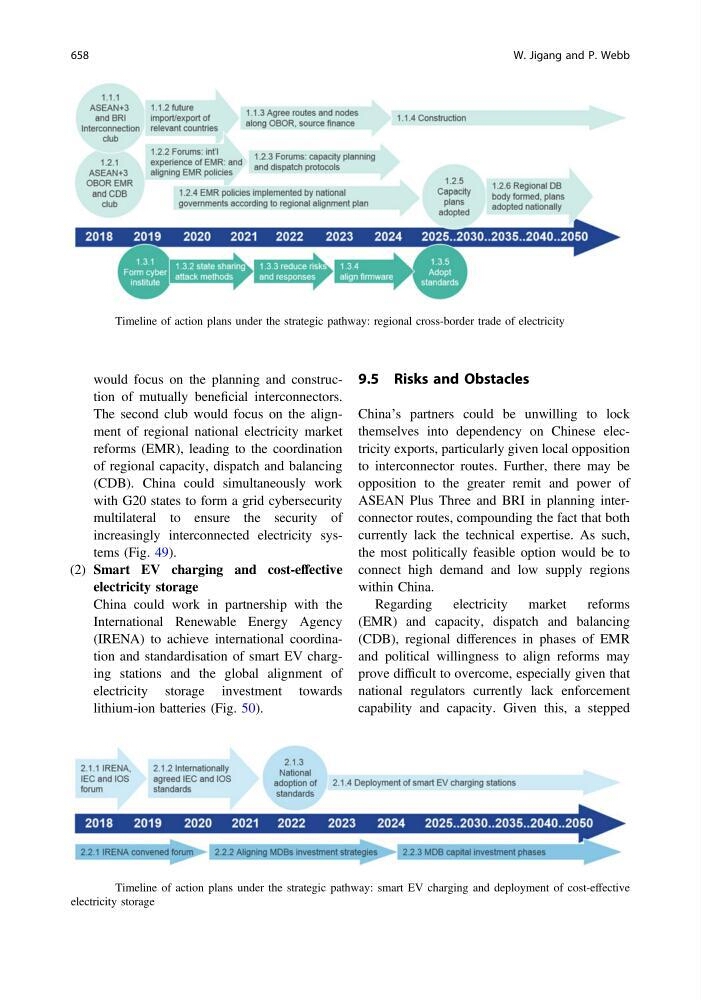
would focus on the planning and construction of mutually beneficial interconnectors.
The second club would focus on the alignment of regional national electricity market
reforms (EMR), leading to the coordination
of regional capacity, dispatch and balancing
(CDB). China could simultaneously work
with G20 states to form a grid cybersecurity
multilateral to ensure the security of
increasingly interconnected electricity systems (Fig. 49).
(2) Smart EV charging and cost-effective
electricity storage
China could work in partnership with the
International Renewable Energy Agency
(IRENA) to achieve international coordination and standardisation of smart EV charging stations and the global alignment of
electricity storage investment towards
lithium-ion batteries (Fig. 50).
9.5 Risks and Obstacles
China’s partners could be unwilling to lock
themselves into dependency on Chinese electricity exports, particularly given local opposition
to interconnector routes. Further, there may be
opposition to the greater remit and power of
ASEAN Plus Three and BRI in planning interconnector routes, compounding the fact that both
currently lack the technical expertise. As such,
the most politically feasible option would be to
connect high demand and low supply regions
within China.
Regarding
electricity
market
reforms
(EMR) and capacity, dispatch and balancing
(CDB), regional differences in phases of EMR
and political willingness to align reforms may
prove difficult to overcome, especially given that
national regulators currently lack enforcement
capability and capacity. Given this, a stepped
Fig. 49 Timeline of action plans under the strategic pathway: regional cross-border trade of electricity
Fig. 50 Timeline of action plans under the strategic pathway: smart EV charging and deployment of cost-effective
electricity storage
658
W. Jigang and P. Webb