

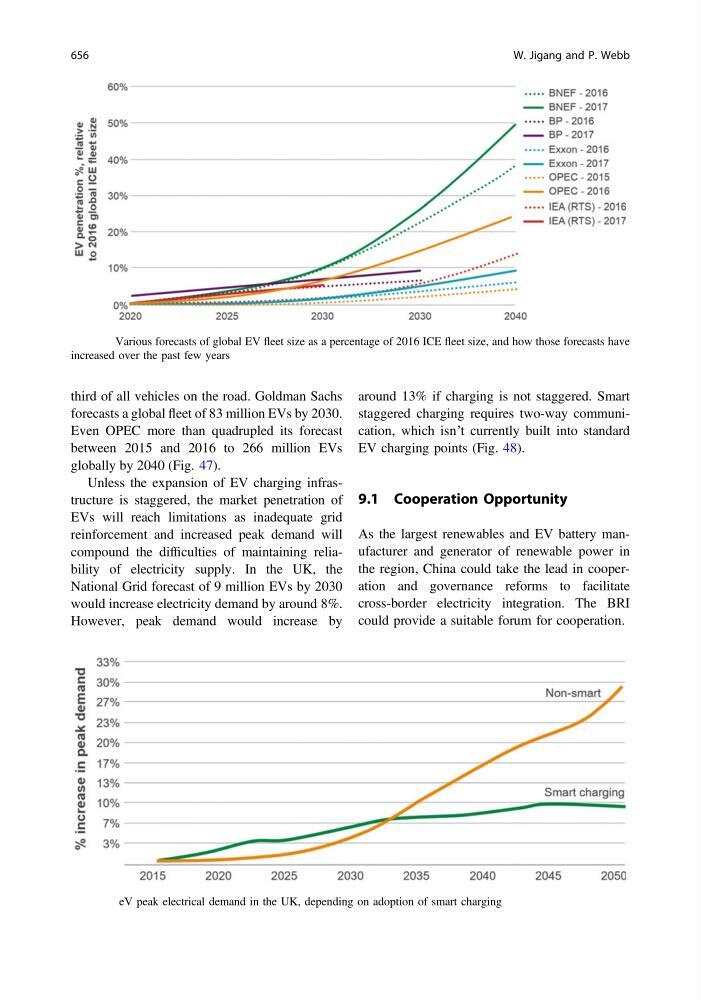
third of all vehicles on the road. Goldman Sachs
forecasts a global fleet of 83 million EVs by 2030.
Even OPEC more than quadrupled its forecast
between 2015 and 2016 to 266 million EVs
globally by 2040 (Fig. 47).
Unless the expansion of EV charging infrastructure is staggered, the market penetration of
EVs will reach limitations as inadequate grid
reinforcement and increased peak demand will
compound the difficulties of maintaining reliability of electricity supply. In the UK, the
National Grid forecast of 9 million EVs by 2030
would increase electricity demand by around 8%.
However, peak demand would increase by
around 13% if charging is not staggered. Smart
staggered charging requires two-way communication, which isn’t currently built into standard
EV charging points (Fig. 48).
9.1 Cooperation Opportunity
As the largest renewables and EV battery manufacturer and generator of renewable power in
the region, China could take the lead in cooperation and governance reforms to facilitate
cross-border electricity integration. The BRI
could provide a suitable forum for cooperation.
Fig. 47 Various forecasts of global EV fleet size as a percentage of 2016 ICE fleet size, and how those forecasts have
increased over the past few years
Fig. 48 eV peak electrical demand in the UK, depending on adoption of smart charging
656
W. Jigang and P. Webb