

accelerating such R&D. China’s circular
economy strategy could also help reduce its
long-term import needs for these critical
materials. Reducing reliance on critical
metals and minerals could be furthered by
forming unconventional alliances with
regional neighbours, including the EU and
Japan, to support: (ii) R&D and piloting of
substitution
technologies
for
those
low-carbon energy technologies most
dependent on critical metals and minerals
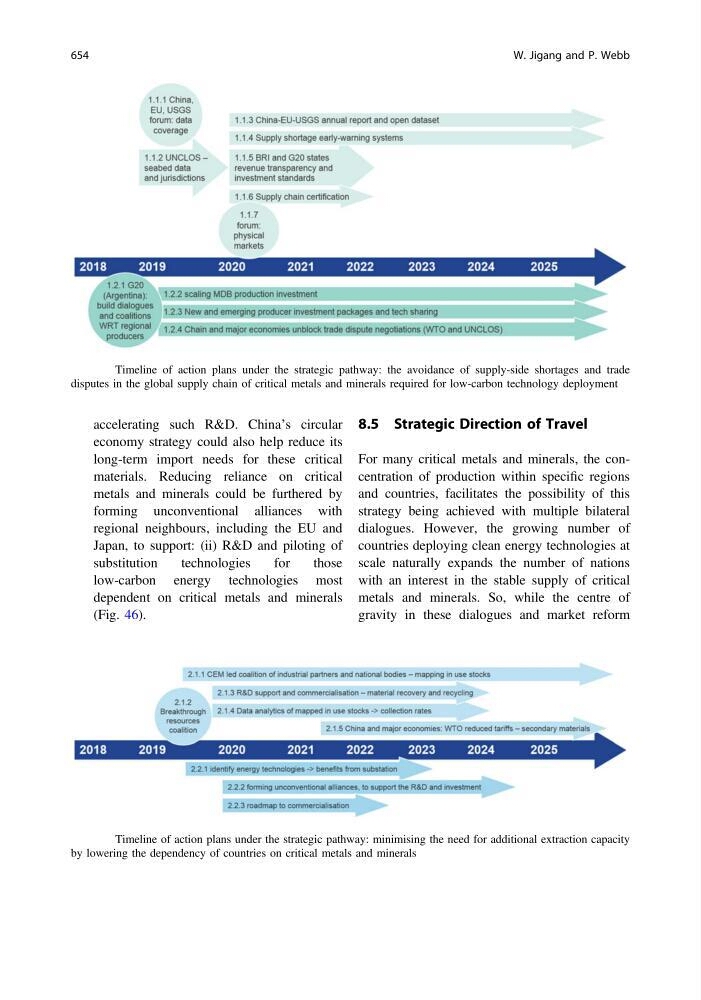
(Fig. 46).
8.5 Strategic Direction of Travel
For many critical metals and minerals, the concentration of production within specific regions
and countries, facilitates the possibility of this
strategy being achieved with multiple bilateral
dialogues. However, the growing number of
countries deploying clean energy technologies at
scale naturally expands the number of nations
with an interest in the stable supply of critical
metals and minerals. So, while the centre of
gravity in these dialogues and market reform
Fig. 45 Timeline of action plans under the strategic pathway: the avoidance of supply-side shortages and trade
disputes in the global supply chain of critical metals and minerals required for low-carbon technology deployment
Fig. 46 Timeline of action plans under the strategic pathway: minimising the need for additional extraction capacity
by lowering the dependency of countries on critical metals and minerals
654
W. Jigang and P. Webb