

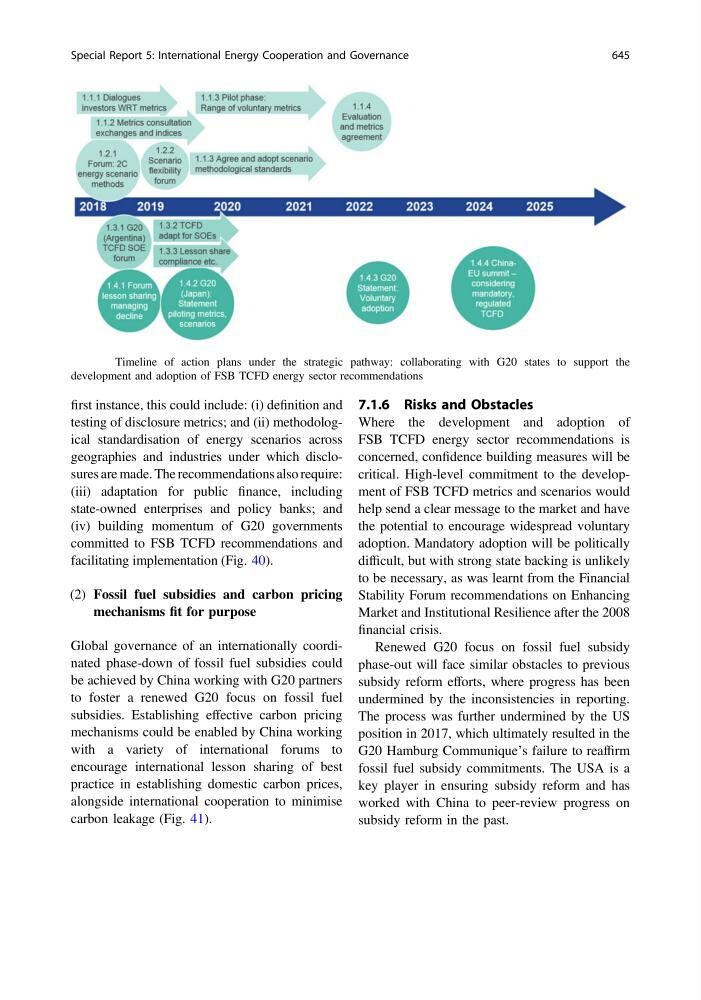
first instance, this could include: (i) definition and
testing of disclosure metrics; and (ii) methodological standardisation of energy scenarios across
geographies and industries under which disclosures are made. The recommendations also require:
(iii) adaptation for public finance, including
state-owned enterprises and policy banks; and
(iv) building momentum of G20 governments
committed to FSB TCFD recommendations and
facilitating implementation (Fig. 40).
(2) Fossil fuel subsidies and carbon pricing
mechanisms fit for purpose
Global governance of an internationally coordinated phase-down of fossil fuel subsidies could
be achieved by China working with G20 partners
to foster a renewed G20 focus on fossil fuel
subsidies. Establishing effective carbon pricing
mechanisms could be enabled by China working
with a variety of international forums to
encourage international lesson sharing of best
practice in establishing domestic carbon prices,
alongside international cooperation to minimise
carbon leakage (Fig. 41).
7.1.6 Risks and Obstacles
Where the development and adoption of
FSB TCFD energy sector recommendations is
concerned, confidence building measures will be
critical. High-level commitment to the development of FSB TCFD metrics and scenarios would
help send a clear message to the market and have
the potential to encourage widespread voluntary
adoption. Mandatory adoption will be politically
difficult, but with strong state backing is unlikely
to be necessary, as was learnt from the Financial
Stability Forum recommendations on Enhancing
Market and Institutional Resilience after the 2008
financial crisis.
Renewed G20 focus on fossil fuel subsidy
phase-out will face similar obstacles to previous
subsidy reform efforts, where progress has been
undermined by the inconsistencies in reporting.
The process was further undermined by the US
position in 2017, which ultimately resulted in the
G20 Hamburg Communique’s failure to reaffirm
fossil fuel subsidy commitments. The USA is a
key player in ensuring subsidy reform and has
worked with China to peer-review progress on
subsidy reform in the past.
Fig. 40 Timeline of action plans under the strategic pathway: collaborating with G20 states to support the
development and adoption of FSB TCFD energy sector recommendations
Special Report 5: International Energy Cooperation and Governance
645