

dialogue” to revisit those pledges before the
agreement enters into force in 2020. The decision
of the USA to withdraw from the Paris Agreement (see Box 2) is a blow to this process, but it
could also be a catalyst for higher ambition
among other parties and at the city and state level
in the USA itself. The EU, China, India and other
key countries have restated their ongoing commitment since the US announcement.
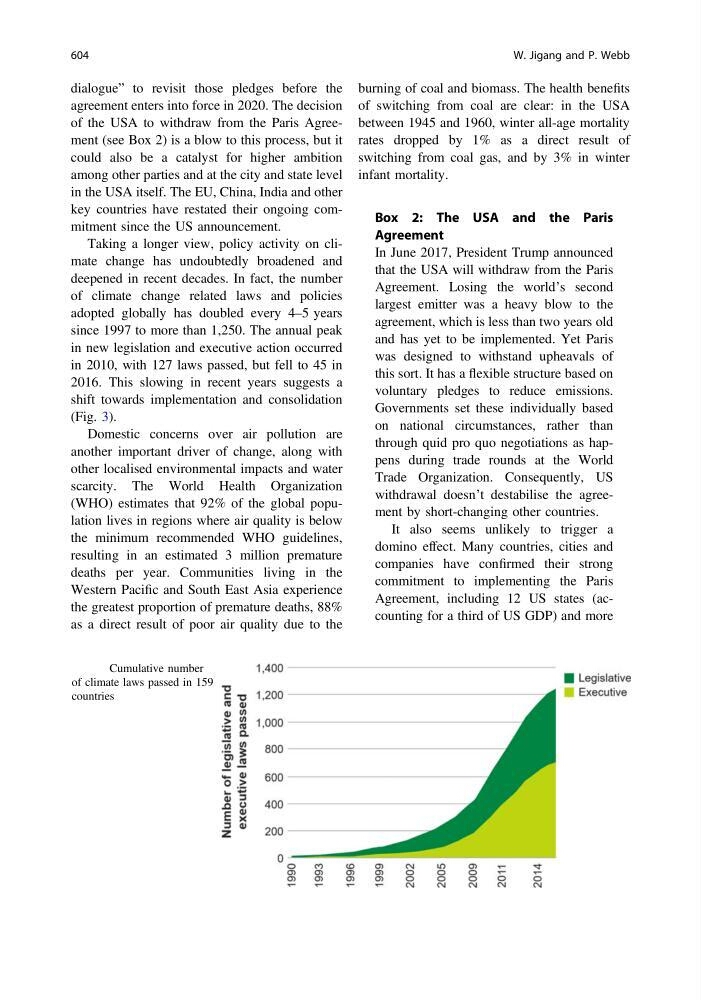
Taking a longer view, policy activity on climate change has undoubtedly broadened and
deepened in recent decades. In fact, the number
of climate change related laws and policies
adopted globally has doubled every 4–5 years
since 1997 to more than 1,250. The annual peak
in new legislation and executive action occurred
in 2010, with 127 laws passed, but fell to 45 in
2016. This slowing in recent years suggests a
shift towards implementation and consolidation
(Fig. 3).
Domestic concerns over air pollution are
another important driver of change, along with
other localised environmental impacts and water
scarcity. The World Health Organization
(WHO) estimates that 92% of the global population lives in regions where air quality is below
the minimum recommended WHO guidelines,
resulting in an estimated 3 million premature
deaths per year. Communities living in the
Western Pacific and South East Asia experience
the greatest proportion of premature deaths, 88%
as a direct result of poor air quality due to the
burning of coal and biomass. The health benefits
of switching from coal are clear: in the USA
between 1945 and 1960, winter all-age mortality
rates dropped by 1% as a direct result of
switching from coal gas, and by 3% in winter
infant mortality.
Box 2: The USA and the Paris
Agreement
In June 2017, President Trump announced
that the USA will withdraw from the Paris
Agreement. Losing the world’s second
largest emitter was a heavy blow to the
agreement, which is less than two years old
and has yet to be implemented. Yet Paris
was designed to withstand upheavals of
this sort. It has a flexible structure based on
voluntary pledges to reduce emissions.
Governments set these individually based
on national circumstances, rather than
through quid pro quo negotiations as happens during trade rounds at the World
Trade Organization. Consequently, US
withdrawal doesn’t destabilise the agreement by short-changing other countries.
It also seems unlikely to trigger a
domino effect. Many countries, cities and
companies have confirmed their strong
commitment to implementing the Paris
Agreement, including 12 US states (accounting for a third of US GDP) and more
Fig. 3 Cumulative number
of climate laws passed in 159
countries
604
W. Jigang and P. Webb