

achieve resilience through redundancy in network infrastructure.
A microgrid is a small-scale, partially
self-sufficient network incorporating both generation and demand sources. Microgrids may be
connected to the local distribution network,
importing or exporting electricity according to
system conditions, but may also disconnect from
the distribution network and operate as an island.
As a microgrid can meet a degree of its own
demand, it is more resilient to wider system
failures, caused by a fault or cyberattack, than a
radial network, and is well suited for critical
functions such as healthcare, military installations or data centres. As microgrids are
self-sufficient, they may require more on-site
generation than conventional networks. The
deployment of on-site generation in microgrids
may result in a larger total volume of generation
assets in the wider electricity system, implying a
degree of asset redundancy and an increase in
costs. In principle, the redundancy can be mitigated if sufficient generation is deployed to serve
only essential loads when islanded. A microgrid
can aggregate its resources like a virtual power
plant to coordinate electricity trading with the
wider power system. This aggregation can be
accomplished by a central controller, or potentially by peer-to-peer communication of individual microgrid resources without a central
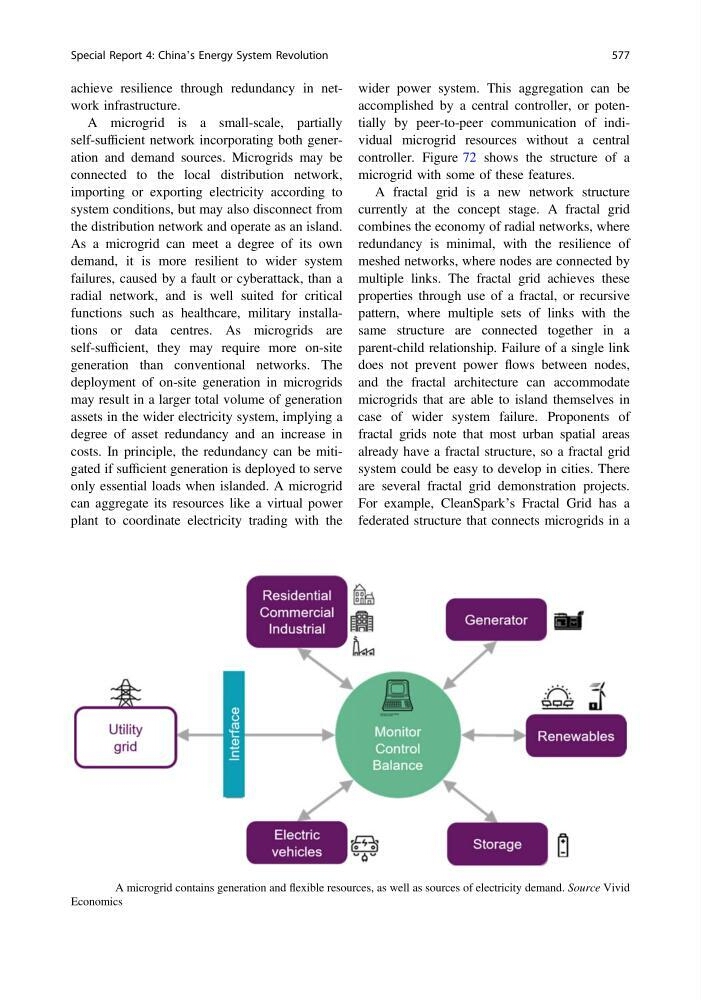
controller. Figure 72 shows the structure of a
microgrid with some of these features.
A fractal grid is a new network structure
currently at the concept stage. A fractal grid
combines the economy of radial networks, where
redundancy is minimal, with the resilience of
meshed networks, where nodes are connected by
multiple links. The fractal grid achieves these
properties through use of a fractal, or recursive
pattern, where multiple sets of links with the
same structure are connected together in a
parent-child relationship. Failure of a single link
does not prevent power flows between nodes,
and the fractal architecture can accommodate
microgrids that are able to island themselves in
case of wider system failure. Proponents of
fractal grids note that most urban spatial areas
already have a fractal structure, so a fractal grid
system could be easy to develop in cities. There
are several fractal grid demonstration projects.
For example, CleanSpark’s Fractal Grid has a
federated structure that connects microgrids in a
Fig. 72 A microgrid contains generation and flexible resources, as well as sources of electricity demand. Source Vivid
Economics
Special Report 4: China’s Energy System Revolution
577
A microgrid is a small-scale, partially
self-sufficient network incorporating both generation and demand sources. Microgrids may be
connected to the local distribution network,
importing or exporting electricity according to
system conditions, but may also disconnect from
the distribution network and operate as an island.
As a microgrid can meet a degree of its own
demand, it is more resilient to wider system
failures, caused by a fault or cyberattack, than a
radial network, and is well suited for critical
functions such as healthcare, military installations or data centres. As microgrids are
self-sufficient, they may require more on-site
generation than conventional networks. The
deployment of on-site generation in microgrids
may result in a larger total volume of generation
assets in the wider electricity system, implying a
degree of asset redundancy and an increase in
costs. In principle, the redundancy can be mitigated if sufficient generation is deployed to serve
only essential loads when islanded. A microgrid
can aggregate its resources like a virtual power
plant to coordinate electricity trading with the
wider power system. This aggregation can be
accomplished by a central controller, or potentially by peer-to-peer communication of individual microgrid resources without a central
controller. Figure 72 shows the structure of a
microgrid with some of these features.
A fractal grid is a new network structure
currently at the concept stage. A fractal grid
combines the economy of radial networks, where
redundancy is minimal, with the resilience of
meshed networks, where nodes are connected by
multiple links. The fractal grid achieves these
properties through use of a fractal, or recursive
pattern, where multiple sets of links with the
same structure are connected together in a
parent-child relationship. Failure of a single link
does not prevent power flows between nodes,
and the fractal architecture can accommodate
microgrids that are able to island themselves in
case of wider system failure. Proponents of
fractal grids note that most urban spatial areas
already have a fractal structure, so a fractal grid
system could be easy to develop in cities. There
are several fractal grid demonstration projects.
For example, CleanSpark’s Fractal Grid has a
federated structure that connects microgrids in a
Fig. 72 A microgrid contains generation and flexible resources, as well as sources of electricity demand. Source Vivid
Economics
Special Report 4: China’s Energy System Revolution
577