

grid connection and is able to make this information public.
However, a decentralised electricity system
may not provide adequate information, risking
inefficient investment. As resources shift to the
distribution system level, the same coordination
problem may arise. This is because, unless adequate procedures are introduced, no single market participant knows which resources are under
development and awaiting grid connection across
all electricity networks in the system. The consequence is, again, inefficient investment: overinvestment, underinvestment, a poor technology
mix or a poor spatial distribution of resources.
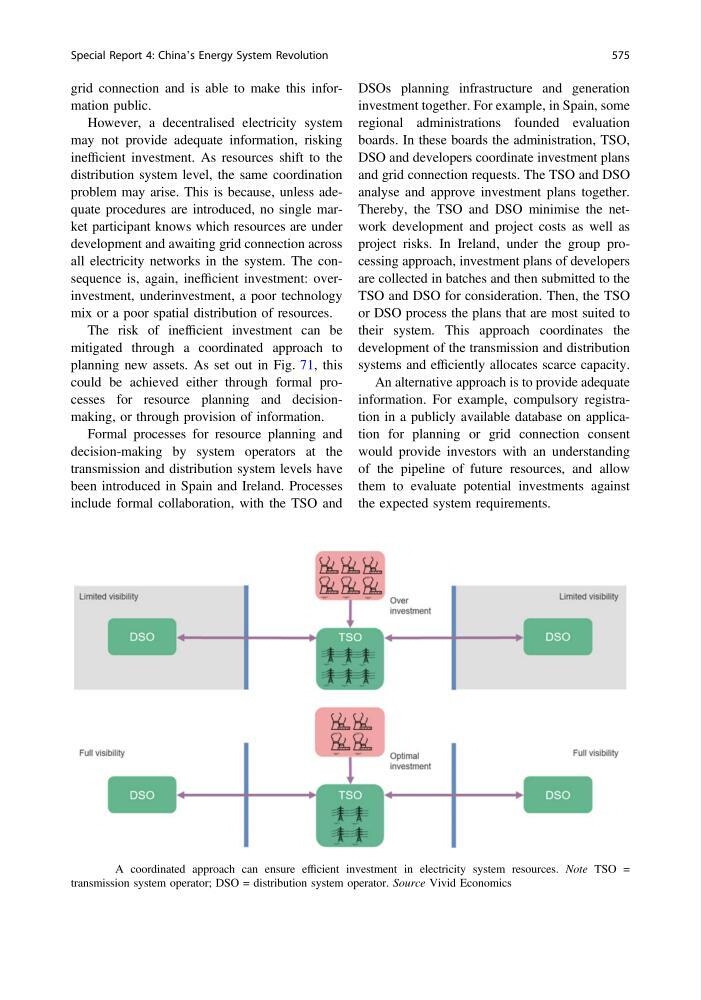
The risk of inefficient investment can be
mitigated through a coordinated approach to
planning new assets. As set out in Fig. 71, this
could be achieved either through formal processes for resource planning and decisionmaking, or through provision of information.
Formal processes for resource planning and
decision-making by system operators at the
transmission and distribution system levels have
been introduced in Spain and Ireland. Processes
include formal collaboration, with the TSO and
DSOs planning infrastructure and generation
investment together. For example, in Spain, some
regional administrations founded evaluation
boards. In these boards the administration, TSO,
DSO and developers coordinate investment plans
and grid connection requests. The TSO and DSO
analyse and approve investment plans together.
Thereby, the TSO and DSO minimise the network development and project costs as well as
project risks. In Ireland, under the group processing approach, investment plans of developers
are collected in batches and then submitted to the
TSO and DSO for consideration. Then, the TSO
or DSO process the plans that are most suited to
their system. This approach coordinates the
development of the transmission and distribution
systems and efficiently allocates scarce capacity.
An alternative approach is to provide adequate
information. For example, compulsory registration in a publicly available database on application for planning or grid connection consent
would provide investors with an understanding
of the pipeline of future resources, and allow
them to evaluate potential investments against
the expected system requirements.
Fig. 71 A coordinated approach can ensure efficient investment in electricity system resources. Note TSO =
transmission system operator; DSO = distribution system operator. Source Vivid Economics
Special Report 4: China’s Energy System Revolution
575
However, a decentralised electricity system
may not provide adequate information, risking
inefficient investment. As resources shift to the
distribution system level, the same coordination
problem may arise. This is because, unless adequate procedures are introduced, no single market participant knows which resources are under
development and awaiting grid connection across
all electricity networks in the system. The consequence is, again, inefficient investment: overinvestment, underinvestment, a poor technology
mix or a poor spatial distribution of resources.
The risk of inefficient investment can be
mitigated through a coordinated approach to
planning new assets. As set out in Fig. 71, this
could be achieved either through formal processes for resource planning and decisionmaking, or through provision of information.
Formal processes for resource planning and
decision-making by system operators at the
transmission and distribution system levels have
been introduced in Spain and Ireland. Processes
include formal collaboration, with the TSO and
DSOs planning infrastructure and generation
investment together. For example, in Spain, some
regional administrations founded evaluation
boards. In these boards the administration, TSO,
DSO and developers coordinate investment plans
and grid connection requests. The TSO and DSO
analyse and approve investment plans together.
Thereby, the TSO and DSO minimise the network development and project costs as well as
project risks. In Ireland, under the group processing approach, investment plans of developers
are collected in batches and then submitted to the
TSO and DSO for consideration. Then, the TSO
or DSO process the plans that are most suited to
their system. This approach coordinates the
development of the transmission and distribution
systems and efficiently allocates scarce capacity.
An alternative approach is to provide adequate
information. For example, compulsory registration in a publicly available database on application for planning or grid connection consent
would provide investors with an understanding
of the pipeline of future resources, and allow
them to evaluate potential investments against
the expected system requirements.
Fig. 71 A coordinated approach can ensure efficient investment in electricity system resources. Note TSO =
transmission system operator; DSO = distribution system operator. Source Vivid Economics
Special Report 4: China’s Energy System Revolution
575