

needed, with some VPPs coordinating the activity of smaller VPPs further down the hierarchy.
Distribution system operators are VPPs that
coordinate all resources in a given distribution
system, either directly or via intermediate VPPs.
Hierarchies of resource control provide only
partial optimisation of the electricity system. In
order to optimise the whole electricity system, a
single optimising agent must know the demand
and supply curves for each system resource.
Where no single agent has this information, only
partial optimisation is possible, as groups of
resources for which information is available must
be optimised separately. Markets between groups
of resources will be required to coordinate their
operation to balance the whole system. However,
supply and demand curves in electricity systems
change in real time, while the process of price
discovery in decentralised markets takes place
over time through multiple iterative trades.
Therefore, markets between multiple levels of
resource coordination can provide only a partial
optimisation of the electricity system.
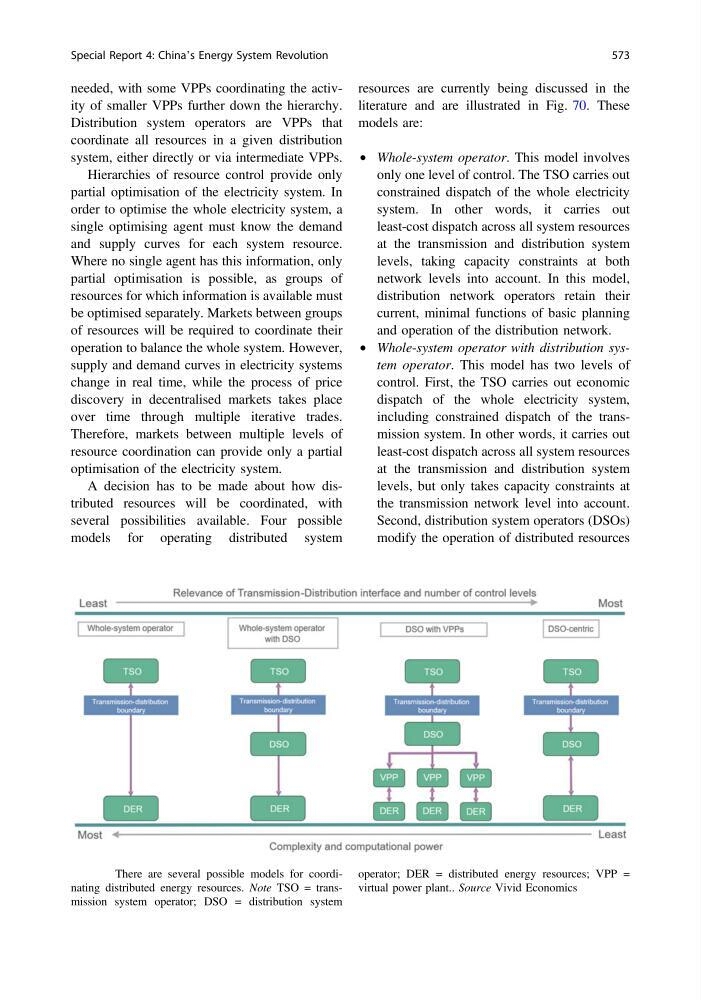
A decision has to be made about how distributed resources will be coordinated, with
several possibilities available. Four possible
models for operating distributed system
resources are currently being discussed in the
literature and are illustrated in Fig. 70. These
models are:
• Whole-system operator. This model involves
only one level of control. The TSO carries out
constrained dispatch of the whole electricity
system. In other words, it carries out
least-cost dispatch across all system resources
at the transmission and distribution system
levels, taking capacity constraints at both
network levels into account. In this model,
distribution network operators retain their
current, minimal functions of basic planning
and operation of the distribution network.
• Whole-system operator with distribution system operator. This model has two levels of
control. First, the TSO carries out economic
dispatch of the whole electricity system,
including constrained dispatch of the transmission system. In other words, it carries out
least-cost dispatch across all system resources
at the transmission and distribution system
levels, but only takes capacity constraints at
the transmission network level into account.
Second, distribution system operators (DSOs)
modify the operation of distributed resources
Fig. 70 There are several possible models for coordinating distributed energy resources. Note TSO = transmission system operator; DSO = distribution system
operator; DER = distributed energy resources; VPP =
virtual power plant.. Source Vivid Economics
Special Report 4: China’s Energy System Revolution
573
Distribution system operators are VPPs that
coordinate all resources in a given distribution
system, either directly or via intermediate VPPs.
Hierarchies of resource control provide only
partial optimisation of the electricity system. In
order to optimise the whole electricity system, a
single optimising agent must know the demand
and supply curves for each system resource.
Where no single agent has this information, only
partial optimisation is possible, as groups of
resources for which information is available must
be optimised separately. Markets between groups
of resources will be required to coordinate their
operation to balance the whole system. However,
supply and demand curves in electricity systems
change in real time, while the process of price
discovery in decentralised markets takes place
over time through multiple iterative trades.
Therefore, markets between multiple levels of
resource coordination can provide only a partial
optimisation of the electricity system.
A decision has to be made about how distributed resources will be coordinated, with
several possibilities available. Four possible
models for operating distributed system
resources are currently being discussed in the
literature and are illustrated in Fig. 70. These
models are:
• Whole-system operator. This model involves
only one level of control. The TSO carries out
constrained dispatch of the whole electricity
system. In other words, it carries out
least-cost dispatch across all system resources
at the transmission and distribution system
levels, taking capacity constraints at both
network levels into account. In this model,
distribution network operators retain their
current, minimal functions of basic planning
and operation of the distribution network.
• Whole-system operator with distribution system operator. This model has two levels of
control. First, the TSO carries out economic
dispatch of the whole electricity system,
including constrained dispatch of the transmission system. In other words, it carries out
least-cost dispatch across all system resources
at the transmission and distribution system
levels, but only takes capacity constraints at
the transmission network level into account.
Second, distribution system operators (DSOs)
modify the operation of distributed resources
Fig. 70 There are several possible models for coordinating distributed energy resources. Note TSO = transmission system operator; DSO = distribution system
operator; DER = distributed energy resources; VPP =
virtual power plant.. Source Vivid Economics
Special Report 4: China’s Energy System Revolution
573