

(2) Future changes: decarbonisation and
decentralisation
Electricity systems are decarbonising and
decentralising, and efficient network provision
takes these changes into account. Potential
changes in key characteristics of the electricity
system are encompassed within two broader
trends: decarbonisation of electricity and the
wider energy system; and decentralisation of
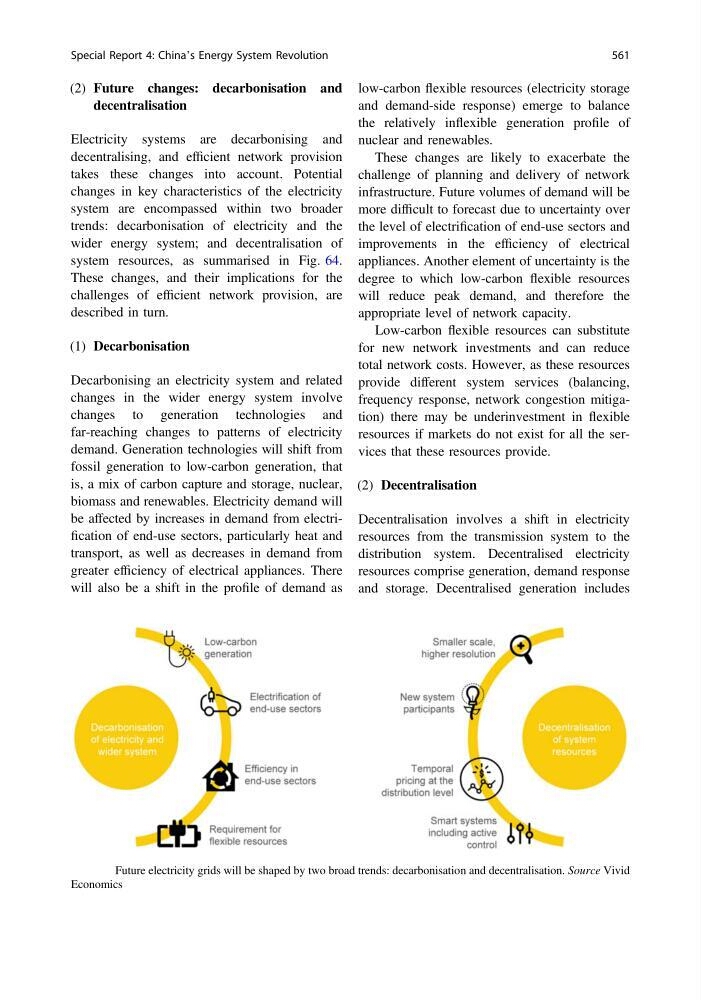
system resources, as summarised in Fig. 64.
These changes, and their implications for the
challenges of efficient network provision, are
described in turn.
(1) Decarbonisation
Decarbonising an electricity system and related
changes in the wider energy system involve
changes to generation technologies and
far-reaching changes to patterns of electricity
demand. Generation technologies will shift from
fossil generation to low-carbon generation, that
is, a mix of carbon capture and storage, nuclear,
biomass and renewables. Electricity demand will
be affected by increases in demand from electrification of end-use sectors, particularly heat and
transport, as well as decreases in demand from
greater efficiency of electrical appliances. There
will also be a shift in the profile of demand as
low-carbon flexible resources (electricity storage
and demand-side response) emerge to balance
the relatively inflexible generation profile of
nuclear and renewables.
These changes are likely to exacerbate the
challenge of planning and delivery of network
infrastructure. Future volumes of demand will be
more difficult to forecast due to uncertainty over
the level of electrification of end-use sectors and
improvements in the efficiency of electrical
appliances. Another element of uncertainty is the
degree to which low-carbon flexible resources
will reduce peak demand, and therefore the
appropriate level of network capacity.
Low-carbon flexible resources can substitute
for new network investments and can reduce
total network costs. However, as these resources
provide different system services (balancing,
frequency response, network congestion mitigation) there may be underinvestment in flexible
resources if markets do not exist for all the services that these resources provide.
(2) Decentralisation
Decentralisation involves a shift in electricity
resources from the transmission system to the
distribution system. Decentralised electricity
resources comprise generation, demand response
and storage. Decentralised generation includes
Fig. 64 Future electricity grids will be shaped by two broad trends: decarbonisation and decentralisation. Source Vivid
Economics
Special Report 4: China’s Energy System Revolution
561
decentralisation
Electricity systems are decarbonising and
decentralising, and efficient network provision
takes these changes into account. Potential
changes in key characteristics of the electricity
system are encompassed within two broader
trends: decarbonisation of electricity and the
wider energy system; and decentralisation of
system resources, as summarised in Fig. 64.
These changes, and their implications for the
challenges of efficient network provision, are
described in turn.
(1) Decarbonisation
Decarbonising an electricity system and related
changes in the wider energy system involve
changes to generation technologies and
far-reaching changes to patterns of electricity
demand. Generation technologies will shift from
fossil generation to low-carbon generation, that
is, a mix of carbon capture and storage, nuclear,
biomass and renewables. Electricity demand will
be affected by increases in demand from electrification of end-use sectors, particularly heat and
transport, as well as decreases in demand from
greater efficiency of electrical appliances. There
will also be a shift in the profile of demand as
low-carbon flexible resources (electricity storage
and demand-side response) emerge to balance
the relatively inflexible generation profile of
nuclear and renewables.
These changes are likely to exacerbate the
challenge of planning and delivery of network
infrastructure. Future volumes of demand will be
more difficult to forecast due to uncertainty over
the level of electrification of end-use sectors and
improvements in the efficiency of electrical
appliances. Another element of uncertainty is the
degree to which low-carbon flexible resources
will reduce peak demand, and therefore the
appropriate level of network capacity.
Low-carbon flexible resources can substitute
for new network investments and can reduce
total network costs. However, as these resources
provide different system services (balancing,
frequency response, network congestion mitigation) there may be underinvestment in flexible
resources if markets do not exist for all the services that these resources provide.
(2) Decentralisation
Decentralisation involves a shift in electricity
resources from the transmission system to the
distribution system. Decentralised electricity
resources comprise generation, demand response
and storage. Decentralised generation includes
Fig. 64 Future electricity grids will be shaped by two broad trends: decarbonisation and decentralisation. Source Vivid
Economics
Special Report 4: China’s Energy System Revolution
561