

and so on. Use competitive tenders or auctions for the trials. These may provide
proof-of-concept and experience with innovative, cost-effective solutions. To be successful, procurement has to be open-access
and transparent.
• Progressively introduce market procurement.
If the competitive procurement trials are
successful, they can be scaled up and wider
market procurement progressively introduced, where appropriate, across each transmission system. Market procurement can help
to reveal information about the relative costs
and benefits of a range of technologies.
(4) Make institutional choices
• Develop the transmission network institutions. Options include the status quo, an
enhanced role for market procurement and a
regulated transmission system operator
(TSO) or independent system operator (ISO).
International experience of the regulated TSO
and ISO models is yet to reveal the best
performer of the two, so it matters more to
adopt a good-quality institutional model early
than to choose between the options.
• Select a model of control for decentralised
resources. Initially, when the number of
resources is small, the TSO may be able to
control them directly. However, as the number of resources increases, and as temporal
and locational pricing become more sophisticated, the computational, commercial and
contractual capacity of a single operator
model may be exceeded, and new models of
control may be needed.
Box 1: Balancing the electricity system
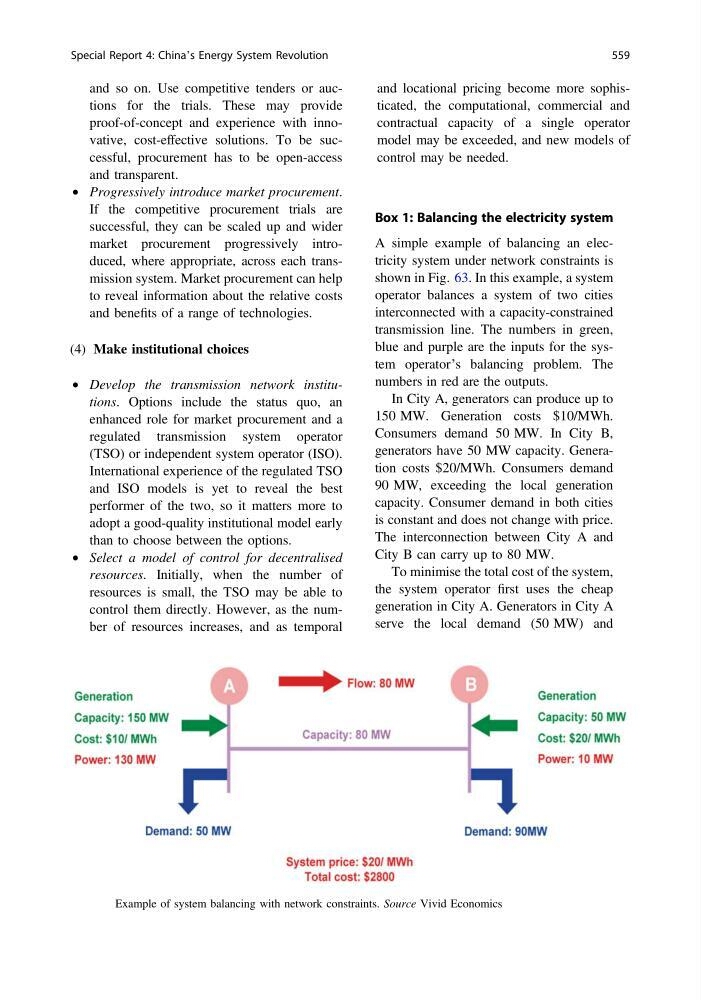
A simple example of balancing an electricity system under network constraints is
shown in Fig. 63. In this example, a system
operator balances a system of two cities
interconnected with a capacity-constrained
transmission line. The numbers in green,
blue and purple are the inputs for the system operator’s balancing problem. The
numbers in red are the outputs.
In City A, generators can produce up to
150 MW. Generation costs $10/MWh.
Consumers demand 50 MW. In City B,
generators have 50 MW capacity. Generation costs $20/MWh. Consumers demand
90 MW, exceeding the local generation
capacity. Consumer demand in both cities
is constant and does not change with price.
The interconnection between City A and
City B can carry up to 80 MW.
To minimise the total cost of the system,
the system operator first uses the cheap
generation in City A. Generators in City A
serve the local demand (50 MW) and
Fig. 63 Example of system balancing with network constraints. Source Vivid Economics
Special Report 4: China’s Energy System Revolution
559
proof-of-concept and experience with innovative, cost-effective solutions. To be successful, procurement has to be open-access
and transparent.
• Progressively introduce market procurement.
If the competitive procurement trials are
successful, they can be scaled up and wider
market procurement progressively introduced, where appropriate, across each transmission system. Market procurement can help
to reveal information about the relative costs
and benefits of a range of technologies.
(4) Make institutional choices
• Develop the transmission network institutions. Options include the status quo, an
enhanced role for market procurement and a
regulated transmission system operator
(TSO) or independent system operator (ISO).
International experience of the regulated TSO
and ISO models is yet to reveal the best
performer of the two, so it matters more to
adopt a good-quality institutional model early
than to choose between the options.
• Select a model of control for decentralised
resources. Initially, when the number of
resources is small, the TSO may be able to
control them directly. However, as the number of resources increases, and as temporal
and locational pricing become more sophisticated, the computational, commercial and
contractual capacity of a single operator
model may be exceeded, and new models of
control may be needed.
Box 1: Balancing the electricity system
A simple example of balancing an electricity system under network constraints is
shown in Fig. 63. In this example, a system
operator balances a system of two cities
interconnected with a capacity-constrained
transmission line. The numbers in green,
blue and purple are the inputs for the system operator’s balancing problem. The
numbers in red are the outputs.
In City A, generators can produce up to
150 MW. Generation costs $10/MWh.
Consumers demand 50 MW. In City B,
generators have 50 MW capacity. Generation costs $20/MWh. Consumers demand
90 MW, exceeding the local generation
capacity. Consumer demand in both cities
is constant and does not change with price.
The interconnection between City A and
City B can carry up to 80 MW.
To minimise the total cost of the system,
the system operator first uses the cheap
generation in City A. Generators in City A
serve the local demand (50 MW) and
Fig. 63 Example of system balancing with network constraints. Source Vivid Economics
Special Report 4: China’s Energy System Revolution
559