

Access channels for private capital are not
smooth, making effective output difficult to
achieve. Mining rights overlap is a longstanding
issue. Effective constraints through the policy of
“coalbed methane before coal mining” are not in
place. Mining rights in favourable shale gas
zones often overlap with conventional oil and gas
mining rights. In addition, the technical services
market is underdeveloped and averse to
improving exploration and production technologies and equipment through market competition,
making cost reductions and production increases
difficult.
Third, effects of support policies and incentives have been weakened. Support policies,
including refunded coalbed methane VAT, are
not well implemented in some regions. The
subsidy for shale gas is lower than during the
12th Five-Year Plan (2011–15). There are no
subsidies for tight gas. Furthermore, the Chinese
government has repeatedly lowered natural gas
prices, which has weakened the effects of subsidies and tax reduction and exemption measures.
Fourth, exploration and production are not
always cost-effective. Shale gas wells are characterised by high single-well investment costs,
long implementation cycles and rapidly
decreasing output over time. This brings heavy
capital pressure and investment risk to shale gas
development businesses. Gas content and pressure increase, and coalbed gas permeability
decreases, with depth, making CBM extraction
more difficult. In some regions, tight gas deposits
are in difficult geological conditions. The cost of
exploiting the deposits is high and the
output-input ratio is low, leading to poor economic returns or even losses.
6.6.3 The Role of Unconventional Gas
in the Energy Revolution
Unconventional gas is the key to the sustainable
development of the oil and gas industry and an
enabler for the global oil and gas production
revolution. It can safeguard China’s energy
supply security, revolutionise energy production
and consumption, and help sectors of the economy develop and expand.
Unconventional gas can boost China’s gas
production and improve gas supply security.
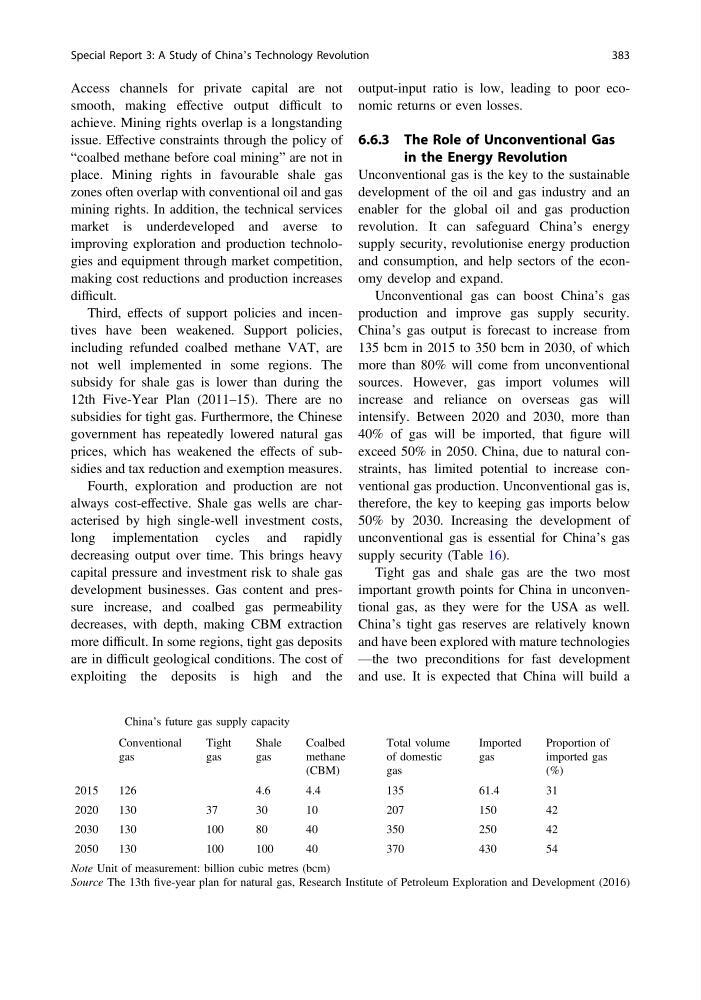
China’s gas output is forecast to increase from
135 bcm in 2015 to 350 bcm in 2030, of which
more than 80% will come from unconventional
sources. However, gas import volumes will
increase and reliance on overseas gas will
intensify. Between 2020 and 2030, more than
40% of gas will be imported, that figure will
exceed 50% in 2050. China, due to natural constraints, has limited potential to increase conventional gas production. Unconventional gas is,
therefore, the key to keeping gas imports below
50% by 2030. Increasing the development of
unconventional gas is essential for China’s gas
supply security (Table 16).
Tight gas and shale gas are the two most
important growth points for China in unconventional gas, as they were for the USA as well.
China’s tight gas reserves are relatively known
and have been explored with mature technologies
—the two preconditions for fast development
and use. It is expected that China will build a
Table 16 China’s future gas supply capacity
Conventional
gas
Tight
gas
Shale
gas
Coalbed
methane
(CBM)
Total volume
of domestic
gas
Imported
gas
Proportion of
imported gas
(%)
2015
126
4.6
4.4
135
61.4
31
2020
130
37
30
10
207
150
42
2030
130
100
80
40
350
250
42
2050
130
100
100
40
370
430
54
Note Unit of measurement: billion cubic metres (bcm)
Source The 13th five-year plan for natural gas, Research Institute of Petroleum Exploration and Development (2016)
Special Report 3: A Study of China’s Technology Revolution
383
smooth, making effective output difficult to
achieve. Mining rights overlap is a longstanding
issue. Effective constraints through the policy of
“coalbed methane before coal mining” are not in
place. Mining rights in favourable shale gas
zones often overlap with conventional oil and gas
mining rights. In addition, the technical services
market is underdeveloped and averse to
improving exploration and production technologies and equipment through market competition,
making cost reductions and production increases
difficult.
Third, effects of support policies and incentives have been weakened. Support policies,
including refunded coalbed methane VAT, are
not well implemented in some regions. The
subsidy for shale gas is lower than during the
12th Five-Year Plan (2011–15). There are no
subsidies for tight gas. Furthermore, the Chinese
government has repeatedly lowered natural gas
prices, which has weakened the effects of subsidies and tax reduction and exemption measures.
Fourth, exploration and production are not
always cost-effective. Shale gas wells are characterised by high single-well investment costs,
long implementation cycles and rapidly
decreasing output over time. This brings heavy
capital pressure and investment risk to shale gas
development businesses. Gas content and pressure increase, and coalbed gas permeability
decreases, with depth, making CBM extraction
more difficult. In some regions, tight gas deposits
are in difficult geological conditions. The cost of
exploiting the deposits is high and the
output-input ratio is low, leading to poor economic returns or even losses.
6.6.3 The Role of Unconventional Gas
in the Energy Revolution
Unconventional gas is the key to the sustainable
development of the oil and gas industry and an
enabler for the global oil and gas production
revolution. It can safeguard China’s energy
supply security, revolutionise energy production
and consumption, and help sectors of the economy develop and expand.
Unconventional gas can boost China’s gas
production and improve gas supply security.
China’s gas output is forecast to increase from
135 bcm in 2015 to 350 bcm in 2030, of which
more than 80% will come from unconventional
sources. However, gas import volumes will
increase and reliance on overseas gas will
intensify. Between 2020 and 2030, more than
40% of gas will be imported, that figure will
exceed 50% in 2050. China, due to natural constraints, has limited potential to increase conventional gas production. Unconventional gas is,
therefore, the key to keeping gas imports below
50% by 2030. Increasing the development of
unconventional gas is essential for China’s gas
supply security (Table 16).
Tight gas and shale gas are the two most
important growth points for China in unconventional gas, as they were for the USA as well.
China’s tight gas reserves are relatively known
and have been explored with mature technologies
—the two preconditions for fast development
and use. It is expected that China will build a
Table 16 China’s future gas supply capacity
Conventional
gas
Tight
gas
Shale
gas
Coalbed
methane
(CBM)
Total volume
of domestic
gas
Imported
gas
Proportion of
imported gas
(%)
2015
126
4.6
4.4
135
61.4
31
2020
130
37
30
10
207
150
42
2030
130
100
80
40
350
250
42
2050
130
100
100
40
370
430
54
Note Unit of measurement: billion cubic metres (bcm)
Source The 13th five-year plan for natural gas, Research Institute of Petroleum Exploration and Development (2016)
Special Report 3: A Study of China’s Technology Revolution
383