

reserves have not been ascertained yet, preliminary estimates by Chinese and foreign researchers show that shale gas resources in China are
abundant, diversified, widely distributed and
highly promising. The resource base needed for
fast exploration and production is already in
place. According to the report titled Results of
the Survey and Assessment of Shale Gas
Resource Potential of China and Favourable
Zone Optimisation published by the Ministry of
Land and Resources of the People’s Republic of
China in March 2012, China’s geological
reserves of onshore shale gas are 134.42 trillion
cubic metres, of which 25.08 trillion cubic
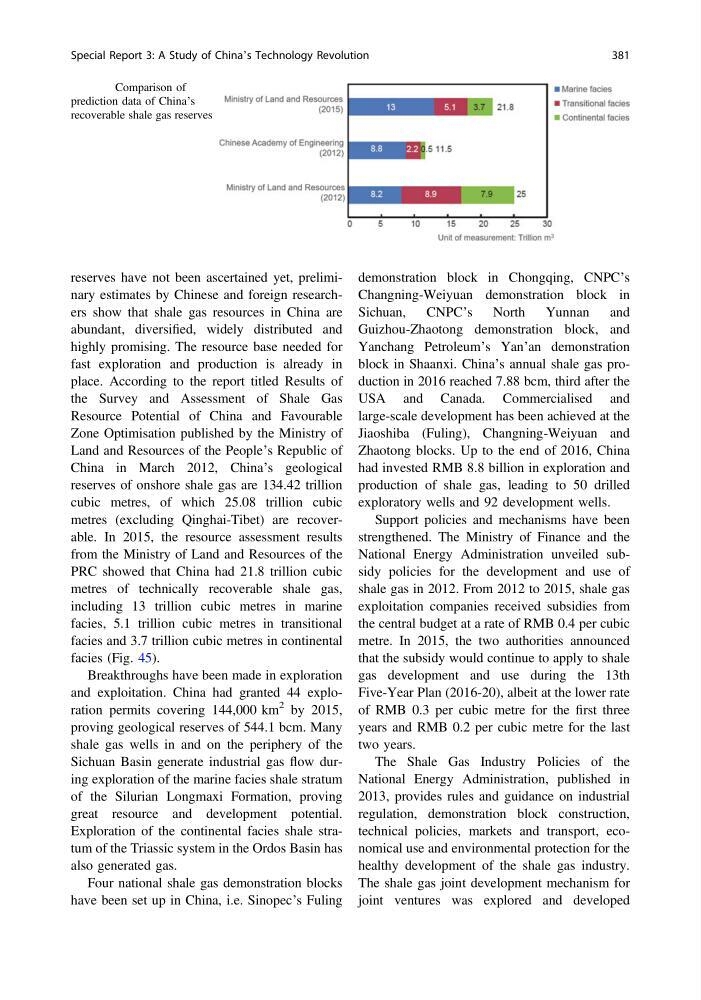
metres (excluding Qinghai-Tibet) are recoverable. In 2015, the resource assessment results
from the Ministry of Land and Resources of the
PRC showed that China had 21.8 trillion cubic
metres of technically recoverable shale gas,
including 13 trillion cubic metres in marine
facies, 5.1 trillion cubic metres in transitional
facies and 3.7 trillion cubic metres in continental
facies (Fig. 45).
Breakthroughs have been made in exploration
and exploitation. China had granted 44 exploration permits covering 144,000 km
2 by 2015,
proving geological reserves of 544.1 bcm. Many
shale gas wells in and on the periphery of the
Sichuan Basin generate industrial gas flow during exploration of the marine facies shale stratum
of the Silurian Longmaxi Formation, proving
great resource and development potential.
Exploration of the continental facies shale stratum of the Triassic system in the Ordos Basin has
also generated gas.
Four national shale gas demonstration blocks
have been set up in China, i.e. Sinopec’s Fuling
demonstration block in Chongqing, CNPC’s
Changning-Weiyuan demonstration block in
Sichuan, CNPC’s North Yunnan and
Guizhou-Zhaotong demonstration block, and
Yanchang Petroleum’s Yan’an demonstration
block in Shaanxi. China’s annual shale gas production in 2016 reached 7.88 bcm, third after the
USA and Canada. Commercialised and
large-scale development has been achieved at the
Jiaoshiba (Fuling), Changning-Weiyuan and
Zhaotong blocks. Up to the end of 2016, China
had invested RMB 8.8 billion in exploration and
production of shale gas, leading to 50 drilled
exploratory wells and 92 development wells.
Support policies and mechanisms have been
strengthened. The Ministry of Finance and the
National Energy Administration unveiled subsidy policies for the development and use of
shale gas in 2012. From 2012 to 2015, shale gas
exploitation companies received subsidies from
the central budget at a rate of RMB 0.4 per cubic
metre. In 2015, the two authorities announced
that the subsidy would continue to apply to shale
gas development and use during the 13th
Five-Year Plan (2016-20), albeit at the lower rate
of RMB 0.3 per cubic metre for the first three
years and RMB 0.2 per cubic metre for the last
two years.
The Shale Gas Industry Policies of the
National Energy Administration, published in
2013, provides rules and guidance on industrial
regulation, demonstration block construction,
technical policies, markets and transport, economical use and environmental protection for the
healthy development of the shale gas industry.
The shale gas joint development mechanism for
joint ventures was explored and developed
Fig. 45 Comparison of
prediction data of China’s
recoverable shale gas reserves
Special Report 3: A Study of China’s Technology Revolution
381
abundant, diversified, widely distributed and
highly promising. The resource base needed for
fast exploration and production is already in
place. According to the report titled Results of
the Survey and Assessment of Shale Gas
Resource Potential of China and Favourable
Zone Optimisation published by the Ministry of
Land and Resources of the People’s Republic of
China in March 2012, China’s geological
reserves of onshore shale gas are 134.42 trillion
cubic metres, of which 25.08 trillion cubic
metres (excluding Qinghai-Tibet) are recoverable. In 2015, the resource assessment results
from the Ministry of Land and Resources of the
PRC showed that China had 21.8 trillion cubic
metres of technically recoverable shale gas,
including 13 trillion cubic metres in marine
facies, 5.1 trillion cubic metres in transitional
facies and 3.7 trillion cubic metres in continental
facies (Fig. 45).
Breakthroughs have been made in exploration
and exploitation. China had granted 44 exploration permits covering 144,000 km
2 by 2015,
proving geological reserves of 544.1 bcm. Many
shale gas wells in and on the periphery of the
Sichuan Basin generate industrial gas flow during exploration of the marine facies shale stratum
of the Silurian Longmaxi Formation, proving
great resource and development potential.
Exploration of the continental facies shale stratum of the Triassic system in the Ordos Basin has
also generated gas.
Four national shale gas demonstration blocks
have been set up in China, i.e. Sinopec’s Fuling
demonstration block in Chongqing, CNPC’s
Changning-Weiyuan demonstration block in
Sichuan, CNPC’s North Yunnan and
Guizhou-Zhaotong demonstration block, and
Yanchang Petroleum’s Yan’an demonstration
block in Shaanxi. China’s annual shale gas production in 2016 reached 7.88 bcm, third after the
USA and Canada. Commercialised and
large-scale development has been achieved at the
Jiaoshiba (Fuling), Changning-Weiyuan and
Zhaotong blocks. Up to the end of 2016, China
had invested RMB 8.8 billion in exploration and
production of shale gas, leading to 50 drilled
exploratory wells and 92 development wells.
Support policies and mechanisms have been
strengthened. The Ministry of Finance and the
National Energy Administration unveiled subsidy policies for the development and use of
shale gas in 2012. From 2012 to 2015, shale gas
exploitation companies received subsidies from
the central budget at a rate of RMB 0.4 per cubic
metre. In 2015, the two authorities announced
that the subsidy would continue to apply to shale
gas development and use during the 13th
Five-Year Plan (2016-20), albeit at the lower rate
of RMB 0.3 per cubic metre for the first three
years and RMB 0.2 per cubic metre for the last
two years.
The Shale Gas Industry Policies of the
National Energy Administration, published in
2013, provides rules and guidance on industrial
regulation, demonstration block construction,
technical policies, markets and transport, economical use and environmental protection for the
healthy development of the shale gas industry.
The shale gas joint development mechanism for
joint ventures was explored and developed
Fig. 45 Comparison of
prediction data of China’s
recoverable shale gas reserves
Special Report 3: A Study of China’s Technology Revolution
381