

and put into operation across the globe. Many of
those plants have a 40-year lifespan that will
expire by 2020. Nearly a third of them will be
decommissioned in the following 10 years if
their operating life is not extended. Although
new nuclear power capacity can replace decommissioned plants, it remains to be seen if this new
capacity can smoothly deliver sustained development of the nuclear power industry.
6.5.1 Global Nuclear Power History
(1) Cyclical fluctuations
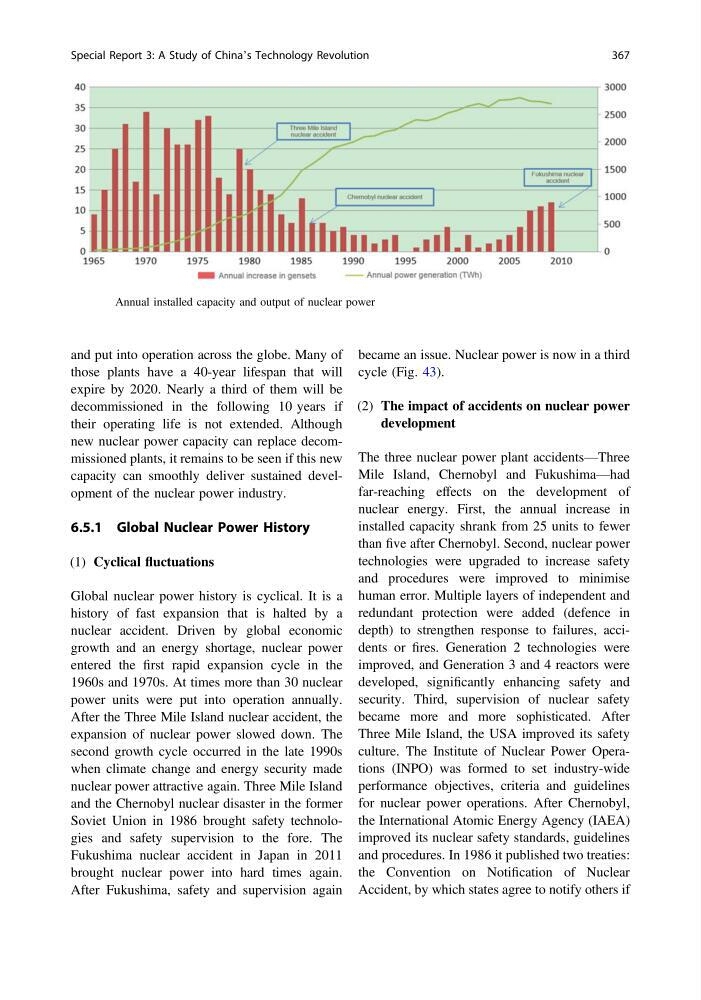
Global nuclear power history is cyclical. It is a
history of fast expansion that is halted by a
nuclear accident. Driven by global economic
growth and an energy shortage, nuclear power
entered the first rapid expansion cycle in the
1960s and 1970s. At times more than 30 nuclear
power units were put into operation annually.
After the Three Mile Island nuclear accident, the
expansion of nuclear power slowed down. The
second growth cycle occurred in the late 1990s
when climate change and energy security made
nuclear power attractive again. Three Mile Island
and the Chernobyl nuclear disaster in the former
Soviet Union in 1986 brought safety technologies and safety supervision to the fore. The
Fukushima nuclear accident in Japan in 2011
brought nuclear power into hard times again.
After Fukushima, safety and supervision again
became an issue. Nuclear power is now in a third
cycle (Fig. 43).
(2) The impact of accidents on nuclear power
development
The three nuclear power plant accidents—Three
Mile Island, Chernobyl and Fukushima—had
far-reaching effects on the development of
nuclear energy. First, the annual increase in
installed capacity shrank from 25 units to fewer
than five after Chernobyl. Second, nuclear power
technologies were upgraded to increase safety
and procedures were improved to minimise
human error. Multiple layers of independent and
redundant protection were added (defence in
depth) to strengthen response to failures, accidents or fires. Generation 2 technologies were
improved, and Generation 3 and 4 reactors were
developed, significantly enhancing safety and
security. Third, supervision of nuclear safety
became more and more sophisticated. After
Three Mile Island, the USA improved its safety
culture. The Institute of Nuclear Power Operations (INPO) was formed to set industry-wide
performance objectives, criteria and guidelines
for nuclear power operations. After Chernobyl,
the International Atomic Energy Agency (IAEA)
improved its nuclear safety standards, guidelines
and procedures. In 1986 it published two treaties:
the Convention on Notification of Nuclear
Accident, by which states agree to notify others if
Fig. 43 Annual installed capacity and output of nuclear power
Special Report 3: A Study of China’s Technology Revolution
367
those plants have a 40-year lifespan that will
expire by 2020. Nearly a third of them will be
decommissioned in the following 10 years if
their operating life is not extended. Although
new nuclear power capacity can replace decommissioned plants, it remains to be seen if this new
capacity can smoothly deliver sustained development of the nuclear power industry.
6.5.1 Global Nuclear Power History
(1) Cyclical fluctuations
Global nuclear power history is cyclical. It is a
history of fast expansion that is halted by a
nuclear accident. Driven by global economic
growth and an energy shortage, nuclear power
entered the first rapid expansion cycle in the
1960s and 1970s. At times more than 30 nuclear
power units were put into operation annually.
After the Three Mile Island nuclear accident, the
expansion of nuclear power slowed down. The
second growth cycle occurred in the late 1990s
when climate change and energy security made
nuclear power attractive again. Three Mile Island
and the Chernobyl nuclear disaster in the former
Soviet Union in 1986 brought safety technologies and safety supervision to the fore. The
Fukushima nuclear accident in Japan in 2011
brought nuclear power into hard times again.
After Fukushima, safety and supervision again
became an issue. Nuclear power is now in a third
cycle (Fig. 43).
(2) The impact of accidents on nuclear power
development
The three nuclear power plant accidents—Three
Mile Island, Chernobyl and Fukushima—had
far-reaching effects on the development of
nuclear energy. First, the annual increase in
installed capacity shrank from 25 units to fewer
than five after Chernobyl. Second, nuclear power
technologies were upgraded to increase safety
and procedures were improved to minimise
human error. Multiple layers of independent and
redundant protection were added (defence in
depth) to strengthen response to failures, accidents or fires. Generation 2 technologies were
improved, and Generation 3 and 4 reactors were
developed, significantly enhancing safety and
security. Third, supervision of nuclear safety
became more and more sophisticated. After
Three Mile Island, the USA improved its safety
culture. The Institute of Nuclear Power Operations (INPO) was formed to set industry-wide
performance objectives, criteria and guidelines
for nuclear power operations. After Chernobyl,
the International Atomic Energy Agency (IAEA)
improved its nuclear safety standards, guidelines
and procedures. In 1986 it published two treaties:
the Convention on Notification of Nuclear
Accident, by which states agree to notify others if
Fig. 43 Annual installed capacity and output of nuclear power
Special Report 3: A Study of China’s Technology Revolution
367