

losses from risky innovations, it can face greater
institutional barriers to accepting failure than the
private sector. However, as prolonging failure
comes at an increasing economic cost, it is best
to fail fast before rising costs make failure
inevitable. This requires more than constant
evaluation. It also requires a political understanding that innovation is a dynamic, uncertain
process, where failure can be a good outcome,
and it may be best to fail fast.
2.2 Innovation Policy: Case Study
Many of the technologies leading the low-carbon
transition were initially developed more than
40 years ago and may still require years to
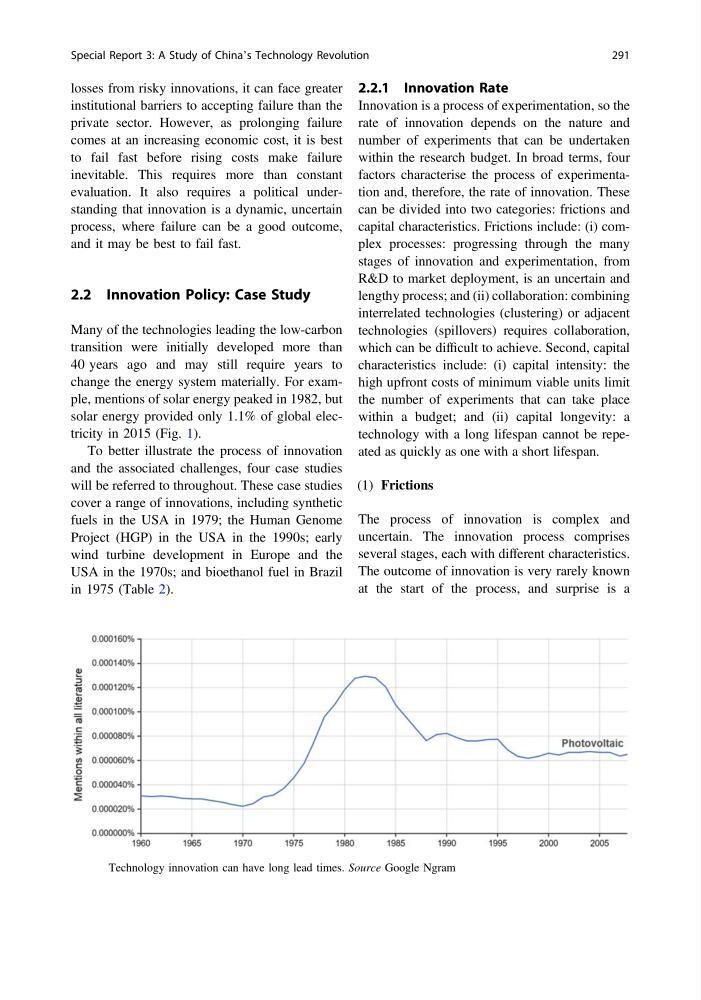
change the energy system materially. For example, mentions of solar energy peaked in 1982, but
solar energy provided only 1.1% of global electricity in 2015 (Fig. 1).
To better illustrate the process of innovation
and the associated challenges, four case studies
will be referred to throughout. These case studies
cover a range of innovations, including synthetic
fuels in the USA in 1979; the Human Genome
Project (HGP) in the USA in the 1990s; early
wind turbine development in Europe and the
USA in the 1970s; and bioethanol fuel in Brazil
in 1975 (Table 2).
2.2.1 Innovation Rate
Innovation is a process of experimentation, so the
rate of innovation depends on the nature and
number of experiments that can be undertaken
within the research budget. In broad terms, four
factors characterise the process of experimentation and, therefore, the rate of innovation. These
can be divided into two categories: frictions and
capital characteristics. Frictions include: (i) complex processes: progressing through the many
stages of innovation and experimentation, from
R&D to market deployment, is an uncertain and
lengthy process; and (ii) collaboration: combining
interrelated technologies (clustering) or adjacent
technologies (spillovers) requires collaboration,
which can be difficult to achieve. Second, capital
characteristics include: (i) capital intensity: the
high upfront costs of minimum viable units limit
the number of experiments that can take place
within a budget; and (ii) capital longevity: a
technology with a long lifespan cannot be repeated as quickly as one with a short lifespan.
(1) Frictions
The process of innovation is complex and
uncertain. The innovation process comprises
several stages, each with different characteristics.
The outcome of innovation is very rarely known
at the start of the process, and surprise is a
Fig. 1 Technology innovation can have long lead times. Source Google Ngram
Special Report 3: A Study of China’s Technology Revolution
291
institutional barriers to accepting failure than the
private sector. However, as prolonging failure
comes at an increasing economic cost, it is best
to fail fast before rising costs make failure
inevitable. This requires more than constant
evaluation. It also requires a political understanding that innovation is a dynamic, uncertain
process, where failure can be a good outcome,
and it may be best to fail fast.
2.2 Innovation Policy: Case Study
Many of the technologies leading the low-carbon
transition were initially developed more than
40 years ago and may still require years to
change the energy system materially. For example, mentions of solar energy peaked in 1982, but
solar energy provided only 1.1% of global electricity in 2015 (Fig. 1).
To better illustrate the process of innovation
and the associated challenges, four case studies
will be referred to throughout. These case studies
cover a range of innovations, including synthetic
fuels in the USA in 1979; the Human Genome
Project (HGP) in the USA in the 1990s; early
wind turbine development in Europe and the
USA in the 1970s; and bioethanol fuel in Brazil
in 1975 (Table 2).
2.2.1 Innovation Rate
Innovation is a process of experimentation, so the
rate of innovation depends on the nature and
number of experiments that can be undertaken
within the research budget. In broad terms, four
factors characterise the process of experimentation and, therefore, the rate of innovation. These
can be divided into two categories: frictions and
capital characteristics. Frictions include: (i) complex processes: progressing through the many
stages of innovation and experimentation, from
R&D to market deployment, is an uncertain and
lengthy process; and (ii) collaboration: combining
interrelated technologies (clustering) or adjacent
technologies (spillovers) requires collaboration,
which can be difficult to achieve. Second, capital
characteristics include: (i) capital intensity: the
high upfront costs of minimum viable units limit
the number of experiments that can take place
within a budget; and (ii) capital longevity: a
technology with a long lifespan cannot be repeated as quickly as one with a short lifespan.
(1) Frictions
The process of innovation is complex and
uncertain. The innovation process comprises
several stages, each with different characteristics.
The outcome of innovation is very rarely known
at the start of the process, and surprise is a
Fig. 1 Technology innovation can have long lead times. Source Google Ngram
Special Report 3: A Study of China’s Technology Revolution
291